
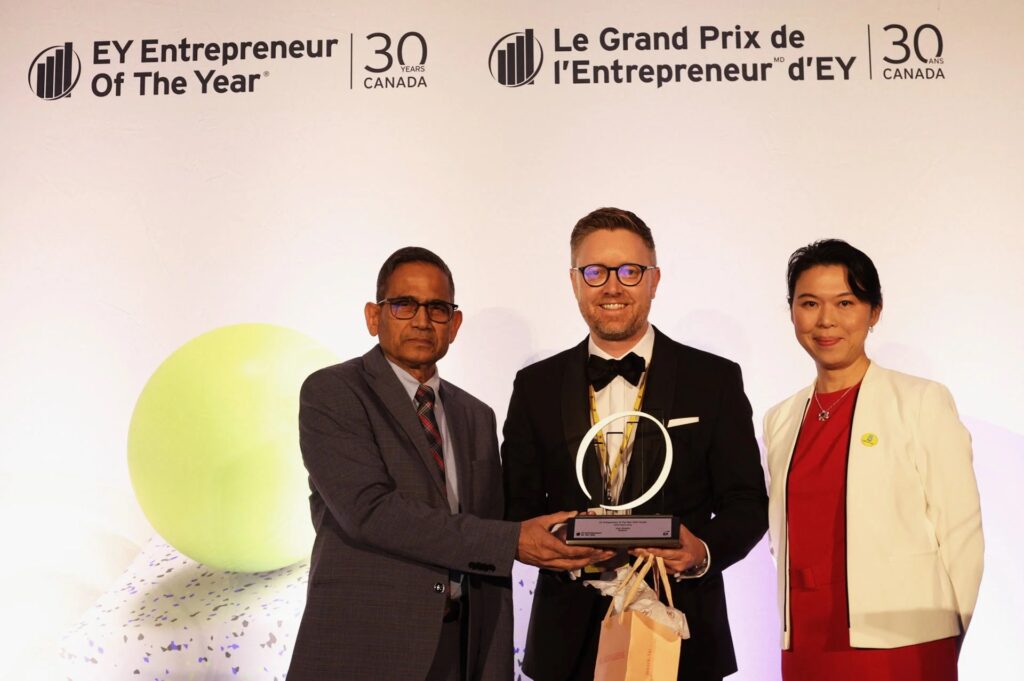
Tobyn Sowden – EY Entrepreneur of the Year 2024 – Regional Award Winner
Episode
Phil Bliss, Founder of Canada’s Podcast interviews Tobyn Sowden after receiving the Award November 26, 2024. EY Entrepreneur Of...
Key takeaways
- Getting good at failing and learning from failures is a critical skill that entrepreneurs need to develop and normalize.
- Starting a business while still in university can provide real-world experience and generate significant revenue before graduation.
- Transitioning from providing services to clients to building and owning your own software products can dramatically increase enterprise value.
- Acquiring complementary businesses and integrating them under a shared services model can create a scalable portfolio of companies.
- Gaining early executive experience, even in your early twenties, can provide invaluable knowledge equivalent to an MBA in a compressed timeframe.
Transcript
Full transcript page · Interactive episode
============================================================
TRANSCRIPTION WITH SPEAKERS
============================================================

[00:00] SPEAKER_01: Welcome to Candace Podcast.
[00:05] SPEAKER_01: I'm Phil Bliss, founder and CEO of Candace Podcast.
[00:10] SPEAKER_01: Today we're going to meet Tobin Sodin, who's CEO of Redbrick.
[00:18] SPEAKER_01: And Tobin, it's great to meet you.
[00:21] SPEAKER_01: Great to see you here in the finals of the EY Awards.
[00:25] SPEAKER_01: And I want you to first of all tell us a little bit about your journey, who you are, and how you got here.
[00:37] SPEAKER_00: Yeah, thank you. My pleasure.
[00:40] SPEAKER_00: So you can always pick different starting points of your journey.
[00:44] SPEAKER_00: And I'd say a good spot to start is my, I got the opportunity to study computer science at the University of Victoria.
[00:52] SPEAKER_00: And like many, you know, you can spend a lot of money getting a great education.
[00:59] SPEAKER_00: And I spent a lot of money, but it wasn't my money.
[01:01] SPEAKER_00: And it wasn't the government's money.
[01:04] SPEAKER_00: It was debt from a big bank.
[01:06] SPEAKER_00: And when you rack up debt from a big bank, it's not like the government.
[01:09] SPEAKER_00: They just don't let you off the hook or don't give you a long time, pay it back.
[01:13] SPEAKER_00: But instead, it's serious.
[01:15] SPEAKER_00: And so, during my degree as I was studying computer science, I realized I needed to make some money.
[01:21] SPEAKER_00: And the thing called Google was getting going.
[01:24] SPEAKER_00: And they had an advertising program.
[01:27] SPEAKER_00: And so I got in there and I studied how it worked.
[01:29] SPEAKER_00: And so I started helping some local companies in Victoria and started earning some money to pay off the student debt.
[01:35] SPEAKER_00: And it went really well.
[01:36] SPEAKER_00: So the last year of my degree program, my little one person company, some marketing agency working on Google,
[01:45] SPEAKER_00: I think I had $1.1 million in revenue.
[01:49] SPEAKER_00: Very, very profitable.
[01:51] SPEAKER_00: And I ended up selling that or an aqua hire, you could call it, into another local business.
[01:58] SPEAKER_00: And I got the opportunity to join their executive team.
[02:01] SPEAKER_00: 23, 24 years old.
[02:03] SPEAKER_00: To sit on an executive team, learn how to hire people, budget.
[02:08] SPEAKER_00: I sat on the M&A committee.
[02:10] SPEAKER_00: Like it was just an incredible, you know, it was like an MBA in 18 months.
[02:14] SPEAKER_00: And so I finished up my stand there, ran the course of my earn out.
[02:18] SPEAKER_00: And then started Redbrick.
[02:19] SPEAKER_00: And Redbrick initially was just a marketing services company.
[02:23] SPEAKER_00: And we were helping other software companies grow.
[02:26] SPEAKER_00: But what we realized was we were just having just a great impact on their enterprise value.
[02:31] SPEAKER_00: Really growing their business.
[02:33] SPEAKER_00: And so she's, wouldn't it be nice to own the software?
[02:36] SPEAKER_00: She started building some things, trying our hand.
[02:40] SPEAKER_00: And we were able to build one business, a shift.
[02:42] SPEAKER_00: We still have shift today. It's a browser-based business.
[02:45] SPEAKER_00: We started a publisher technology company.
[02:48] SPEAKER_00: And it went really well.
[02:49] SPEAKER_00: So we stopped working with external customers and just focused on our own businesses.
[02:56] SPEAKER_00: And then we got an opportunity to acquire a business.
[03:00] SPEAKER_00: And so in 2020, we closed our first major acquisition of a company in Minneapolis.
[03:05] SPEAKER_00: It's called Lead Pages.
[03:06] SPEAKER_00: It was a landing page in website builder.
[03:09] SPEAKER_00: And that went well.
[03:10] SPEAKER_00: So we thought, well, geez, let's do this again.
[03:12] SPEAKER_00: So we integrated, we transitioned, and we got back to work.
[03:16] SPEAKER_00: And about a year, a year and a half later, we acquired Delivera in Indianapolis.
[03:19] SPEAKER_00: So there's weird Midwest thing happening.
[03:22] SPEAKER_00: It's a Midwest thing.
[03:23] SPEAKER_00: Yeah.
[03:24] SPEAKER_00: They joked they were more Canadian than we were in Victoria.
[03:29] SPEAKER_00: But so that went well.
[03:31] SPEAKER_00: And then, just over a year ago, we acquired Anomoto, which is a video creation platform.
[03:37] SPEAKER_00: So today, we have a group of companies that support digital entrepreneurs
[03:42] SPEAKER_00: and small businesses around the world.
[03:46] SPEAKER_00: And Redbrick is unique in that the way it's structured is executive team
[03:50] SPEAKER_00: that oversees shared services in HR and finance and creative marketing.
[03:55] SPEAKER_00: And those get shared down to the CEO and leadership team that run each of those companies.
[04:00] SPEAKER_00: So it's a model that we've failed a lot.
[04:03] SPEAKER_00: Don't get it right, but now today it's working pretty well.
[04:06] SPEAKER_00: So that's the journey and that's where we're at.
[04:10] SPEAKER_01: That's very interesting journey.
[04:13] SPEAKER_01: We could talk a lot more.
[04:14] SPEAKER_01: I understand it very well.
[04:17] SPEAKER_01: But here you are in basically the finals of the UI entrepreneur of the year.
[04:25] SPEAKER_01: What would you say is a unique characteristic that you have
[04:32] SPEAKER_01: or that you've created that's got you here?
[04:37] SPEAKER_00: You know, it's probably my ability to fail.
[04:42] SPEAKER_00: You know, I think I fail a lot.
[04:47] SPEAKER_00: I fail every day.
[04:48] SPEAKER_00: There's so many things that I try and it goes wrong.
[04:52] SPEAKER_00: And when you get good at failing, you get good at picking yourself back up,
[04:58] SPEAKER_00: learning from why did it fail?
[05:02] SPEAKER_00: What were the reasons?
[05:03] SPEAKER_00: Maybe you come up with a thesis of why I could try this instead of that.
[05:07] SPEAKER_00: You get good at failing.
[05:09] SPEAKER_00: And I think part of this platform, you know,
[05:12] SPEAKER_00: Ernst and Young's entrepreneur of the year, you know,
[05:14] SPEAKER_00: platform, it's the shared stories of entrepreneurship.
[05:17] SPEAKER_00: And some extent I really believe we need a normalized failing.
[05:21] SPEAKER_00: Because, you know, I think young entrepreneurs, people just trying their hand for the first time,
[05:27] SPEAKER_00: you fail hard and you don't know that maybe that's normal and you just get back up and get going.
[05:35] SPEAKER_00: So I just think that's something that we try so many things and attempt, you know,
[05:39] SPEAKER_00: you have so many opportunities that I got good at failing and then finding a new path forward.
[05:47] SPEAKER_01: Fantastic insight, you know, I really love it.
[05:50] SPEAKER_01: Okay, so congratulations on getting this far and I hope you get the big one tonight.
[05:58] SPEAKER_01: Okay? Great seeing you.
[06:00] SPEAKER_01: Glad you came on camera, spot cash. Thank you.