
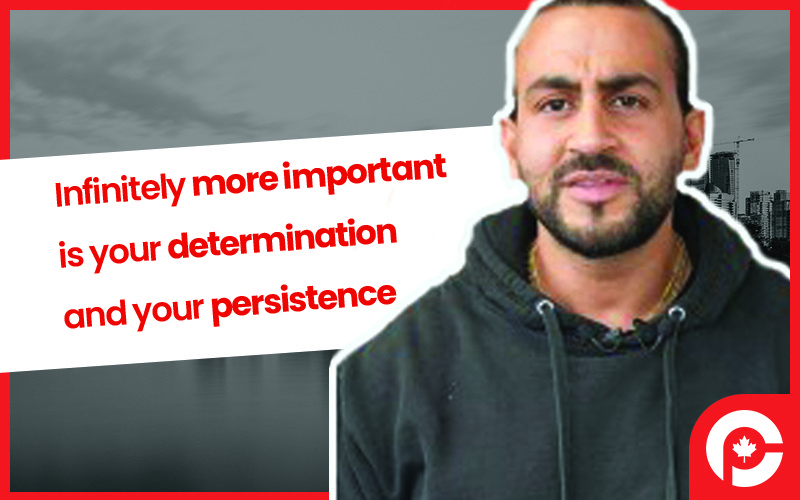
Infinitely more important is your determination and your persistence
Episode
Seif El-Sahly is a P. Eng., but he’s also a Dreamer, Renovator and Crushing Expectations! He turns drawings into...
Key takeaways
- Wearing multiple hats in smaller projects provides more valuable life experience than being narrowly focused on one component of large projects.
- View every challenge as an opportunity for growth rather than a problem, and put systems in place to prevent the same issue from recurring.
- Set tangible, actionable goals that are close enough to achieve rather than dreams that are twenty steps away and impossible to act on.
- Persistence and determination are infinitely more important than intelligence or talent when building a successful business.
- Stay flexible with the details of how you'll reach your vision when starting out, and be willing to listen and consider feedback even if you don't apply all of it.
Transcript
Full transcript page · Interactive episode
============================================================
TRANSCRIPTION WITH SPEAKERS
============================================================

[00:00] SPEAKER_01: Welcome to Candace Podcast.
[00:05] SPEAKER_01: Hi there, I'm Phil Bliss, founder and CEO of Candace Podcast.
[00:10] SPEAKER_01: Coming to you today from Hamilton.
[00:13] SPEAKER_01: Dave Falsahi is a p-n-g, but he's also a dreamer, a renovator, and likes to crush expectations.
[00:21] SPEAKER_01: He turns drawings into reality with a dose of humour, and he's a top 40 under 40.
[00:29] SPEAKER_01: He's the driving force behind tiny homes, garage addition.
[00:34] SPEAKER_01: Safe is renovated over 150 units in three years.
[00:39] SPEAKER_01: He's a self-pronounce workaholic, when ordered the office.
[00:43] SPEAKER_01: He's on the hunt for a banded real estate that can be turned into luxurious rentals in great neighborhoods.
[00:50] SPEAKER_01: Armed with bandwidth creativity and unwavering passion, saferies new life into abandoned properties,
[00:58] SPEAKER_01: transforming them into all inspiring homes.
[01:02] SPEAKER_01: Dave, welcome to Candace Podcast.
[01:06] SPEAKER_01: Kind of funny that we're just about neighbours in Stony Creek in Hamilton.
[01:11] SPEAKER_01: So before we get too deep into the conversation,
[01:15] SPEAKER_01: what do you tell us a bit about who you are, what you do, and how you got here, if you like.
[01:22] SPEAKER_00: Sure.
[01:24] SPEAKER_00: So, my name is Safe.
[01:26] SPEAKER_00: I own a construction company based in Hamilton over here.
[01:30] SPEAKER_00: I started engineering at McMaster, and then after that I got fly-in fly-out jobs in Quebec and Northern BC,
[01:40] SPEAKER_00: gained a ton of experience working over there on those type of jobs, especially if they were seven days a week type of jobs.
[01:48] SPEAKER_00: And then decided I want to move here closer to friends and family.
[01:51] SPEAKER_00: So I got settled down in Burlington, started working as a consultant in Toronto on Union Station, also doing engineering work.
[01:58] SPEAKER_00: And from there I had started dabbling about in real estate, about my first property.
[02:03] SPEAKER_00: It needed a little bit of work.
[02:04] SPEAKER_00: So I worked closely with the guys, rented it.
[02:07] SPEAKER_00: It was a good investment, the market was on up and up.
[02:11] SPEAKER_00: And then about a second one needed a little bit more work.
[02:14] SPEAKER_00: And then I was really hands on with the guys at that point.
[02:17] SPEAKER_00: Long story short, I kept buying and fixing up properties.
[02:20] SPEAKER_00: And then eventually there was so much construction that was going on.
[02:24] SPEAKER_00: We were offering my construction services because I had quite a few guys working under me.
[02:28] SPEAKER_00: And that's when I had started new for it.
[02:33] SPEAKER_01: Why did you go to that?
[02:35] SPEAKER_01: I mean, you know, you know, you're a pianist, you work in, I imagine you're flying fly outs and consulting in the city.
[02:44] SPEAKER_01: You know, you've got good credentials, people meet civil engineers on big projects.
[02:50] SPEAKER_01: Why move into the smaller projects?
[02:54] SPEAKER_01: You know, it's a very different kind of life life than working in the large construction projects.
[03:04] SPEAKER_00: Yeah.
[03:05] SPEAKER_00: The large construction projects sound more grand and they sound amazing.
[03:10] SPEAKER_00: But everybody is at their absolute single and best use.
[03:13] SPEAKER_00: You know, you only really work on your drop in the bucket.
[03:16] SPEAKER_00: So you don't ever really end up gathering that much life experience in my opinion.
[03:21] SPEAKER_00: Because you're so narrowed and so focused on one specific aspect.
[03:25] SPEAKER_00: You could be a civil engineer, but you only responsible for one component, which is design.
[03:30] SPEAKER_00: Let alone if the product is even larger design of one part of the project.
[03:36] SPEAKER_00: And then if the product is even that big, it could be one component of one building of one part of a project.
[03:42] SPEAKER_00: So if you're working on a high rise building, you could be the designer of just the slabs.
[03:47] SPEAKER_00: If nothing to do with the column, the lateral support system.
[03:51] SPEAKER_00: So it's like it's it's almost to niche working in big projects like that.
[03:55] SPEAKER_00: It doesn't give you a lot of the life experiences in my opinion because the more hats you wear, the more you get to understand the loose ends and the communication between different departments.
[04:05] SPEAKER_00: And oftentimes those are the biggest inefficiencies.
[04:08] SPEAKER_00: So if you're working on a smaller project in my opinion and you're wearing multiple hats, you'll end up transferring a lot more life experience.
[04:17] SPEAKER_01: Let's just talk about new for a little bit because you know, you're in the trendy kind of garage, like tiny homes business.
[04:30] SPEAKER_01: You've been there for over the years now.
[04:34] SPEAKER_01: How does it evolve? How does it change? What's different about it than when you started?
[04:41] SPEAKER_00: So the garage conversions, garden suites, laneway, laneway housing, whatever you want to call them is fairly new. The bylaws were just passed, I think three, four years ago, to allow you to build these type of properties without having to do any rezoning.
[04:56] SPEAKER_00: And it only really started taking popularity and people are building them as of two years ago.
[05:03] SPEAKER_00: So you know, if people started building them two years ago, the initial people that the pioneers, let's call them only finished about a year ago.
[05:10] SPEAKER_00: So they're fairly new. I don't think there's been much evolving yet because things are just starting to roll out for those projects.
[05:20] SPEAKER_00: So, so how many of you built today then?
[05:24] SPEAKER_00: We've done four and we have two under designer.
[05:28] SPEAKER_01: Right yourself. I mean, what do you like most about being an entrepreneur? You gave us the professional side of it in terms of the engineering side of it.
[05:38] SPEAKER_01: But what about safe and your sort of personal motivations, things like that? What, what, what, what you like most about it?
[05:49] SPEAKER_00: You know, I like, I like growth a lot and I'm sure everybody does, but you know, with growth comes a little bit of discomfort. And to me, I really, really do enjoy having a good understanding of other facets of the business.
[06:03] SPEAKER_00: So, you know, not just sticking to the engineering side, but you know, evolving beyond that, like the construction side, the actual constructability, you know, how to build it, costing the financing that goes into it.
[06:17] SPEAKER_00: And then once you get all that dialed in, there's layers to starting a business and growing a business because now you got to make sure that the pipeline of work is getting larger and larger to support the kind of base that you have.
[06:31] SPEAKER_00: So, that point you start getting into marketing and a lot of online ads and lead gens. So it's for me, the part I love the most is being able to dabble in all these different things and then seeing it all come to fruition, seeing that wow, you know, when we got our
[06:46] SPEAKER_00: our Google ads team to make these tweaks.
[06:49] SPEAKER_00: So, this look, you know, two months down the road, I'm looking at the pipeline, when everybody's receiving the calls in here and estimated the jobs look at the pipeline, how much it grew.
[06:58] SPEAKER_00: And you can actually attach a dollar figure to that. To me, that's the most interesting is kind of understanding everything in between the lines, because certain jobs can be spelled out, you know, modify this ad, use this creative.
[07:12] SPEAKER_00: Install this flooring system, pour that concrete, like it's very defined, right. But the part that I like the most, I think, is everything that's in between the lines and how one translates into the other, how you can get somebody that tweaking ads and doing all this stuff that they do online and that translates into real life projects.
[07:35] SPEAKER_01: It's an interesting business here and, you know, what do you see is sort of the biggest opportunity in that, as we said, the laneway tiny homes business over the next five years.
[07:49] SPEAKER_01: I mean, it's a weird old economy at the moment. What do you see, how does that reflect into your business?
[07:58] SPEAKER_00: I think right now we just signed the partnership with the company called Mizongard and sweets. And what they're doing is they're really focusing on the lead gen aspect and getting tons of those leads and closing a lot of those leads.
[08:15] SPEAKER_00: And essentially what we're going to be doing for a certain period of time is we're going to be their construction arm. So we really plan on ramping this up and scaling a lot more.
[08:23] SPEAKER_00: And being able to build these homes sort of in the exact same system, no matter what municipality you're in.
[08:30] SPEAKER_00: In the long, long term, I would say, you know, if you're part to ask me this question, you know, two, three years from today, hey, where do you see this going? It could very well be modular in a sense where we have these, you know, five or 10 designs.
[08:44] SPEAKER_00: You only have those five 10 designs. Pick them. Give us your address. We'll tell you which one of those five 10 work and then you're buying them off the shelf will do obviously all the prep work on site and then pop them in place.
[08:57] SPEAKER_00: That drastically reduces the time that you need because if you were normally building these depending on the time of year that you start, you could be waiting six to eight months versus this thing is off the shelf.
[09:08] SPEAKER_00: And the ground is frozen, you know, two weeks of prep work and then popping this thing in place.
[09:15] SPEAKER_01: What's the biggest challenge you see in the future as a business? I mean, how did money do that? Do that mean what, what do you see?
[09:26] SPEAKER_00: The biggest challenge is specifically with garden sweets. Yeah.
[09:28] SPEAKER_00: But I think it's getting easier to be honest. I think the biggest challenge is going to be trying to keep up with whoever's trying to lead this industry and the person that's trying to lead this industry is going to be doing it in volume and modular.
[09:45] SPEAKER_00: So depending how quickly that comes to the market, I think that will probably be the biggest challenge is getting away from the stick build a little bit.
[09:53] SPEAKER_01: You've already hit some challenges, I'm sure.
[09:59] SPEAKER_01: How do you handle it?
[10:02] SPEAKER_01: You pass on some of that knowledge and advice to the people that are kind of moving down the entrepreneurial road.
[10:09] SPEAKER_00: Yeah. So the entrepreneurial road is filled with challenges like, you know, every day you're going to be hitting what seems in the moment, probably like a brick wall.
[10:21] SPEAKER_00: And they're not always the biggest challenges. Sometimes they could be the smallest things that you even maybe don't even have the patience to push through could be two key people not getting along.
[10:31] SPEAKER_00: The clients, you know, having a bad day and it's being a little bit difficult.
[10:35] SPEAKER_00: But no matter what we each one of those challenges are, I started seeing them a little bit differently because and that's really when we started seeing the business grow a couple of years ago.
[10:45] SPEAKER_00: So every time before prior to that when I had seen a challenge, I would say, well, if only this went right, you know, if only we didn't have that problem.
[10:54] SPEAKER_00: But the reality is each each challenge and each brick wall you hit is an opportunity for you to grow because every time you push through one of those, that's an opportunity.
[11:06] SPEAKER_00: So to me, I feel like we're blessed because each one of those every time you go through it, as long as you put the right systems in place after for the exact same problem not to happen again, that's an opportunity for your team as a whole to grow.
[11:18] SPEAKER_00: So that's sort of how I deal with it. It's more like a mindset shift that you shouldn't see them as problems because they're not problems.
[11:25] SPEAKER_00: You're fortunate enough to get that kind of roadblock and opportunity to fix it without it sinking.
[11:31] SPEAKER_01: Canada's podcast, the number one podcast for entrepreneurs by entrepreneurs.
[11:38] SPEAKER_01: If you could go back in time when you were at Mac, what advice would you give you twenty year old self, twenty one year old self, whatever?
[11:49] SPEAKER_00: You know what? I would say that I would have liked to, I mean, I started off pretty early, but if I were to say a really good piece of advice is zero in on something that you really, really love and it's sort of somewhat tangible.
[12:06] SPEAKER_00: I see a lot, I mean, I see a lot of people they come up with big, big, big dreams and those are fantastic.
[12:13] SPEAKER_00: There's nothing wrong with that from a mindset standpoint. You can have those massive goals. But the problem is if it's twenty steps away, it makes it for the majority of the time in actionable.
[12:24] SPEAKER_00: So I used to have someone that used to work with them, what they said is you know what?
[12:28] SPEAKER_00: I want to be sort of in the same position that you are, but not doing these projects that you're doing.
[12:33] SPEAKER_00: We do projects up to up to a million or a million and a half for project. That's that sort of our capacity right now.
[12:39] SPEAKER_00: I don't want these small projects. I want to build high rise buildings.
[12:44] SPEAKER_00: And that's fantastic. It's very ambitious. But the point is it's a very, very far step away.
[12:49] SPEAKER_00: So I would say if you zero win on a specific niche that you know you can get into and be somewhat flexible with the details on how you can get there, you're going to be in a much better position.
[13:01] SPEAKER_00: Because if you're flexible and you say, you know what? I'm interested in structures.
[13:06] SPEAKER_00: It could be two stories, three story. It could be just a house that you're putting another level on top of believe because believe me, there's enough challenges going from zero to that as well.
[13:16] SPEAKER_00: It'll put you in a much better position because now you can write down what the steps are to get there. It makes it very actionable.
[13:26] SPEAKER_01: So, you're sort of talking like a mentor and learning to mentorship. You know, what's the best piece of advice that you've been given?
[13:35] SPEAKER_01: The you carry anything in your hip pocket and use on a daily basis.
[13:45] SPEAKER_00: Yeah, okay, you know, actually speaking of in your pocket, I got had a mentor in 2013 up north in BC.
[13:51] SPEAKER_00: And he gave me a car. And I still I still keep it with me today.
[13:57] SPEAKER_00: Ten years, believe it or not, still even in 10 years, I still haven't memorized it. So it's a quote says nothing in the world can pick the place of persistence talent will not nothing is more common than unsuccessful men with talent.
[14:08] SPEAKER_00: I'm sure everybody a lot of people have heard this. And the point is that you always have to be consistent and persistent because that is the most important thing.
[14:19] SPEAKER_00: I know some very, very, very intelligent people with a lot higher education than I have PhDs or you know of those sorts.
[14:28] SPEAKER_00: And though intelligence is very important, what is infinitely more important is your determination and your persistence.
[14:38] SPEAKER_00: So if I were to pick only one thing, it would be that.
[14:43] SPEAKER_01: Let's have some fun questions. So that's some great stuff.
[14:47] SPEAKER_01: But I like that one.
[14:52] SPEAKER_01: If you want to do what you do now, what would you be doing instead?
[14:59] SPEAKER_00: That's a really good question. You know, I only do two things.
[15:04] SPEAKER_00: I build and I work out at the gym. That's all I do.
[15:10] SPEAKER_00: So if I weren't to be building, you know what I would be having a really hard time. I was just on the phone a couple of days, a couple of weeks ago, sorry, rather with my mother.
[15:22] SPEAKER_00: And I told you one mom, I need a hobby because I have nothing that I do in my free time other than work some more.
[15:28] SPEAKER_00: So I really don't know the answer to that question.
[15:30] SPEAKER_01: You need to switch off the work at some stage.
[15:36] SPEAKER_00: Yeah, the day I find out how to do it, I'll let you know.
[15:40] SPEAKER_01: So you probably, I mean, my other one is what book you're currently reading, listening to, you know, I do read a lot.
[15:49] SPEAKER_00: The one I'm reading right now is the autobiography of William's second or.
[15:54] SPEAKER_00: He is arguably one of the most successful people in all of real estate and is an incredible, incredible story with his peak in about the 1950s or yeah, probably in the late 1950s was his absolute peak.
[16:08] SPEAKER_00: He was such a massive developer and he would go into cities at the core that were, you know, cities that are not quite thriving.
[16:19] SPEAKER_00: He originally started off in New York and that's where he did all his initial real estate transactions and then he started going to different states and then internationally.
[16:29] SPEAKER_00: So he would go into cities like, you know, Denver, downtown Denver, where there was nothing there and revitalizes and pour so much money into it that it would actually bring an absolute, ridiculous amount of business to it.
[16:42] SPEAKER_00: He was the one at one point in the 1950s that had Montreal and Montreal's growth and trajectory ahead of Toronto.
[16:51] SPEAKER_00: That was actually, that's true in the 1950s was because of William's second or he built these massive plazas and these massive developments.
[17:01] SPEAKER_00: And so he's really, it's a really inspirational person that I sort of.
[17:06] SPEAKER_00: That's good. That's good. Yeah.
[17:09] SPEAKER_01: Simple one.
[17:10] SPEAKER_01: Are you a morning or a night person?
[17:12] SPEAKER_00: Oh, morning. I wake up 4 a.m. every day.
[17:16] SPEAKER_01: You're like many of us. It's funny. It's about 85 to 15% morning.
[17:22] SPEAKER_01: Yeah.
[17:24] SPEAKER_00: It feels good. Like when I come into the office, usually I come in around eight.
[17:30] SPEAKER_00: Yeah. When I come into the office at eight, I've already worked out and gone to the gym for an hour and a half.
[17:37] SPEAKER_00: I've had breakfast and I've done a little bit of reading as well. It just feels good.
[17:44] SPEAKER_01: If you had to put your word to describe yourself, what would it be?
[17:47] SPEAKER_01: Why would you choose that one?
[17:49] SPEAKER_00: Persistent.
[17:51] SPEAKER_01: Persistent?
[17:52] SPEAKER_00: Yeah. I've had a lot of challenges in the last six years maybe.
[17:57] SPEAKER_00: And I'm really proud to say that some things that have been challenges and were expected to continue to be challenges.
[18:03] SPEAKER_00: For years, I still stuck through with it and luckily we came out on top.
[18:09] SPEAKER_00: So what's still keeping you up at night?
[18:14] SPEAKER_00: I sleep completely fine.
[18:20] SPEAKER_01: That's good. That's good.
[18:22] SPEAKER_00: I think usually it's, you know, when you're really ambitious, you end up being your own enemy type of thing.
[18:29] SPEAKER_00: So sometimes you set the bar and then, you know, you hit it and then you go to bed at night, you're like, you know, I could be doing more.
[18:37] SPEAKER_00: So you become your own worst enemy because you're always pushing yourself to do more.
[18:40] SPEAKER_00: So if anything, if we don't want to call them stresses, the stresses that are causing life are usually self-inflicted because you continue to change the targets and you never hit them because when you hit them for people that are meant to be entrepreneur, your people that are very high performance, the thrill goes away.
[18:59] SPEAKER_01: So, you know, having been an entrepreneur for a few years now, what advice would you give?
[19:06] SPEAKER_01: I mean, an entrepreneur that's sort of listening, viewing this and sticking about starting your business now.
[19:18] SPEAKER_00: I would say when you start off, if you're starting it from zero, completely from scratch is just an idea you're starting to get incorporated.
[19:24] SPEAKER_00: So, you're starting to be very flexible when you're starting with whatever your, the details of how you're going to get to your vision.
[19:31] SPEAKER_00: So, have a vision in your mind, but at the very, very start, be a little bit flexible because you're going to hear a lot of stuff come in.
[19:38] SPEAKER_00: You may read out through 80% of them, but don't be so stern to not listen to anything.
[19:42] SPEAKER_00: Just listen to people no matter what, consider it. You may not actually apply it, but make sure you're actually listening.
[19:50] SPEAKER_00: Because many times you'll find that's founders, well, they all get to the point where they start, they say, you know what, this is exactly what I want.
[19:59] SPEAKER_00: But you don't end up with that. So, you need to make sure that you're welcoming those iterations.
[20:05] SPEAKER_01: That's good. You're quite right. I agree with that. It's amazing how I don't like to use the term pivot, but it does sort of move around with it.
[20:15] SPEAKER_01: Yes.
[20:16] SPEAKER_01: On the way to your goal.
[20:20] SPEAKER_01: Great session. How could people get a hold of you?
[20:25] SPEAKER_00: You know, we, you can even go to the new for calm, www.newfor.com. That's N-E-W-F-O-R-E.
[20:33] SPEAKER_00: Or if you're more to social media, we're super active on Instagram and our account is new for ink, I and C.
[20:41] SPEAKER_01: Thanks for coming on Canada's podcast. We've been really nice meeting you.
[20:44] SPEAKER_01: Thanks for having me, Philip. Canada's podcast. The number one podcast for entrepreneurs by entrepreneurs.