
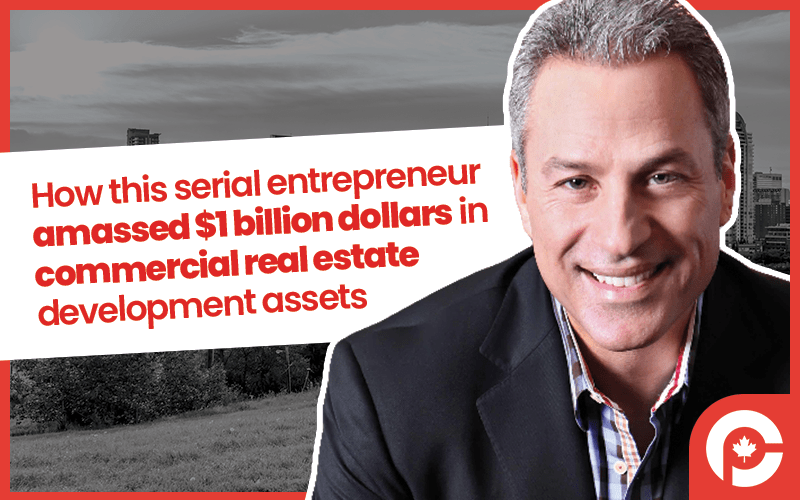
How this serial entrepreneur amassed $1 billion dollars in commercial real estate development assets
Episode
Frank Lonardelli is a “serial entrepreneur” who has been investing and developing Real Estate since he was 25 years...
Key takeaways
- Success in business requires maintaining a positive mental attitude through difficult times, as success is measured over decades not moments, and your response to adversity determines long-term outcomes.
- Truth has endurance while lies have speed, so entrepreneurs must be comfortable delivering brutal honesty to partners and staff when circumstances change rather than fabricating stories or delaying difficult conversations.
- Calgary offers unique advantages for business including affordability, safety, and lifestyle amenities that are attracting young professionals away from expensive cities like Toronto and Vancouver, while the economy has successfully diversified beyond energy dependence.
- In real estate development, think beyond individual buildings to transform entire corridors by consolidating multiple properties off-market, creating opportunities that traditional brokers and developers overlook due to complexity and time requirements.
- High interest rate environments actually strengthen rental markets by keeping potential buyers as long-term renters, creating sustained demand in undersupplied markets like Calgary where affluent residents historically preferred ownership over renting.
Transcript
Full transcript page · Interactive episode
============================================================
TRANSCRIPTION WITH SPEAKERS
============================================================

[00:00] SPEAKER_02: Welcome to Canada's podcast.
[00:05] SPEAKER_02: Hello, I'm Mario Tonigus, the managing editor of Canada's podcast.
[00:10] SPEAKER_02: Today's guest on Calgary's podcast is Frank Lunard-Dally, CEO of Arlington Street
[00:17] SPEAKER_02: Infestment. Thanks Frank for joining us today.
[00:20] SPEAKER_02: Welcome, nice to see you again.
[00:22] SPEAKER_02: You bet. So tell us Frank just a little bit about Arlington Street and what you guys do.
[00:30] SPEAKER_00: Well, Arlington Street is a street on Winnipeg where I grew up.
[00:33] SPEAKER_00: So that's why we determined to name the company after that.
[00:38] SPEAKER_00: And all the lessons learned from that early-challet experience.
[00:41] SPEAKER_00: Arlington Street is an operating company, is fundamentally focused on urban or super urban,
[00:49] SPEAKER_00: mixed to use multi-family development in Calgary, currently in Kelowna,
[00:55] SPEAKER_00: and we have two Eastern Canadian sites as well.
[00:58] SPEAKER_02: Okay, now one of the things that you guys do quite successfully here in Calgary is along
[01:04] SPEAKER_02: our 17th Avenue Southwest, the high street, 17th Avenue, very for those of people
[01:11] SPEAKER_02: are outside the city that don't know it.
[01:13] SPEAKER_02: It's a very entertainment and restaurant and hospitality hub.
[01:19] SPEAKER_02: Tell us a little bit about your strategy there and what you've been doing along our 17th.
[01:25] SPEAKER_00: Well, I couldn't imagine anyone doesn't know where a 17th Avenue is in Calgary,
[01:30] SPEAKER_00: but if they do, we got to do a better job marketing.
[01:34] SPEAKER_00: But yeah, so 17th Avenue is interesting because of what you said, Mario.
[01:40] SPEAKER_00: And you know that the nomenclature or the urbanized terminology we use today is not high streets,
[01:47] SPEAKER_00: it's cool streets.
[01:48] SPEAKER_00: And it's that big shift between what happened in the rotation of the 70s and 80s
[01:53] SPEAKER_00: with all the wealth that was created from the baby boomers.
[01:56] SPEAKER_00: And everybody wanted to be seen in Cughalboss and Fendi and Valentino and all that kind of good stuff.
[02:02] SPEAKER_00: So these high streets were created.
[02:04] SPEAKER_00: Today we're creating cool streets and cool streets refers to places where the young,
[02:09] SPEAKER_00: up and coming professionals can live, work, play and shop within a small radius and also be able to get to work.
[02:19] SPEAKER_00: So if you consider the location of 17th Avenue and the vibrancy,
[02:24] SPEAKER_00: the location is some four to five blocks over the 38 million square feet of office towers
[02:30] SPEAKER_00: that most people work in still, if you believe in the office market, which I do,
[02:35] SPEAKER_00: it's changed quite a bit, but that's happening.
[02:38] SPEAKER_00: And secondly is we have 140 to 150 service providers or opportunities for people to live, work and play.
[02:46] SPEAKER_00: And so these are the nodes that we build into as it relates specifically to 17th Avenue.
[02:53] SPEAKER_00: When we looked at 17th Avenue, we didn't do what we've done historically,
[02:57] SPEAKER_00: which is to buy a set of buildings and say, well, we'll convert them into a different build form with different applications.
[03:06] SPEAKER_00: We looked at 17th Avenue and said, let's not look at building a building.
[03:10] SPEAKER_00: Let's look at transforming a corridor.
[03:12] SPEAKER_00: And it's never been done on 17th Avenue because of three very simple reasons.
[03:17] SPEAKER_00: Number one, the average building has been owned by the same person or family or entity for 55 to 60 years.
[03:24] SPEAKER_00: Number two, there's no consolidated parcels to be bought and then built.
[03:30] SPEAKER_00: And then number three, no broker in his right mind, whatever spent as much time and energy as we did to go and do exactly what we did.
[03:38] SPEAKER_00: So what we did was we went off market and we bought 40 separate buildings and created eight different development sites.
[03:46] SPEAKER_00: And so now we're on project number four in terms of the buildings that were currently recreating.
[03:52] SPEAKER_02: Tell me a little bit about the marketing general here in Calgary, Frank, and what you're seeing these days.
[03:59] SPEAKER_02: And obviously, you know, you know, primarily, you know, your initiatives deal with the residential side and then obviously street level, the retail slash hospitality side.
[04:13] SPEAKER_02: What are those markets showing you these days?
[04:17] SPEAKER_00: I think we have a tale of two worlds really.
[04:21] SPEAKER_00: And the foundation of both those worlds is that we're now in a high interest rate economy, which, which Maraud, I don't want to date you because we both got gray hair.
[04:31] SPEAKER_00: You know, but people are a little bit more than we did three years ago.
[04:35] SPEAKER_00: But, but what people forget is is that over the span of time, let's call it 50 years, eight percent interest is the mean interest rate that people were used to paying over that period of time.
[04:46] SPEAKER_00: It's only been the last decade to decade and half where we had this Japanese style low interest rate economy where people thought they'd always have to pay interest or always have the ability of being afforded to have a, you know, one or two percent interest rate.
[05:01] SPEAKER_00: And so now we've got an interest rate that's climbed five times in 12 months and the cost of capital is some 300 percent more today than it was in, you know, 12 months ago.
[05:13] SPEAKER_00: And that's good to affect everybody in very unique ways.
[05:17] SPEAKER_00: So in what we do for a living, it's actually perpetuated the business.
[05:22] SPEAKER_00: The positive is is that renters and we're under supplied in the Calgary marketplace specifically, same as Colona, we're dramatically under supplied.
[05:30] SPEAKER_00: And we have been for a long time. Why? Because we live in an affluent city where people were making lots of money in the oil and gas business and no one rented it.
[05:38] SPEAKER_00: They want to buy their first condo just like I did when I was 30 years old.
[05:41] SPEAKER_00: And so now we're going to more of a European style economy or culture or way of looking at this kind of living arrangement where renters will be larger in span and they'll rent for longer periods of time because the first time mortgage tests and the fact that people are actually going to have to spend
[06:01] SPEAKER_00: 4.5 to 5 percent of their cost of capital.
[06:04] SPEAKER_00: And that's really shifted the marketplace for residential rentals. So we're under supplied, interest rates have created that renter to be a longer term renter and they'll be more renters.
[06:16] SPEAKER_00: In terms of in terms of the other asset classes, you know, and God bless these guys going after these office conversions to residential.
[06:23] SPEAKER_00: And I know who they are and they're very different people. You have you have institutionally funded companies that I would consider they're getting these conversions done because they're in the loose less business, not make more money business.
[06:40] SPEAKER_00: And then you've got small entrepreneurs like us who are small private companies that are very entrepreneurial, you know, trying to do these very creative projects.
[06:50] SPEAKER_00: And I wish them all luck. I like we're pretty brave over here. We're just not that brave.
[06:55] SPEAKER_00: But but just because I think there's just so many challenges with with that kind of whole equation.
[06:59] SPEAKER_00: And the last part is and it's sort of long answer to your short question. I think that we have a sea change in the Alberta marketplace.
[07:09] SPEAKER_00: I think there's lots of cracks across Canada, but we have a sea change in the Alberta marketplace in this in this way.
[07:15] SPEAKER_00: I think that we're finally figured out that we can't tire ourselves to energy in the way that we have in the past.
[07:22] SPEAKER_00: And I am long and hydrocarbons. I'm a big oil and gas supporter. I do everything to support that into the business.
[07:31] SPEAKER_00: But the beautiful thing that we've done in our economy is we've really perpetuated the technology space alternatives.
[07:40] SPEAKER_00: And we've really worked towards diversifying our economy.
[07:44] SPEAKER_00: And I think now that Calgary has the top three things that everyone's migrating towards, which is affordability.
[07:51] SPEAKER_00: Who would have thought that would have been, you know, the claim to fame for our city.
[07:55] SPEAKER_00: We have the cool factor. It's an awesome city with awesome amenities and great lifestyle opportunities.
[08:01] SPEAKER_00: And it's safe. And if you live in Toronto and you live in Vancouver, all those young up and coming 30 roles who are graduating from all these great business schools,
[08:11] SPEAKER_00: they don't get any three of those in those two areas. And I think Calgary is well suited for the future because of that reason.
[08:18] SPEAKER_02: All right. So Frank, growing up in the peg, I imagine real estate was probably not your first career choice.
[08:27] SPEAKER_02: Right? You probably thought of something else to do when I grow up. How did you get involved in real estate? And why?
[08:35] SPEAKER_00: Well, you know, speaking to the choir here, I'm Italian. So if you're Italian, you have an affinity for bricks and mortar. So yes, there's always real estate.
[08:44] SPEAKER_00: And I always knew I was going to be involved in real estate. But my first business was actually a food company.
[08:49] SPEAKER_00: And it was a food company because when I when I dropped out of school, I really didn't have any formal experience,
[08:56] SPEAKER_00: except for I grew up in an Italian restaurant. And I think I always had an entrepreneurial kind of, you know, thread that went through me.
[09:04] SPEAKER_00: And so I didn't have any capital. And I had an idea. And I thought I could take, you know, hold cooking into large institutional facilities and turn key those facilities with this kind of mandate to provide people non institutional based food products and food options and optionality.
[09:22] SPEAKER_00: So that food company was a cafeteria company, then a catering company, an eventing company, then a coffee company and a coffee roasting company, and then a garbage company.
[09:31] SPEAKER_00: And it was called, it was called the first Avenue group that I started when I was 26 years old and went to peg Manitoba.
[09:36] SPEAKER_00: And the real estate piece really was from the year that I started the business. It was a cash flowing business. I took my money in free, flowing cash. And I started investing into real estate.
[09:45] SPEAKER_00: And I didn't have a strategy. My strategy was more spray and prey. And but but it led me to making some really lucky decisions.
[09:56] SPEAKER_00: And it informed me on the things that I really wanted to do in the future. And so 10 years ago, and that company's been around for 20 years. But but 10 years ago, I just thought I need to get really serious about monetizing all of the learnings that I had in real estate from all these different things I get across Canada and the US.
[10:12] SPEAKER_00: And and really really formalize Arlington Street and really go after this very focused approach. Interesting. What do you like about it about being in real estate, especially now?
[10:25] SPEAKER_00: Well, I think it's probably because I'm partially insane. It's it's I think it's one of the hardest businesses in the world to be successful at.
[10:34] SPEAKER_00: I really think that the dynamics in real estate, the second only to the restaurant business.
[10:41] SPEAKER_00: And I grew up in the restaurant because you know, I tell people this all the time, I said, when you go to a restaurant, you're there for two hours.
[10:47] SPEAKER_00: The person who owns the restaurant has 26 different opportunities to screw up your experience.
[10:52] SPEAKER_00: They also have 26 different opportunities to make to provide you an experience that you'll always remember that, which is why people coming, keep coming back to the restaurants.
[11:00] SPEAKER_00: They love and you know the people who figured that out are the urls of the worlds and the joys of the worlds.
[11:08] SPEAKER_00: They figured out how do I monetize through a system approach?
[11:13] SPEAKER_03: Yeah.
[11:13] SPEAKER_00: The experience that people coming back much like McDonald's except in a very different class of food.
[11:19] SPEAKER_00: And so I think the dynamics of everything buying the asset, ideating the end result, designing the building, building the building,
[11:29] SPEAKER_00: and financing the building, and then trying to create a brand, it's so hard.
[11:34] SPEAKER_00: Like it's really, it's really, really difficult, which is why, and you know all the guys that I know in real estate, in regards to what your opinions are of them, I have an infinite amount of respect in everybody who's doing what we're doing because it's really, really dynamic.
[11:50] SPEAKER_00: And because of it, it's very difficult.
[11:51] SPEAKER_02: You know what you guys are in Arlington, as you said, you operate in different areas including Colona, but what is it about Calgary?
[12:03] SPEAKER_02: What do you like about Calgary and doing business here?
[12:08] SPEAKER_00: Well, when I moved to Calgary in 2000, I told the mayor I was leaving and I told the mayor where I was coming and I had the great pleasure of meeting the mayor when I moved here.
[12:19] SPEAKER_00: And I told our mayor I said the reason I'm leaving Winnipeg and we'd won some small business awards, you know, and we're a very small company.
[12:28] SPEAKER_00: As I said, you know, Winnipeg always feels like someone has to win and someone has to lose. That feels like the business environment.
[12:35] SPEAKER_00: And then when I moved to Calgary in 2000, we were at the precipice of a new energy cycle.
[12:41] SPEAKER_00: And I mean, all these like 30-year-old guys who had mud companies and exploration businesses and were geologists in these large, you know, companies that were created by Albertans.
[12:54] SPEAKER_00: And it was just entrepreneurial. And we were open for business and Ralph Klein was here.
[13:00] SPEAKER_00: And you know, he was a cool guy that you can have a beer with and talk about business and he didn't really care what your last name was.
[13:06] SPEAKER_00: And I just found and I found that with our partners too because real estate super capital intensive, we needed partners.
[13:12] SPEAKER_00: And you know, people would sit in the pocket who made money and they said, hey, like I can see myself in this guy. I was 30. I was 29 when I moved here.
[13:20] SPEAKER_00: I can see myself in this guy. And this guy, even if the world goes to crap, he's going to hold on him. He's going to make something work.
[13:28] SPEAKER_00: And we developed these relationships. And so I love that about the city then.
[13:33] SPEAKER_00: And I love that about the city now. I will say, I will say, the pre five-year down cycle to the pandemic was deadly for the spirit of Caligary.
[13:47] SPEAKER_00: Albert, really, I think we lost our way entrepreneurily. I think people started giving up.
[13:53] SPEAKER_00: We had a lot of guys that are partners of ours who turned 60 and 70 and said, look, I'm going to move all my money into the US because it's kind of better, you know, tax regime.
[14:02] SPEAKER_00: I don't think we're going to have a new cycle. And I don't think we're going to get out of it. And so we're in this rut. This really long rut.
[14:08] SPEAKER_00: And I think people just lost faith. And we did. We thought from a Winnipeg perspective, wow.
[14:13] SPEAKER_00: You know, if I love the city and I love the real estate at the height of the market, why wouldn't want why wouldn't I want to buy a bunch of real estate on sale?
[14:20] SPEAKER_00: Because I'm going to be your friend like 20 years and that's the approach we took.
[14:24] SPEAKER_01: What do you think it takes to be a successful entrepreneur?
[14:31] SPEAKER_00: I think at the very foundation of positive mental attitude.
[14:37] SPEAKER_00: You can be really smart. You can be really technically savvy. You can you can be clever.
[14:44] SPEAKER_00: But if you don't have a positive mental attitude, you're going to get killed.
[14:48] SPEAKER_00: And I always I always guise it in this way. A lot of people think that success is like what I refer to as a shooting star.
[15:01] SPEAKER_00: It's not. You know, there's three there's three types of you know, there's three types of continuums in that equation.
[15:08] SPEAKER_00: There's shooting stars, shining stars and space junk. Right. And and shining stars are people who are successful over the span of time, not in the moment.
[15:20] SPEAKER_00: Right. So in the moment, if you look at slice of my life over 20 years at any given time, I could look really, really bad.
[15:26] SPEAKER_00: And by the way, there are some guys who are way more successful successful than I am.
[15:33] SPEAKER_00: And I'm relatively successful who have multi billion dollar platforms and you know their names because some of them may own hockey teams.
[15:40] SPEAKER_00: But if you look at the smartest guy in energy and you picked just what he looked like in a very short period of time, they need two quarters in 2020, you go, the guys at bomb like his company is like one 50th of what it was worth.
[15:55] SPEAKER_00: And you're like, but and people think about things like that. And they're like, and people love to make comments about people when they're down.
[16:01] SPEAKER_00: But it's it's success is about a positive mental attitude reacting and excuse me, acting to the marketplace being very cognizant of what's happening in the next five to 10 years and being very thoughtful about maintaining a positive attitude regardless of when the market goes away.
[16:25] SPEAKER_00: And then if you start feeding into that, you're dead in the water.
[16:31] SPEAKER_02: What's the biggest lesson you've learned as a businessman?
[16:36] SPEAKER_00: Hey, Mario, I'll put it to you a different way and I know you're asking the questions, but I'll have some fun with you.
[16:41] SPEAKER_00: Okay. I would imagine like you're you're one of the most respected and likable guys in your space. And by the way, nobody like me, who doesn't like Mario Tonoguzi?
[16:51] SPEAKER_00: Oh my gosh, but I, but I bet, but I bet there are some colleagues because you guys had this crazy thing that happened in your in a journalism space.
[17:00] SPEAKER_00: There are a couple guys looking at Mario gone, like, Mario's got his podcast. He's got a whole new career. He's kicking butt. There's probably a couple people who feel envious of you, right?
[17:11] SPEAKER_00: Because you found a new career and you did it in a very difficult circumstances. You know, and so that's beautiful. That like that's a beautiful story.
[17:23] SPEAKER_00: That's a classic on straight and you've done amazing. So sorry, I wanted to say that and I forgot your question.
[17:28] SPEAKER_00: Thank you for that.
[17:29] SPEAKER_02: You got me lost. But okay, thanks a lot.
[17:32] SPEAKER_02: Okay, so back to me leading this.
[17:36] SPEAKER_02: So what is the biggest lesson you think you've learned over the 20 years or so of being in business?
[17:50] SPEAKER_00: So many, but the thing that comes to mind and I know because I'm very comfortable in difficult times.
[18:01] SPEAKER_00: And I'm very comfortable telling people the truth, even if the truth doesn't sound good.
[18:05] SPEAKER_00: What I mean by that is that when you're in business and the tide goes against you, yeah, all your forecasts and all the things you thought you were going to do and accomplish, you can't do.
[18:17] SPEAKER_00: And if I have a partner, I'm very comfortable telling them that. So this idea that truth has endurance and lies have speed.
[18:26] SPEAKER_00: And a lot of entrepreneurs when they get into the into the mud, the blood and the flood, they think that the response is they should lie to their partners or they should lie to their staff or they should make up a story.
[18:39] SPEAKER_00: I love the brutal truth when we hit the pandemic and we went negative oil.
[18:45] SPEAKER_00: And I said this in public before I looked at everybody and I said, I think our I think our portfolio in this moment is not only worth zero.
[18:56] SPEAKER_00: It could be worth minus 25 million dollars.
[18:59] SPEAKER_00: Now you got to take people to the next place if you say something because that'll scare the crap out of someone, right?
[19:04] SPEAKER_00: But it was the truth. And if you don't deal with the brutal fact when it's sitting right in front of you, then you make up stories and you don't act not react, but you don't act to the circumstance.
[19:17] SPEAKER_00: And if you don't act quickly and decisively, you're going to get killed long term.
[19:21] SPEAKER_03: Yeah.
[19:22] SPEAKER_02: So Frank, you know, anybody that's an entrepreneur and business person owner, you know, you're working basically 24 seven, right?
[19:32] SPEAKER_02: If you're not actually working or thinking about the business all the time, I'm just curious, what do you do outside of business to keep your mind and healthy, I guess.
[19:44] SPEAKER_02: So that's not 99.9% thinking business all the time.
[19:49] SPEAKER_00: Well, I told one of my best friends at dinner at Nolpa, a little plug for our new Mexican restaurant next door on 17th and 5th best Mexican restaurant city.
[20:00] SPEAKER_00: I said to him my best friend, my best friend in the world.
[20:05] SPEAKER_00: And I said, I lead an exceptionally boring life.
[20:09] SPEAKER_00: Like I've become exceptionally boring in terms of my life, but your question is such an important question because the projects in the company fight for my time against my kids.
[20:26] SPEAKER_00: And really, it's the only two priorities I have, like the business and the kids.
[20:30] SPEAKER_00: And I have kids in the business too, because a lot of my 15, 60 year old guys sometimes act like kids do, right?
[20:36] SPEAKER_00: And you got to take care of them, you got to nurture them, you got to support them, you got to help them through challenging times.
[20:44] SPEAKER_00: The honest answer is, I haven't done a good job creating environments for myself where my mind can be at peace, where I could be quiet.
[20:56] SPEAKER_00: And I'm involved in nurturing activities from my soul and my mind body.
[21:03] SPEAKER_00: I haven't done a good job at that, and it's something that I'm working on regularly.
[21:08] SPEAKER_00: I think the good news is I'm the kind of person who can get a lot in a very short period of time.
[21:14] SPEAKER_00: So if I get a chance on a business trip, I know this is going to sound, you know, you're whoever's watching this is going to say, now I completely understand what dysfunctional is guys.
[21:23] SPEAKER_00: I actually look forward to going to Toronto to work because I know when I'm all done, that I get to fly back in a really nice seat in a big plane, and I get to watch a movie, and I'm quiet and no one can talk to me.
[21:40] SPEAKER_00: Yeah, exactly.
[21:42] SPEAKER_00: Right?
[21:43] SPEAKER_00: And I believe believe it or not, those are some of the ways in which I create that equilibrium.
[21:49] SPEAKER_00: Excellent.
[21:51] SPEAKER_02: I guess before closing off here, Frank, just a stock of go back to Arlington for a second.
[21:59] SPEAKER_02: You know, what are the plans for the company in the future like just continuing on what you're doing or anything else that you might have.
[22:09] SPEAKER_02: You know, looking forward to.
[22:11] SPEAKER_00: Yeah, well, you know, this company is led by a growth entrepreneur today in the future.
[22:16] SPEAKER_00: It may be different.
[22:18] SPEAKER_00: So I'm having fun when I'm growing it if I'm not growing, I'm not having fun.
[22:22] SPEAKER_00: So we intend to grow. That's that's our number one mandate.
[22:25] SPEAKER_00: Grow always in all markets.
[22:28] SPEAKER_00: And so we are as you're aware, we're going to start construction on our inzo project, which is on the site of the old Bungernos.
[22:38] SPEAKER_00: We'll be the old barn journals and we want to tell that that'll be me of this year.
[22:41] SPEAKER_00: So that's right around the corner.
[22:43] SPEAKER_00: We'll be and then we'll be going in the first quarter next year to build our fish bins project, which will be the largest multifamily project in the urban belt line on 17th Avenue.
[22:52] SPEAKER_00: We are portfolio and coloners of about 2.5 times larger.
[22:55] SPEAKER_00: So we have two projects going in the ground at the same time this year.
[22:59] SPEAKER_00: So we'll be growing.
[23:00] SPEAKER_00: So it's growth.
[23:02] SPEAKER_00: We're also there.
[23:04] SPEAKER_00: We have two very large mandates that are kind of outside of that.
[23:07] SPEAKER_00: And what is the consolidation of all of our multi family into a different entity and a different brand, which when I when I get there and I've got my head all around it,
[23:16] SPEAKER_00: and I got the right people in place.
[23:17] SPEAKER_00: I'll give you a heads up and tell you what it's about because I think it's very exciting because it hasn't been done before.
[23:22] SPEAKER_00: And then and then and then quite frankly, my intention is to plan out what my life looks like after I'm 60, which is about, you know, nine odd years down the road, which is what I really want to do in life and it won't have anything to do with business.
[23:36] SPEAKER_00: I'm trying to plan out my life when I'm 90.
[23:39] SPEAKER_02: So.
[23:42] SPEAKER_02: It'll be it'll be a lot of a lot of lunches that down at Bonjourno with a shot of grappa.
[23:47] SPEAKER_02: So that'll be that'll be my 90.
[23:50] SPEAKER_00: Yeah, well, it's a moving target right if you're not waking up every day asking how you have to mend your assumptions, you're probably not very thoughtful in the future, right?
[23:58] SPEAKER_02: Yeah, you bet.
[23:59] SPEAKER_02: All right, Frank, I'm glad you're speaking with you again. Thanks very much for joining us.
[24:04] SPEAKER_02: Merrill, thanks for the time. Great to see you again.
[24:06] SPEAKER_02: All right, super.
[24:07] SPEAKER_02: That was Frank Loneard Deli, who was CEO, Arlington Street investments.
[24:12] SPEAKER_02: I'm Mario Tonoguzi, managing editor of Canada's podcast.
[24:16] SPEAKER_02: This has been Calgary's podcast. Thanks for joining us today.