
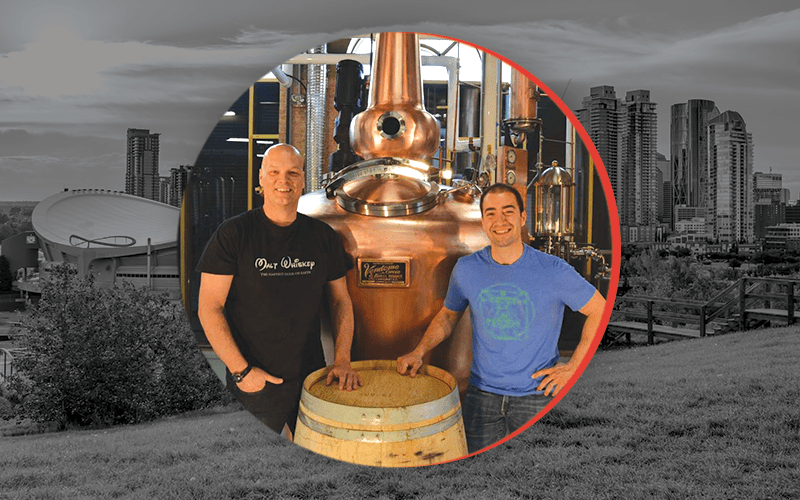
Two former engineers pursued their passion a few years ago to establish the ‘spirits’ making company Bridgeland Distillery
Episode
Daniel Plenzik and Jacques Tremblay are founders and owners of Bridgeland Distillery. The former engineers pursued their passion a...
Key takeaways
- Finding the right business partner with complementary skills is essential for entrepreneurial success, as running a business alone can be overwhelming with too many parallel responsibilities.
- Starting a craft distillery requires significant upfront investment in designing the right space and equipment, and learning from other operations' mistakes before building your own facility.
- Agility and the ability to pivot quickly are crucial for business survival, especially during economic downturns when you need to assess what's working week to week and adapt accordingly.
- Building strong community relationships and supporting local initiatives can help sustain a business through difficult times, as customers will reciprocate that support.
- Life is short, so if you're in your 40s or 50s and have a passion project in the back of your mind, now is the time to pursue it rather than waiting until later.
Transcript
Full transcript page · Interactive episode
============================================================
TRANSCRIPTION WITH SPEAKERS
============================================================

[00:05] SPEAKER_01: Hello and welcome to Calgary's podcast with Mario Toneguzi on Canada's podcast network.
[00:12] SPEAKER_01: Joining me today is Daniel Plensik and Jacques Tombley, who are the founders and owners
[00:18] SPEAKER_01: of Bridgeland Distillery in Calgary.
[00:21] SPEAKER_01: Thanks for joining us today guys.
[00:23] SPEAKER_03: Yeah, thanks Mario.
[00:24] SPEAKER_03: Thank you.
[00:25] SPEAKER_01: Okay, first of all, I got to ask, I see a big thing in the background behind you.
[00:30] SPEAKER_01: What is that?
[00:32] SPEAKER_03: It's a beautiful traditional pot still.
[00:37] Speaker UNKNOWN: The whole Jacques and I went down to the Taken to see some of the larger, uh, main factories
[00:45] SPEAKER_03: of beautiful stills for making whiskies and burpees, you know, brandy's crap out of
[00:52] Speaker UNKNOWN:
[00:53] SPEAKER_03: So we went down to the Taken and we built this bridge to come from.
[00:58] Speaker UNKNOWN: And like we made all our vessels here at the Distillery at different bridges.
[01:03] Speaker UNKNOWN: But we made our bubby's bridge, so it's bubby's behind us from bubby building Taken.
[01:09] SPEAKER_01: Okay, and just out of curiosity, how much of that baby cost?
[01:15] SPEAKER_03: Oh, well, it's like a frog.
[01:20] SPEAKER_01: Okay, we'll leave it at that.
[01:22] SPEAKER_03: That's the best of the best, yeah.
[01:24] SPEAKER_01: First of all, guys, tell me just a little bit about Bridgeland Distillery when you guys
[01:30] SPEAKER_01: started it and what you guys do.
[01:34] SPEAKER_03: Yeah, so we started here in Bridgeland back in 2018.
[01:40] SPEAKER_03: We started construction at this building.
[01:42] SPEAKER_03: We got six months into construction and that we were ready to start production.
[01:48] SPEAKER_03: We opened the public in August 2019.
[01:51] SPEAKER_03: So it's been a year and a half now.
[01:53] SPEAKER_03: They're all built and with receiving gas and the customer.
[01:59] SPEAKER_01: Okay, super.
[02:00] SPEAKER_01: And so obviously there is a seating area there.
[02:04] SPEAKER_01: There when COVID restrictions are fine.
[02:10] SPEAKER_01: And so you added the distillery together, right?
[02:13] SPEAKER_01: Just as for our folks that are maybe not here from Calgary that don't know, right?
[02:19] SPEAKER_01: Okay, super.
[02:21] SPEAKER_01: Tell me a little bit about your backgrounds and what were you doing prior to starting this
[02:31] SPEAKER_01: business?
[02:31] SPEAKER_01: Daniel, start with you.
[02:32] SPEAKER_03: Yeah, I mean both John and I are engineers first.
[02:38] SPEAKER_03: I could John and I didn't know each other until we met at the Distillery force in the
[02:44] SPEAKER_03: open august 2016.
[02:45] SPEAKER_03: But before that, I guess I was born in Bridgeland where it's been created from Italy.
[02:52] SPEAKER_03: It's more near, went to school here, different schools here in Bridgeland, Brickfield and
[02:57] SPEAKER_03: then just went to the St. Francis.
[02:59] SPEAKER_03: Went to University of Dalton, you got my electrical engineering job right there.
[03:04] SPEAKER_03: It's a geomatically system.
[03:05] SPEAKER_03: I eventually I worked at the oil and gas industry for both 20 years and look at genres
[03:11] SPEAKER_03: in critical services 9.1.
[03:14] SPEAKER_03: Yeah, it was a public safety knife with one software sign.
[03:17] SPEAKER_03: So quite different.
[03:19] Speaker UNKNOWN: So when we met, we got a couple of notes and the desire to start the business in a
[03:25] SPEAKER_03: completely different field.
[03:27] SPEAKER_03: Yeah, I mean my entire life, like, job, we were brewing.
[03:32] SPEAKER_03: I was doing a different line of job, just doing different gear.
[03:36] SPEAKER_03: You know, I heard once in a while you tried your head and it was still like not lined
[03:41] SPEAKER_03: into brandy.
[03:42] SPEAKER_03: A lot of talent with the major group, you know, taking those great skills, it's still
[03:46] SPEAKER_03: like into drama.
[03:48] SPEAKER_03: And we were talking about, actually, we had a passion for it and we decided what we wanted
[03:53] SPEAKER_03: to take that passion and make it a second career.
[03:56] SPEAKER_01: Okay, super.
[03:57] SPEAKER_01: Let me just ask you guys, like, recently you received some awards, right, for some of
[04:03] SPEAKER_01: your spirits.
[04:06] SPEAKER_01: Can you tell me what those awards were?
[04:09] SPEAKER_01: And then maybe we'll even make some of those winners.
[04:15] SPEAKER_03: Because a few of them here that if we won in the over the better towards a judges selection,
[04:20] SPEAKER_03: just most recently, just a photo we get a half a gold.
[04:24] SPEAKER_03: Four dollars, we have a front of us here, just one, that it had the Canadian Ferguson
[04:30] SPEAKER_03: Spirit competition.
[04:32] SPEAKER_03: It's for all Canadian, they submit their bottles for the tasting.
[04:40] SPEAKER_03: And yeah, everyone's a little bit of a seller.
[04:43] SPEAKER_01: Okay, let's try one.
[04:48] SPEAKER_02: Let's start with the bottom.
[04:51] SPEAKER_01: Bottom beam.
[04:51] SPEAKER_02: Bottom beam.
[04:52] SPEAKER_02: It's actually, it's a party.
[04:54] SPEAKER_01: Okay, I got my little sample here.
[05:00] SPEAKER_03: So this is an image, most active grain.
[05:04] SPEAKER_03: So I need to be in an absolutely no color.
[05:07] SPEAKER_03: It's a perfectly clear spirit.
[05:09] SPEAKER_03: That talent comes off still quite a few times.
[05:15] SPEAKER_03: It's perfectly clear.
[05:17] SPEAKER_03: We used for this product 100% most active grapes for my sketch.
[05:24] SPEAKER_02: Okay.
[05:25] SPEAKER_03: The grapes come from this product from California.
[05:30] SPEAKER_03: We see grapes through start bonus times for here.
[05:34] SPEAKER_03: And yeah, it's our first sip.
[05:37] SPEAKER_03: Okay, thank you.
[05:42] SPEAKER_00: It's a very refreshing product.
[05:45] SPEAKER_03: It is.
[05:46] SPEAKER_03: I get a lot of like pears, like peaches, like you leave a value on the enrollment.
[05:53] SPEAKER_03: This product, one, a whole better than the OVB category.
[05:59] SPEAKER_01: So where do you get your names from for your spirits?
[06:03] SPEAKER_03: Our names.
[06:05] SPEAKER_03: I mean, it's funny.
[06:06] SPEAKER_03: We take our life to make spirits that we can't actually call out their standard names.
[06:13] SPEAKER_03: For example, we make a scotch, but we take called scotch, the scotch.
[06:18] SPEAKER_03: The only thing they, it's common.
[06:20] Speaker UNKNOWN: We made a graph, we cannot call it a grapha because it's got to be made in Italy for a small town to Chino, Switzerland.
[06:30] SPEAKER_03: Urban is another one.
[06:32] SPEAKER_03: We can't actually call it urban, the OVB or the OVB because that's again a protected name in the US.
[06:38] SPEAKER_03: So our urban is actually a chartered vehicle.
[06:41] SPEAKER_03: After hearing the coordinates derived from which is from Tiga.
[06:45] SPEAKER_01: Yeah.
[06:46] SPEAKER_01: Let me ask you in general, you know, there's, I guess in the last few years, there's been quite a movement,
[06:55] SPEAKER_01: a popularity movement towards distilleries, towards craft beer places.
[07:03] SPEAKER_01: Why do you think that's happening in the world?
[07:07] SPEAKER_03: Yeah, it's a question.
[07:08] SPEAKER_03: I think it's part of the local and slow food movement where everyone wants to get back to what everything should be tasting like.
[07:21] SPEAKER_03: So this craft movement is like you said, it's really still evolving in popularity.
[07:27] SPEAKER_03: And it's, it illustrates that everyone, when I say everyone, everyone in their particular location can produce something unique and something that is flavorful and taste the difference from the next problem or the next city over.
[07:42] Speaker UNKNOWN: For instance, we're using grains for whiskeys that are just a big roll within a hundred miles of the distillery.
[07:51] Speaker UNKNOWN: We take our meat and barley and all just some of it here and our our corn and paper.
[07:59] SPEAKER_03: So for us, it's important that ingredients are local.
[08:03] SPEAKER_03: Yeah, just like on the one side, we have grapes from California, but we also have grapes from the open up the valley.
[08:10] SPEAKER_03: So it's important for us.
[08:13] SPEAKER_01: Yeah, it's that movement, that local movement is unbelievable.
[08:17] SPEAKER_01: You know, these days, you know, you're seeing it more and more in different areas.
[08:23] SPEAKER_01: What about, you know, just the whiskey side of things.
[08:28] SPEAKER_01: There seems to be, I don't know if you want to use the word rebirth, but in some ways there seems to be a rebirth in whiskey and cocktails and stuff like that.
[08:40] SPEAKER_01: Why do you think that's happening?
[08:42] SPEAKER_03: Yeah, so welcome.
[08:44] SPEAKER_03: What's interesting with the whiskey world is going in Scotland with their scotch whiskey and single call of flavor and Kentucky and the US general with the verb.
[08:56] SPEAKER_03: Yeah, there's been a rebirth in the last 20 year in the last 15 years on that.
[09:01] SPEAKER_03: Why is that rebirth?
[09:02] SPEAKER_03: I think what happened in the 80s, like everyone was about wanted a life flavor.
[09:09] SPEAKER_03: And that's like a gin and vodka where all of a sudden green poplar.
[09:13] SPEAKER_03: But after that, people start looking for more flavor.
[09:17] SPEAKER_03: Yeah, they realize that scotch has broken and I'm past it amongst the flavor.
[09:22] SPEAKER_01: Yeah, exactly.
[09:23] SPEAKER_01: Okay, guys, time for the second tasting. What's one we're going to try?
[09:27] SPEAKER_03: We'll try what we call a tropical, a good, but extreme, or what to be.
[09:33] SPEAKER_03: What we usually use water life, we make what the bean, which is water from the bomb.
[09:40] SPEAKER_03: Again, you can't call it a crap. That's why it's being a.
[09:46] SPEAKER_01: Daniel being a.
[09:49] SPEAKER_01: As I for now, Daniel being Italian, you know, maybe a lot of people out there that are not as fortunate. Sorry, Jacques.
[09:59] SPEAKER_01: Yeah, being Italian.
[10:02] SPEAKER_01: Can tell you tell people and explain to people what crap is.
[10:06] SPEAKER_03: Yeah, so if you just feel different beers, you make whiskey.
[10:11] SPEAKER_03: You just feel different wine.
[10:13] SPEAKER_03: You make brandy.
[10:14] SPEAKER_03: If you take the grape skins, that we actually, what we do is we prevent them separately.
[10:19] SPEAKER_03: Typically, we're using white riles. In this case, the different sugar.
[10:22] SPEAKER_03: We take those skins out and they've been pressed.
[10:25] SPEAKER_03: And they're still residual sugars. We prevent them separately.
[10:29] SPEAKER_03: Yeah, we distill those entire skins in the scale.
[10:32] SPEAKER_03: We actually take those whole skin, and it's easier.
[10:35] SPEAKER_03: And this will be alcohol, a lot.
[10:38] SPEAKER_03: We get very little product because there's very little alcohol to get with it.
[10:43] SPEAKER_03: Those skins.
[10:43] SPEAKER_03: Yeah, it takes us about.
[10:46] SPEAKER_03: During the season, 68 weeks, to be our distillations of just the skins alone.
[10:51] SPEAKER_03: It's a short period.
[10:52] SPEAKER_03: It's a lot of work, but it's a lot of fun.
[10:54] SPEAKER_03: Normally, you see, you grab a kind of, like, an unaged style similar to our pot of beer.
[11:03] Speaker UNKNOWN: But this one in particular, what we get is we aged it in French and the Casino barrels.
[11:08] Speaker UNKNOWN: These barrels were painted in 20 minutes from my expirte.
[11:13] SPEAKER_03: So, to me, it's low on.
[11:15] SPEAKER_01: Okay.
[11:15] SPEAKER_01: Gentleman, enjoy.
[11:19] SPEAKER_03: Now, the aroma, the aroma is a lot of light.
[11:24] Speaker UNKNOWN: I get a lot of light on the nerves.
[11:27] SPEAKER_01: Okay.
[11:27] SPEAKER_03: I have a cocktail that uses this in cocktail with light tea.
[11:31] SPEAKER_01: Okay, got, got to ask you.
[11:34] SPEAKER_01: How does, how does your, and not to mention any names, of course, but how does what you produce there compared to some of the old Italians.
[11:45] SPEAKER_03: Well, I can't even compare it to those stuff I used to make in the grab as well.
[11:49] SPEAKER_03: Rayleigh, it's way better, of course.
[11:53] SPEAKER_03: I mean, I've had the best and the worst drop in it.
[11:58] SPEAKER_03: Some of the worst I've had in some very small restaurants where they were making the room.
[12:05] SPEAKER_03: And, in the best, I've had some beautiful disabilities.
[12:08] SPEAKER_03: And then, one was a baritone.
[12:09] SPEAKER_03: And, it's a kind of some inspiration from them, with their each draws and squire reaching our drops as well.
[12:18] SPEAKER_03: This wrap is not each bit.
[12:20] SPEAKER_03: We're finding most people with the birds of Trigger this time.
[12:24] SPEAKER_03: And that's what we're doing.
[12:25] SPEAKER_01: Okay. Maybe, maybe Jacques, you can answer this question.
[12:29] SPEAKER_01: Tell me a little bit about the business model in terms of where you sell the product to.
[12:36] SPEAKER_03: Yeah. So initially, all the products were sold out of our tasting booths,
[12:41] SPEAKER_03: because we're allowed to sell quite a lot of bottles here in Calgary and Alberta from the distillery.
[12:47] SPEAKER_03: But could you realize that to be successful, we need to be in liquor store.
[12:52] SPEAKER_03: Now, to be in liquor store across Canada, each provincial body regularly is selling alcohol.
[13:01] SPEAKER_03: So right now, we're limited to Alberta, because we have gone into the procedure,
[13:07] SPEAKER_03: the process is registered in other provinces.
[13:10] SPEAKER_03: So we're in maybe Calgary and starting to get in,
[13:14] SPEAKER_03: probably in 45 different store across the province right now.
[13:20] SPEAKER_01: Okay. And you guys also customized, for a lack of a better word,
[13:27] SPEAKER_01: a different product for different businesses, right?
[13:34] SPEAKER_01: Like you've done special, special whiskeys for certain companies, right?
[13:40] SPEAKER_03: Yeah. So a good example is this borrow.
[13:43] SPEAKER_03: We did it with collaboration with Spargel,
[13:47] SPEAKER_03: who's a fairly famous daily here in Calgary.
[13:51] SPEAKER_03: And the approach us last fall in 2019.
[13:55] SPEAKER_03: And they wanted to have a bottle of wine,
[14:00] SPEAKER_03: I spur their specs basically.
[14:03] SPEAKER_03: We like it so much that the I spent the provision to use their name to continue selling it.
[14:08] SPEAKER_03: And they were really at the end on our food.
[14:11] SPEAKER_01: Well, one of my family's favorites.
[14:15] SPEAKER_01: Okay.
[14:18] SPEAKER_01: Okay, we'll do that one at the end.
[14:20] SPEAKER_01: Okay.
[14:23] SPEAKER_01: Let me talk.
[14:25] SPEAKER_01: Is there, you know, with the explosion that we've seen in Alberta and locally here in Calgary,
[14:32] SPEAKER_01: of craft breweries, of distilleries?
[14:34] SPEAKER_01: Is there a danger of over saturation in the market?
[14:40] SPEAKER_01: How do you guys feel about that?
[14:43] SPEAKER_03: Yeah, I think it's, it's not, we're not near the point of saturation.
[14:48] SPEAKER_03: You have to know that the craft distilling on the shelf is only represent a small fraction of the big player.
[14:56] SPEAKER_03: Yeah.
[14:56] SPEAKER_03: And everyone now is so interested in, in a big at local.
[15:00] SPEAKER_03: I think it right now, the old sales for a deal to represent three of.
[15:05] SPEAKER_03: We meeting the craft movement, only represent three to five percent of what's available on the shelves.
[15:13] SPEAKER_03: So it's still very, very small in comparison of the whole industry.
[15:20] SPEAKER_03: And I think because everyone's trying to find their own, their own beach.
[15:27] SPEAKER_03: Yeah, there's room for more play.
[15:30] SPEAKER_03: Yeah, we're probably still about four to five years behind the craft movement.
[15:35] Speaker UNKNOWN: I mean, in our group of minutes, and I exploded a little bit like this.
[15:41] Speaker UNKNOWN: It's quite amazing.
[15:43] SPEAKER_03: I think there's only what seven or eight craft skills.
[15:48] SPEAKER_03: Yeah, same job.
[15:50] SPEAKER_01: Okay, super.
[15:51] SPEAKER_01: Okay, what's one next guys?
[15:53] SPEAKER_03: We're doing the urban, paper porn bourbon.
[15:57] SPEAKER_03: This is the bourbon made of 60% more, about 30% barley and 10% wheat.
[16:07] SPEAKER_03: So it's a weeded bourbon.
[16:10] SPEAKER_03: Okay.
[16:11] SPEAKER_03: And yeah, what's unique is where the porn's coming from, the favorite.
[16:15] SPEAKER_03: Everyone knows the sweet corn of the favorite.
[16:18] Speaker UNKNOWN: And we were fortunate to be shot that and meet with the family and growing their corn in the paper comp.
[16:25] SPEAKER_03: And they're providing us with the point to make that person.
[16:31] SPEAKER_01: Yeah, obviously, you know, for people, these are people in Alberta and Southern Alberta will know all about paper corn.
[16:37] SPEAKER_01: But for other viewers who may be watching this from the rest of the country, tell us about why paper corn is so good.
[16:46] SPEAKER_03: Yeah, so to be your corn is typically super sweet, the sweet corn that isn't seasoned in August.
[16:52] SPEAKER_03: Here in Alberta, it's everywhere.
[16:54] SPEAKER_03: There's lots of stuff on the side of the road selling it.
[16:58] SPEAKER_03: Yeah.
[16:58] SPEAKER_03: And it became like a tradition, a tradition in August and September to have it with your meals.
[17:05] SPEAKER_03: So we thought it made sense to make a bourbon.
[17:08] SPEAKER_03: Okay.
[17:09] SPEAKER_03: So we're recording that, I mean, just like the BC, they're probably the channel app porn and material, they're probably their corn as well.
[17:17] SPEAKER_01: I'm going to show people the label here.
[17:21] SPEAKER_01: Well, you know what, that doesn't work because it turns backwards, never mind.
[17:25] SPEAKER_03: Yeah, so this one is a bit higher on the alcohol by 12.
[17:29] SPEAKER_03: We're at 45, it's only 42 for a traditional bourbon.
[17:34] SPEAKER_01: Okay, let's try it.
[17:35] SPEAKER_03: Nice color.
[17:36] SPEAKER_03: It's been in the cast for about 12 months.
[17:40] SPEAKER_03: And there's lots of notes of caramel, sweet caramel, basically fresh straws and corn as well.
[17:49] SPEAKER_01: Excellent. Thanks.
[17:51] SPEAKER_01: I'm going to switch gears and talk a little bit about being entrepreneurs, you know, in this day and age.
[17:59] SPEAKER_01: Now, I presume just by your background, you both worked for quote unquote, the man, right?
[18:06] SPEAKER_01: In your careers, what's it like being your own bosses, your own being an entrepreneur?
[18:14] SPEAKER_03: It's amazing.
[18:15] SPEAKER_03: I mean, everything's on you.
[18:18] SPEAKER_03: It's, yeah, I mean, Jack and I have a basic relationship.
[18:22] SPEAKER_03: I would never do a business by myself, either a job.
[18:26] SPEAKER_03: It's just, it was just too many, too many things that are going in parallel.
[18:33] SPEAKER_03: You need to make sure you have a business partner that has, you know, good attributes that you go to that kind of thing.
[18:40] SPEAKER_03: So we're actually going to point good, but you know, one is a little bit better at one thing.
[18:49] SPEAKER_03: They take care of that.
[18:50] SPEAKER_03: So the other one is better than the other experience, probably.
[18:53] SPEAKER_01: So kind of the young, kind of the yin and yang thing.
[18:57] SPEAKER_03: Yeah, exactly.
[18:58] SPEAKER_03: Exactly.
[19:00] Speaker UNKNOWN: It's the number one important thing first called going into business.
[19:04] Speaker UNKNOWN: It's really a marriage outside of a marriage, right?
[19:10] SPEAKER_03: Thanks so much.
[19:12] SPEAKER_03: So you know, I did something I learned that used to own his own business as an electrical engineer.
[19:20] SPEAKER_03: I was operating a large business owned by Americans, but it's something that I might, I didn't see the need for it,
[19:29] SPEAKER_03: but to our conversation, I realized that that's the way to go through so many big parts.
[19:36] SPEAKER_03: And it can be overwhelming, but factored both of us make sense.
[19:42] SPEAKER_01: So what's the best thing from your perspective of being an entrepreneur?
[19:47] SPEAKER_01: What do you like the most about?
[19:50] SPEAKER_03: Well, just, I mean, putting your stand forward in your product business.
[19:54] SPEAKER_03: I mean, I took a lot of pride in it, Chair.
[19:58] SPEAKER_03: As well, like, when I did it to someone, I did it as though it was my own.
[20:03] SPEAKER_03: I was my own facility.
[20:04] SPEAKER_03: Now we're doing it.
[20:05] SPEAKER_03: The truly is our own product.
[20:08] SPEAKER_03: So just putting our stand forward, I think.
[20:11] SPEAKER_03: I guess, like, some sort of big factor in the society.
[20:18] SPEAKER_01: So when you look back, when you started the business,
[20:22] SPEAKER_01: and what were some of the biggest challenges of starting a new business?
[20:28] SPEAKER_03: That's a good question.
[20:30] SPEAKER_03: I think, well, first of all, because we needed to build a space with the right equipment,
[20:36] SPEAKER_03: the initial phases where all designed a whole operation before you, and I think I've done that, right?
[20:45] SPEAKER_03: I mean, we have visited a lot of the still room for the years, whether it's Canada or the US, to Canada.
[20:51] SPEAKER_03: And Italy and so on.
[20:53] SPEAKER_03: And we tried to find out what was working, what was not working.
[20:58] SPEAKER_03: So we would learn from the mistakes of other things.
[21:02] SPEAKER_03: So, yeah, and actually, basically, that's a design in this space where we're important for successful operation today.
[21:13] Speaker UNKNOWN: Yeah, this is model.
[21:15] Speaker UNKNOWN: We aren't making Jim Focker quick market.
[21:21] SPEAKER_03: We like Jim Focker, but it's not our passion.
[21:23] SPEAKER_03: We're not passionate about it.
[21:25] SPEAKER_03: So everything we can do to make it easy, it takes time.
[21:28] SPEAKER_03: Yeah.
[21:29] Speaker UNKNOWN: But the most ancient guy that is teaching patients for sure, we got wait for years to call our single model, the single model based.
[21:40] SPEAKER_03: It just takes a long time.
[21:41] SPEAKER_03: So I guess that's a huge challenge is trying to ensure that also on the financial side, because we aren't good to market with Jim Focker,
[21:51] SPEAKER_03: because then we can take a do that here.
[21:53] SPEAKER_01: Okay, now I think I know Danny, you're born and raised in Calgary, right?
[22:00] SPEAKER_01: Yeah.
[22:00] SPEAKER_01: Jacques, you're from where originally?
[22:03] SPEAKER_01: To Mexico City.
[22:04] SPEAKER_03: So I was from Mexico City being on the St. Lawrence River, so that's where I was from.
[22:10] SPEAKER_01: So when did you move to Calgary?
[22:13] SPEAKER_03: We arrived in Calgary 22 years ago.
[22:16] SPEAKER_01: Okay.
[22:16] SPEAKER_03: I was working for a software company then.
[22:22] SPEAKER_01: Okay, so let me ask you guys about being an entrepreneur these days in Calgary.
[22:28] SPEAKER_01: Now we all know Calgary's gone through some really wicked, tough times in the last, well really last six, seven years, really.
[22:37] SPEAKER_01: I'll start it with the oil price collapse in late 2014.
[22:44] SPEAKER_01: And we really never recovered from that.
[22:46] SPEAKER_01: And then of course the pandemic is added to the roles of the economy here.
[22:54] SPEAKER_01: What's it been like starting a business during a recession?
[22:58] SPEAKER_01: Like basically because you guys really did.
[23:00] SPEAKER_01: Like it's, you know, you know, we may have had ups and downs types thing in the last few years.
[23:06] SPEAKER_01: But you know, since late 2014 Calgary's really been in a recession, right?
[23:11] SPEAKER_01: So what's it that likes starting a business during that time?
[23:14] SPEAKER_03: Well, starting a business week, we kind of revert that recession time, I guess.
[23:20] SPEAKER_03: I mean, even our dollar versus the US dollar was quite different.
[23:24] SPEAKER_03: So even though we were reminded of the US, had a huge impact on the capital space, the initial investment, right?
[23:34] SPEAKER_03: It's, I guess, what for us for the bulk of it?
[23:38] Speaker UNKNOWN: It's in New York, but today, I mean, we're getting shut down.
[23:44] Speaker UNKNOWN: At that time, like Jacques was making, we were quite slowly selling out of our distillery.
[23:50] Speaker UNKNOWN: And, I was going to call it a day that we could get back to this, which we weren't doing many different things.
[23:57] SPEAKER_03: So we were fortunate enough, like, you guys, you think the source of the sun,
[24:02] SPEAKER_03: we were attempting to have your block of the sun.
[24:05] SPEAKER_03: At that time, we had a square making some hand sanitizer as well for our health services.
[24:12] SPEAKER_03: That kind of thing that helped us get through.
[24:14] SPEAKER_03: And we started on on the store, really the community really came together and supported us.
[24:22] SPEAKER_03: We, in terms of the back, we donated a lot of sanitizer, for example, the drop-in center.
[24:28] SPEAKER_03: The blocks were waiting for you.
[24:30] SPEAKER_03: Yeah, I think the word agility is key here, right?
[24:35] SPEAKER_03: You need to learn, and it's a cliche, I know, when you start a business, like learn to build fast, right?
[24:41] SPEAKER_03: But we really have to find out what's working, and from week to week, or month to month,
[24:47] SPEAKER_03: we assist with working, and what's not quickly.
[24:50] SPEAKER_01: Yeah, exactly.
[24:51] SPEAKER_01: Okay, guys, time to try the last one.
[24:54] SPEAKER_01: And just as a preamble to this, you know, this is a Spalumbos Amaro.
[25:01] SPEAKER_01: And my good friend, Johnny Spalotini, one of the owners, with Mike Palumbo at Spalumbos in Calgary,
[25:09] SPEAKER_01: one of the best places to get sausage in the city.
[25:14] SPEAKER_01: Anyways, can you tell me the story, first of all, about how this beauty came about?
[25:20] SPEAKER_01: It happens to be my family favorite as well.
[25:24] SPEAKER_03: So, first of all, at Amaro, it's a bittersweet liquor and Italian style.
[25:29] SPEAKER_03: It's in the St. Bambi, a product that proper liquor from Germany, like the Jagger Maister, basically.
[25:36] SPEAKER_03: But in Italy, the big pride of that, the distance, flavor profile, but it's not one flavor, it's many flavors.
[25:46] SPEAKER_03: We chose to work with Spalumbo and other companies to come up with it, based on what they like.
[25:53] SPEAKER_03: So, it's really failed forward, had this forward.
[25:57] SPEAKER_03: There's cinnamon in there, and how we make it, we started with a brandy,
[26:04] SPEAKER_03: similar to what that thing is, and the Maistery, the herbs, and the old Maidix,
[26:10] SPEAKER_03: and the base of that liquor.
[26:15] SPEAKER_03: The nice red dark color comes from a couple of components,
[26:21] SPEAKER_03: meaning cranberries is in there to give that color.
[26:24] SPEAKER_01: Oh really, wow. Okay, let's give it a whirl.
[26:30] SPEAKER_03: Yeah, we're super grateful, obviously, for Spalumbo, and they called the Friday Club,
[26:36] SPEAKER_03: there was five members of the club, they came together, did a distinguished tour,
[26:42] SPEAKER_03: and honestly, it was great at the beginning of the winter, when we opened the tasting room,
[26:46] Speaker UNKNOWN: and they gave it the purchase of a bunch of halvos from us.
[26:51] SPEAKER_03: It was really good at starting around us, they helped us, and it just great people.
[26:56] SPEAKER_01: Okay guys, so, I'm going to ask you kind of a stupid question, but,
[27:03] SPEAKER_01: how do you not finish off work each day coming out of the shop stumbling drunk?
[27:12] SPEAKER_03: You got to learn to spit, it's really hard.
[27:17] SPEAKER_03: Here are days, when you know, like obviously, when we do our spirit runs of local football,
[27:23] Speaker UNKNOWN: we're collecting the good spirit that we're drinking today.
[27:29] SPEAKER_03: There's only so much instrumentation you can do for you, you have to really taste the product,
[27:34] SPEAKER_03: to make sure you're still in the good product, pretty good soul.
[27:38] SPEAKER_03: Yeah, but yeah, you're definitely spitting it's important.
[27:43] SPEAKER_01: So, what do you guys do, and you're spare time, like what an interest do you have outside of Macon Whiskey?
[27:54] SPEAKER_03: Or Abbey's up to you, we're making whiskey,
[27:58] SPEAKER_03: just turn that into our work.
[28:02] SPEAKER_03: I mean, like Dan, I like Al Corours, I like, I think I like skiing.
[28:07] SPEAKER_03: Yeah, I love fishing, I'm dig, it's all a lot of work techniques, that kind of thing.
[28:14] SPEAKER_01: So, those are types of things you know, in this day and age,
[28:18] SPEAKER_01: we all talk about, everybody talks about that work, life balance, right?
[28:23] SPEAKER_01: And when you're an entrepreneur, you know, when you're an entrepreneur,
[28:27] SPEAKER_01: you're on 24-7 basically, right?
[28:30] SPEAKER_01: And do you guys feel you have, you know, with the other people?
[28:35] SPEAKER_03: I heard that on my last business, I think, say that, do we get 24-7?
[28:40] SPEAKER_03: And all these elements, it's not going to work on the long run this year.
[28:45] SPEAKER_03: So, we've tried to know that anytime it's about any unique, unique to take the time.
[28:50] SPEAKER_03: We do have fabrics, we have a gift, so that kind of, like, really, it's very important.
[28:56] SPEAKER_03: This is a secondary for your first pair, so you guys take a very big, so, so it's very important to.
[29:01] SPEAKER_03: Yeah, and that thing, we build this facility, so we don't have to work,
[29:07] SPEAKER_03: we have to work in here, or as a baby, we have efficiency that we've run this operation.
[29:13] SPEAKER_03: Yeah.
[29:13] SPEAKER_03: And on the schedule site, that is earlier, we hear at 6.30, and I'm probably here a lot later,
[29:21] SPEAKER_03: but I'm staying a lot later, so we have a good conference between Dan and I on the whole process.
[29:27] SPEAKER_01: Okay, so everybody knows, you know, I know you guys quite well,
[29:31] SPEAKER_01: and I visit your spot often, looking over my shoulder over on this side,
[29:38] SPEAKER_01: you see the bottles there, big fans up there.
[29:42] SPEAKER_01: But, you know, what I sense and get from both of you,
[29:47] SPEAKER_01: like, you guys are really enjoying what you're doing, right?
[29:51] SPEAKER_03: Love it.
[29:52] SPEAKER_03: Absolutely.
[29:54] SPEAKER_01: Is that a key for people?
[29:56] SPEAKER_01: You know, they always say that, you know, find something that you love doing,
[30:00] SPEAKER_01: and it doesn't seem to be like work.
[30:02] SPEAKER_01: It's kind of like a key, cliché term, but you find that with yourselves.
[30:07] SPEAKER_03: 100% like, what I did, I was very, very, a lot of people do me get here,
[30:12] Speaker UNKNOWN: just over time, you know, 20 years, a while in, and they wanted to change things, right?
[30:19] Speaker UNKNOWN: People like it, they're interested in their guests.
[30:21] SPEAKER_03: And, yeah, I mean, most of your day is going to be at work,
[30:26] SPEAKER_03: if I was the love work I do.
[30:29] Speaker UNKNOWN: Okay, yeah, John.
[30:30] Speaker UNKNOWN: Yeah, I'd say life is short.
[30:32] Speaker UNKNOWN: So, when you're into your 40s and 50s, it's important to think what you want to do,
[30:37] SPEAKER_03: and then what you want to know is new, right?
[30:40] SPEAKER_03: I mean, there's things that you've been doing all your career,
[30:43] SPEAKER_03: but there's things that it's in the back of your mind as a project later on,
[30:47] SPEAKER_03: so you decide that that's the way for me to do it now.
[30:51] SPEAKER_01: Okay, super.
[30:52] SPEAKER_01: Hey, well, thanks a lot, guys, for joining us today.
[30:54] SPEAKER_01: Thanks for the samples. They were fantastic.
[30:57] SPEAKER_01: As always, I really enjoyed the conversation today with both of you.
[31:03] SPEAKER_03: Thanks so much, Mayor.
[31:04] SPEAKER_03: Thank you.
[31:05] SPEAKER_01: Okay, super. That was Calgary's podcast with Mario Taniguchi, on Canada's podcast network.
[31:12] SPEAKER_01: And with us today, we're Daniel Plinsick and Jacques Prombley,
[31:16] SPEAKER_01: owners and founders of Bridgeland Distillery in Calgary.
[31:21] SPEAKER_01: Thanks for joining us today.