
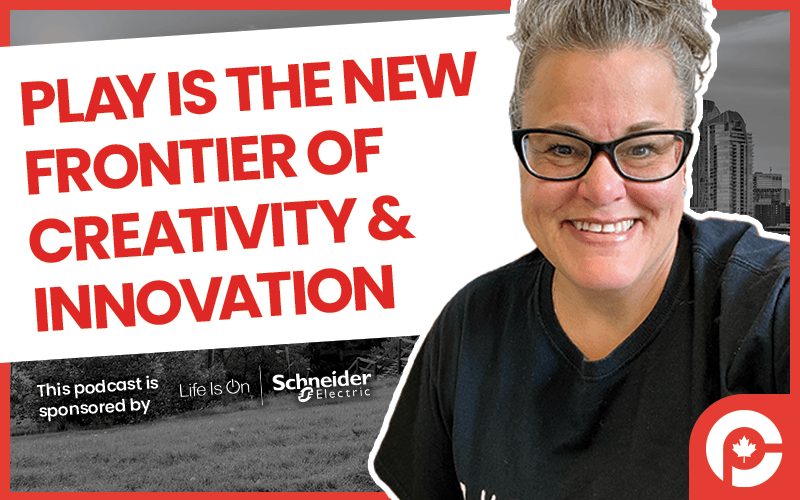
PLAY is the new frontier of creativity and innovation
Episode
Once upon a time, there was a little girl whose childhood was full of mud pies and leaf soup,...
Key takeaways
- Play is not frivolous but rather our most productive space where creativity, innovation, and problem-solving naturally emerge in both personal and professional contexts.
- Effective diversity and inclusion training requires moving beyond well-written policies to actually connecting people with the diverse strengths within their organization through experiential learning.
- Adding playful objects like ping-pong tables to offices misses the point—true workplace play comes from understanding what makes each employee feel engaged and allowing them to bring their whole selves to work.
- The loss of unstructured play in childhood now manifests as reduced resilience and inability to cope with change in adults, affecting how we navigate unknown situations in business and life.
- Sustainable organizational change requires more than one-time team building events—play must be integrated into Monday morning culture to create lasting improvements in engagement, retention, and loyalty.
Transcript
Full transcript page · Interactive episode
============================================================
TRANSCRIPTION WITH SPEAKERS
============================================================

[00:00] SPEAKER_01: Welcome to Canada's podcast.
[00:05] SPEAKER_00: This podcast is brought to you by Schneider Electric,
[00:09] SPEAKER_00: supporting Canadian businesses with innovative energy management and automation solutions.
[00:15] SPEAKER_00: Schneider Electric, your digital partner for sustainability and efficiency.
[00:20] SPEAKER_01: Hello and welcome to Calgary's podcast with Mario Tanaguzzi on Canada's podcast network.
[00:26] SPEAKER_01: Joining me today is Brandi Heather of Amt to play based out of Cochrane, Alberta.
[00:33] SPEAKER_01: She's the chief knowledge officer and founder of the company.
[00:36] SPEAKER_01: Thanks for joining us today, Randy.
[00:38] SPEAKER_02: Thanks so much for having me. I'm excited to be here.
[00:41] SPEAKER_01: Well, let me just start by asking you like what is Amt to play and what do you guys do?
[00:47] SPEAKER_02: Well, Amt to play was really founded on the idea that we needed to get back into our resilient
[00:55] SPEAKER_02: and creative innovative selves and opening up the conversation on diversity and inclusion,
[01:03] SPEAKER_02: change management. And so we were really looking at this process of how could we make a real
[01:09] SPEAKER_02: difference in the landscape for business and education and healthcare.
[01:13] SPEAKER_02: And so Amt to play designs, trainings and certifications and professional services for organizations
[01:23] SPEAKER_02: that are looking for the solutions to or the foundations for diversity and inclusion training
[01:30] SPEAKER_02: for taking a look at change management in these times of so much change in transition.
[01:38] SPEAKER_02: And we also have a product line. So that's our professional services.
[01:42] SPEAKER_02: We have a product line called Isolab Play, where we're actually trying to put play back into the
[01:47] SPEAKER_02: hands of children and families around the world. And so we have a product as well, a play box
[01:55] SPEAKER_02: that ignites play. But our main strategy is really taking a look at returning companies
[02:03] SPEAKER_02: to play, getting them back in play.
[02:06] SPEAKER_01: Well, let me just first of all a couple of factual stuff.
[02:10] SPEAKER_01: One did the start to company, Brandy.
[02:13] SPEAKER_02: The company was founded in 2017 and in 2018, I actually left teaching. I had been a college
[02:21] SPEAKER_02: professor for over 20 years and came to the business full time. And so yeah, we've been in place
[02:29] SPEAKER_01: since 2017. Okay, super. And can you talk a little bit about how it started and the why?
[02:37] SPEAKER_02: Why did you start this company? Well, it's interesting. My background is in disability inclusion
[02:46] SPEAKER_02: for 20 years I taught at the post-secondary level at Red Your College. I taught
[02:53] SPEAKER_02: how do we take coaching and nursing and sports science and all those pieces and actually get people
[03:00] SPEAKER_02: to be more inclusive in their practice by understanding first themselves. And for a long time,
[03:07] SPEAKER_02: I wondered what that strategy was that I was using that worked so well, so well received.
[03:13] SPEAKER_02: And I realized it was actually play that I actually brought people into play. And that's where
[03:19] SPEAKER_02: they did their greatest learning. And so I did some training and professional development
[03:29] SPEAKER_02: in play therapy and got my feet wet in that world. And I realized, oh my goodness, this actually
[03:36] SPEAKER_02: is transformational play can actually change how people interact with each other, how companies
[03:42] SPEAKER_02: interact with every part of their team from talent acquisition to human resources. And so the
[03:50] SPEAKER_02: company was developed by myself and and Ozzy Sawicki, who is a Hall of Fame, is in the Paralympic Hall of Fame
[03:59] SPEAKER_02: for for his work. He's an incredible business strategist. And together with the content and the
[04:07] SPEAKER_01: business strategy we created after play. So can you talk a little bit about some of the specifics?
[04:14] SPEAKER_01: Give me some examples of what kind of things can companies do in this area?
[04:23] SPEAKER_02: So one of our products is called policy to people. It was really designed to help companies take
[04:30] SPEAKER_02: these wonderfully well-written policy documents about everything from diversity and inclusion to
[04:39] SPEAKER_02: pre- you know processing their business. And all of these fancy documents and wonderful,
[04:44] SPEAKER_02: we need policy. But was the policy translating to the people that were using it? And so one of
[04:51] SPEAKER_02: the things that we do is a 21 hour course where we come in and work with a business and help them
[04:57] SPEAKER_02: to really get connected to their the diverse strengths of their organization. So we really build
[05:06] SPEAKER_02: people from creativity and innovation and help them to understand that that's actually a huge part
[05:13] SPEAKER_02: of how our company can strategize for profit and engagement and loyalty and retention. And so we
[05:21] SPEAKER_02: come and work with organizations in a couple of ways. That's just one that we come in and do a
[05:28] SPEAKER_01: policy to people course with your team. And I see your author of the book Return to Play.
[05:37] SPEAKER_01: I am. Right behind you there. What is the book about? And what's the best basic premise of the book?
[05:46] SPEAKER_02: So the book, the book for me was an opportunity to share with the world the real power that play has
[05:53] SPEAKER_02: to create change. And the book really takes a look at fundamentally how we interact with play in
[06:03] SPEAKER_02: our daily lives. We take a look at in the book we take a look at how in our personal lives when we
[06:10] SPEAKER_02: are feeling overwhelmed and scared how we actually resist play and we don't play very often.
[06:17] SPEAKER_02: And in our businesses that we do the same that when we are faced with enormous transition and change
[06:24] SPEAKER_02: that we we don't play. And let me just give a brief definition of that because I think people
[06:31] SPEAKER_02: always ask me like what do you mean by play? Like do we stop work and then we play and then we go
[06:36] SPEAKER_02: back to work and and play is really a space where we feel our most creative and capable cells. So
[06:46] SPEAKER_02: it doesn't it's a place where we choose what we choose the direction we're going we use our kind
[06:53] SPEAKER_02: of creative and innovative cells and we're free to do that. And so the question is are there moments
[06:59] SPEAKER_02: in our work day that we can actually put ourselves so that our play takes on some of the ass or our
[07:06] SPEAKER_02: work becomes some aspects of play or flow. And that's actually the main goal of the book is helping people
[07:14] SPEAKER_02: the question what can I do in my work that could be could also be considered play where I'm actually
[07:22] SPEAKER_01: bringing all of my full self to work. Yeah do you think as a society we've kind of lost our ability to
[07:32] SPEAKER_02: play? We have. And not just our kids I I talk in the book about our kids losing this ability to play
[07:39] SPEAKER_02: when we standardize and structure everything but we've actually done it in our in our business and
[07:45] SPEAKER_02: in our educational worlds as well. So often I think we have lost this ability play because we're so
[07:53] SPEAKER_02: focused on playing being this you know frivolous unproductive space but actually plays our most
[08:00] SPEAKER_02: productive space. And so making that shift it's a hard shift we have we have stopped playing for sure
[08:08] SPEAKER_02: and it's we're seeing all sorts of results of that we're seeing people unable to cope and navigate
[08:15] SPEAKER_02: things that are new and different and unknown to us. Can you yeah maybe elaborate a little bit more
[08:21] SPEAKER_02: on that the consequences of our loss of play. So we're really seeing it we're seeing it in our kids
[08:29] SPEAKER_02: and their ability to cope and be you know resilient when things are are different or changing and
[08:36] SPEAKER_02: I relate that to to people. So children's ability to cope with new and different environments and
[08:45] SPEAKER_02: people is actually reduced by the fact that we don't let them go out and play as freely as we
[08:50] SPEAKER_02: used to. You know you and I probably know that that we spent a lot of time in free unstructured
[08:57] SPEAKER_02: play when we were kids. Yeah. And we actually learned a ton of things from that. So that's actually
[09:02] SPEAKER_02: relating now to our adulthood. It's now it's now seeping into the way that we connect with other
[09:09] SPEAKER_02: people and try to to navigate things that are totally new to us or unknown and so it's a little
[09:17] SPEAKER_02: bit like traveling in a world where you're afraid someone's going to come out from around the
[09:21] SPEAKER_02: corner all the time and jump out and scare you and you're not really ready for that. So I feel like
[09:30] SPEAKER_02: that as we start to return to play just be a little bit more mindful that we need to let go and
[09:35] SPEAKER_02: and that the structure is it's there for a purpose but there's also place for this absolutely
[09:42] SPEAKER_02: unstructured space because that's where great solutions come from.
[09:48] SPEAKER_00: At Schneider Electric we empower Canadian businesses to utilize energy and resources efficiently.
[09:55] SPEAKER_00: Schneider Electric the future of energy.
[10:00] SPEAKER_01: You know I have a very strong sports background not that I was an athlete or anything but
[10:08] SPEAKER_01: as a journalist I spend a lot of time covering sports and you know from the minor level to the elite
[10:16] SPEAKER_01: level Olympics and and you know the people that I've talked to over the years the successful
[10:22] SPEAKER_01: business people I've talked to that had a sports background always referred to that sports background
[10:30] SPEAKER_01: as giving them the base for a lot of stuff right for things like teamwork things like resilience
[10:36] SPEAKER_01: you know things like setting goals and and and and learning how to to overcome obstacles you know
[10:44] SPEAKER_01: things like learning how to fail right because you 100% in every game right and so yeah we've got to
[10:53] SPEAKER_01: return to that so how do we do that like how do we you know change a society that you know I look at
[11:00] SPEAKER_01: you know I'm you know looking across my street now right and you know if I go back in time 30 40
[11:07] SPEAKER_01: years ago whatever when I was a kid I would be outside playing street hockey with my kids right now
[11:13] SPEAKER_02: I don't see anybody out there yep you'd be out there with every kid too like you that was the
[11:19] SPEAKER_02: thing I I think we need a strategy for that and and I think I have to play is set that strategy in
[11:26] SPEAKER_02: place so that we can start to talk about play as the absolute new frontier for creating not only
[11:37] SPEAKER_02: kids who are more creative and innovative and resilient and that are challenging risky situations
[11:44] SPEAKER_02: but also in our business lives where we're really challenging this standard sturdiness with
[11:51] SPEAKER_02: something that's different because we actually know that standard and sturdiness won't get us to
[11:58] SPEAKER_02: our potential standard and sturdiness won't get us to innovation and growth and and so
[12:06] SPEAKER_02: I think the first step is to really put play and fear in the same in the same box and be like we need
[12:15] SPEAKER_02: to not be so scared of something that is so powerful and we've lost it because the seriousness and
[12:24] SPEAKER_02: academic you know structure of what we do but if you look at sports for example none of us started
[12:32] SPEAKER_02: our sport life with the seriousness in which maybe we ended it we actually started a hundred
[12:39] SPEAKER_02: percent in play we love to do it we we did it because it made our bodies and our brains feel good
[12:47] SPEAKER_02: and so if I can come back to your sport illustration that's actually we need to start back into the
[12:53] SPEAKER_02: things that actually give us choice and and is a little bit risky and tell us who we are
[13:00] SPEAKER_01: do you think that's one of the reasons you know I look at a downtown category for example and then
[13:06] SPEAKER_01: maybe even out in the suburbs but offices right more and more you're seeing offices bringing in
[13:13] SPEAKER_01: kind of like a playful environment for employees you know there's foosballs and you know and
[13:20] SPEAKER_01: things like that in kind of amenities in office spaces that part of the reason why they're doing it
[13:29] SPEAKER_02: you know what um I have a real my thought on this is is that people are often bringing in playful
[13:35] SPEAKER_02: things because someone said to them if you bring in playful things employees will be happier
[13:41] SPEAKER_02: but we forgot to ask the employees like we forgot to ask people what would actually
[13:47] SPEAKER_02: make you feel like true belonging engagement in your job and oftentimes it's not a ping-pong table
[13:54] SPEAKER_02: a ping-pong table ends up being at you know a wonderful structure to store things on
[13:58] SPEAKER_02: because you didn't really ask people um so I'm trying to get organizations to really stop trying
[14:06] SPEAKER_02: to make it a thing like we don't need to bring in a foosball table or a ping-pong table what we need
[14:12] SPEAKER_02: is to find out how the people in our organization play how what they value what part of their work
[14:20] SPEAKER_02: really feels like oh my goodness I could do this part of my job forever like I love this part
[14:25] SPEAKER_02: and this is actually what I do outside of these walls too because that actually we know leads to
[14:32] SPEAKER_02: less absenteeism more retention right more loyalty all those things but yeah we want again we want
[14:40] SPEAKER_02: the standard and sturdy if I bring in a ping-pong table then I did the play thing and now I'm good
[14:45] SPEAKER_02: but I actually think the play is is actually in your people you know what is funny because I just
[14:52] SPEAKER_01: reminiscing about my days at at the Calgary herald and I remember working sports and sports
[15:01] SPEAKER_01: was primarily a night shift right and our staff used to use the plank in in in the newsroom right
[15:09] SPEAKER_01: I remember like the little you know those little footballs like those little soft footballs
[15:15] SPEAKER_01: and we toss them around all around the newsroom and stuff like that and I just remember those days
[15:22] SPEAKER_01: fondly and I just think a lot of that sense of play and I don't know spontaneity and
[15:30] SPEAKER_02: creativity is gone in in in workplaces and and it is and and actually if you think if you
[15:37] SPEAKER_02: walk into so many businesses right now if you see people in play at their job that you want to
[15:44] SPEAKER_02: be there it is a customer service experience for to be in a place where people really love what
[15:50] SPEAKER_02: they do and someone said to them you can bring your whole self to work um so that that's really
[15:56] SPEAKER_02: contagious and that's actually the movement we need to make that when when people feel good at work
[16:02] SPEAKER_02: mentally physically they can be in play and laugh and and do the things that actually you know
[16:08] SPEAKER_02: create an environment for productivity then that's created by people you have a winning solution
[16:17] SPEAKER_02: there but you've got to get your people back in play I'm going to throw something odd at you and
[16:23] SPEAKER_01: yeah yeah but I've often thought you know you know we send kids to to camps right and uh
[16:30] SPEAKER_01: where they're playing and doing all these sorts of activities often thought
[16:35] SPEAKER_01: why don't we do that with adults why don't we send a set up these these camps where Joe Blow
[16:42] SPEAKER_01: executive you know uh vice president or senior vice president of a company and the rest of his team
[16:49] SPEAKER_01: go to a camp for a weekend and just play and and can you imagine the psychological physical
[16:58] SPEAKER_02: effects of actually having a weekend in play with your organization um and and we we do that where we
[17:07] SPEAKER_02: just take people away as a group and as a team and people like say oh that's team building it is
[17:14] SPEAKER_02: partially team building but it's also getting people back um so that on Monday they feel
[17:22] SPEAKER_02: not only more like they belong in that space but now they're hugely motivated play is hugely motivating
[17:30] SPEAKER_02: and and so yeah I can we can take a team away for a weekend and make a real difference in how they
[17:38] SPEAKER_02: bonded connect to each other and and engage with each other in diverse and inclusive ways but
[17:44] SPEAKER_02: but the real proof is going to be on Monday when you still let that happen so I love the camp idea
[17:53] SPEAKER_02: but it also has to translate on Monday morning and that's for me that's the challenge I don't
[17:59] SPEAKER_02: want to create a training that's that's 20 you spend 21 hours with me and then uh you know
[18:06] SPEAKER_02: Monday nothing changes but what we find is you spend 21 hours um really getting to know people in play
[18:13] SPEAKER_02: and Monday morning is different your organizational culture changes
[18:18] SPEAKER_01: yeah exactly all right anything else uh Brandi you wanted to add uh no I really I appreciated
[18:25] SPEAKER_01: the opportunity today for sure okay super that was Brandi Heather who is chief knowledge officer
[18:32] SPEAKER_01: and founder of Amt to play based out of Cochrane Alberta she's also author of Return to Play
[18:39] SPEAKER_01: and this has been Calgary's podcast with Mario Tonoguzzi on Canada's podcast network
[18:45] SPEAKER_00: thanks for joining us today this podcast is brought to you by Schneider Electric supporting
[18:52] SPEAKER_00: Canadian businesses with innovative energy management and automation solutions
[18:57] SPEAKER_00: Schneider Electric your digital partner for sustainability and efficiency