
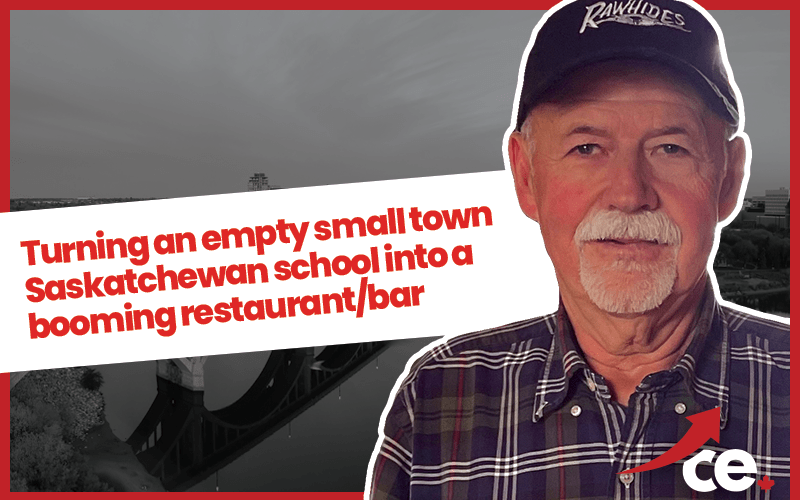
Turning an empty small town Saskatchewan school into a booming restaurant/bar
Watch episode
Episode
Doug Will, one of the co-owners of Rawhides Bistro & Saloon in Stenen, Saskatchewan, grew up on the family...
Key takeaways
- Taking on ambitious projects without knowing every detail upfront can be advantageous, as knowing all the challenges might prevent you from starting at all.
- Creating a unique destination experience through thoughtful design and attention to detail can draw customers from much farther distances than initially expected.
- Hiring international workers from diverse cultural backgrounds can enrich both the business operation and the customer experience while helping newcomers establish themselves in Canada.
- Converting a community landmark like an old brick schoolhouse into a themed venue helps preserve local heritage while meeting the community's need for gathering spaces.
- Combining multiple complementary businesses such as a restaurant, event center, spa, and accommodations in one location creates a comprehensive destination that serves various customer needs.
Transcript
Full transcript page · Interactive episode
============================================================
TRANSCRIPTION WITH SPEAKERS
============================================================

[00:00] SPEAKER_01: Welcome to Canada's Entrepreneur, where we talk to the entrepreneurs who are making it happen
[00:05] SPEAKER_01: across Canada and deliver the news, trends, knowledge and opinions from entrepreneurs and business
[00:13] SPEAKER_02: influences across the country. Hello, I'm Mario Toneguzi, managing editor of Canada's Entrepreneur,
[00:21] SPEAKER_02: joining me today on Saskatchewan's podcast is Doug Will, who is one of the owners of Raheid's
[00:27] SPEAKER_02: Beastro and Saloon in Steenon Saskatchewan. Thanks, Doug, for joining us today. You're
[00:34] SPEAKER_02: about. It's an honor. Okay, well thanks, and maybe if you could start off by just giving us a little
[00:41] SPEAKER_02: history of how this concept and business started and began in Steenon. Well, yes, I guess we
[00:52] SPEAKER_00: were farmers. We farmed all of our lives, and of course we have an L-Felpha meal down the road,
[00:58] SPEAKER_00: and so we would go buy the Steenon, and it was an old King George Hotel, which stopped
[01:04] SPEAKER_00: there on a Thursday for a wing in a beer. And you know, these old hotels and these communities
[01:09] SPEAKER_00: are getting pretty old and fragile, and lots of them are kind of burning down. And anyways,
[01:14] SPEAKER_00: this one was for sale, and we thought about trying to keep it going, and it actually burnt down.
[01:21] SPEAKER_00: But the community was having a hundredth anniversary, and school in town had been shut down for
[01:29] SPEAKER_00: some years, a brick schoolhouse. And so the community had asked if we'd be interested in maybe
[01:36] SPEAKER_00: developing since the old King George has gone, developing a new Beastro and Saloon that could
[01:42] SPEAKER_00: kind of replace it. So I guess when you're farmed as long as I have, you get tired of looking
[01:48] SPEAKER_00: at dirt, and you think, well, hey, maybe I could do something else with my life. And I've always
[01:53] SPEAKER_00: kind of collected antiques and did some wood carpentry and re furnishing, re finishing stuff. So
[02:00] SPEAKER_00: interested in that sort of thing. So we thought, hey, this would be kind of maybe a fun project.
[02:05] SPEAKER_00: We weren't restaurant people, and we had no idea what was involved. But we took it on, and like I
[02:13] SPEAKER_00: say, it was about a hundred days when we took over the place to the hundredth anniversary celebration
[02:19] SPEAKER_00: along weekend in August. So we got all the carpenters and people together, the plumbers and
[02:28] SPEAKER_00: electricians, and said, okay, we got 90 days to put this place together, and everybody worked,
[02:34] SPEAKER_00: and the town was very supportive. And we started at one end of the building just coming up with ideas
[02:39] SPEAKER_00: and designs. And the good news is the Brick Schoolhouse is quite unique. And so we basically kept
[02:46] SPEAKER_00: the theme was, well, let's go with an old western town. And the hallway would turn into like the old
[02:53] SPEAKER_00: town main boardwalk. And we'd have each classroom would be a little different business in the old
[03:01] SPEAKER_00: western town. And so that was kind of the concept. And we started at one end and one classroom
[03:07] SPEAKER_00: as the library, you know, where the horses would be staged. And of course, that was a needing area.
[03:13] SPEAKER_00: And the next place was the jail. And so we had to fix up kind of a jail theme and the sheriff's
[03:19] SPEAKER_00: office was, of course, the office. So originally it was supposed to be a bar and a, you know, for rings
[03:25] SPEAKER_00: and a beer, but the building was so huge. We got partway through and thought, oh my goodness, we
[03:31] SPEAKER_00: better do something in addition. So we thought, okay, let's turn it into a restaurant and get some
[03:36] SPEAKER_00: kitchen equipment and develop a full scale restaurant. So that's kind of what we did. And I
[03:42] SPEAKER_00: guess the rest is history. We opened up a week, but a week ahead of time and started raw hides
[03:49] SPEAKER_02: beach, stone, and so what year was that 2012 2012. Now, after you, you'll open the restaurant
[04:01] SPEAKER_02: side of things, you've also added other businesses there. Can you explain what they they are?
[04:06] SPEAKER_00: Yeah. So in we had the restaurant and we realized that it was kind of a destination place.
[04:15] SPEAKER_00: And we should have an event center, a little larger for holding corporate events and especially
[04:21] SPEAKER_00: weddings and that sort of thing. So we developed an event center kind of on the theme of equestrian
[04:29] SPEAKER_00: barn from down east. So it's got the vaulted ceilings and we then built the outdoor deck
[04:39] SPEAKER_00: doing clothes, all of this. Outdoors, it's kind of an axiomorun, but and so that we could hold
[04:46] SPEAKER_00: wedding, we did that in 2015. And so it's been very popular in terms of wedding events and some
[04:54] SPEAKER_00: corporate events. And and that kind of added a dimension. The plan originally was to do that and
[05:01] SPEAKER_00: maybe have a spa and have some sweets or people could rent. So in two years ago, we then added the
[05:11] SPEAKER_00: spa, where we do here, beauty salon and esthetician manicure, pedicures, massage therapy. It's all
[05:23] SPEAKER_00: kind of on the same theme. So I love to work with WID. So we used hardwoods in this spa,
[05:29] SPEAKER_00: Elm and and blood maples on the vaulted ceilings and some stonework. And it all encompasses the
[05:37] SPEAKER_00: the outdoor outdoor venue that we got a stage there for outdoor events. And we also have
[05:49] SPEAKER_00: fire pits in the center and different colored sand. So we have black sand, white sand, red sand,
[05:55] SPEAKER_00: yellow sand is a kind of a unique aspect and kids can play with the toys in the sandbox.
[06:03] SPEAKER_02: Now when you look, you look back at things, you surprised at how successful this has become.
[06:11] SPEAKER_00: Yeah, to be honest with you, from an economic point of view, when we started, it probably didn't
[06:17] SPEAKER_00: make good sense to build something of this magnitude in a small community. And lots of
[06:25] SPEAKER_00: customers over the years have said, wow, this should be in Saskatoon or Calgary or some,
[06:31] SPEAKER_00: how does this work? And the reason that it works is because number one, the local people,
[06:40] SPEAKER_00: communities around, we're kind of looking for a meeting place. Most of the old hotels that kind of
[06:44] SPEAKER_00: dilapidated are gone. And so they were kind of looking for a place where people could meet and
[06:49] SPEAKER_00: have an ice meal and visit. And number two, of course, interesting for the broader picture in
[06:57] SPEAKER_00: terms of people coming from afar to spend some time or a destination place where close to three
[07:04] SPEAKER_00: lakes, you know, with golf courses. And I guess when we were doing the thought process, we thought,
[07:10] SPEAKER_00: well, people would probably travel up to an hour, an hour and a half to come for a nice
[07:14] SPEAKER_00: mind-dining experience. And so we drew a circle around the map of Stienen and we'd figured there
[07:19] SPEAKER_00: was maybe enough people to support it. But interesting enough, we get many, many people from
[07:26] SPEAKER_00: two, two and a half hours drive, Regina Saskatoon, Malford in Manitoba, Roblin,
[07:36] SPEAKER_00: well, and just they're traveling through, they heard of the place, you know, and we had a couple
[07:41] SPEAKER_00: on Valentine's Day, just behind where I was sitting, young couple that was kind of storming out
[07:46] SPEAKER_00: before Valentine's Day and they'd come from Carlyle, I think about two and a half hour. And I said,
[07:51] SPEAKER_00: you've been here before and they said, no, he just bought his girlfriend here, he was going to
[07:54] SPEAKER_00: buy, was her birthday and Valentine's Day and I said, you drove two and three quarter hours to get
[08:00] SPEAKER_00: here and you got two and three quarter hours drive home and you just came to the raw hides for dinner
[08:04] SPEAKER_00: and he said, yeah, so I said, well, I tell you, I sure hope we don't disappoint in the kitchen. So
[08:10] SPEAKER_00: you laughed, he said, no, the food was great and the service, and he just loved the place,
[08:14] SPEAKER_00: so he said, they'd be back. So I guess that's kind of, you know, that's the part that makes us feel
[08:20] SPEAKER_00: good, that it's kind of some way it's worked out. Mm-hmm. Yeah, you mentioned, you know, where it's
[08:28] SPEAKER_02: located in a small town, but it's also off the beaten path, off the highway and
[08:35] SPEAKER_02: how do you find staff and get staff to operate? Because it's obviously a big place and quite busy.
[08:44] SPEAKER_00: Yeah, so yeah, and it's, we never realized that, you know, like I say, we weren't restaurant people,
[08:52] SPEAKER_00: we didn't realize the success, we didn't realize the amount of staff we'd need, we'd started
[08:57] SPEAKER_00: by advertising for Red Seal Chef, and so we got one from Toronto that came out here and the ad said
[09:03] SPEAKER_00: that we wanted somebody to develop the kitchen. We'd buy the equipment, we didn't know what to buy,
[09:09] SPEAKER_00: so the first chef, Chris Saladad, came out and excellent. He was even a carpenter, so he helped
[09:16] SPEAKER_00: us build the place a little bit. And excellent chef and great, great menu items and beautiful
[09:24] SPEAKER_00: presentation. I asked him, I said, well, why would you come for Toronto to a little community of
[09:30] SPEAKER_00: Steenham? He said, well, Doug, every chef's dream is to have the ability to develop their own
[09:36] SPEAKER_00: kitchen with brand new equipment. He said, he surprised that how many big restaurants have like
[09:41] SPEAKER_00: old equipment in the kitchen, so he said, I could buy anything I wanted and I could set it up,
[09:46] SPEAKER_00: and he said, I just loved doing it. And so I think that the culinary experience that people have
[09:52] SPEAKER_00: is helping to wear to mouth, have people from near and far come and join us for some of those
[09:59] SPEAKER_00: exquisite taste. So we've had a couple of head chefs since that time and added different menu
[10:03] SPEAKER_00: items to our menu, but it certainly has done us done us well. And like I said, the snowmobile,
[10:11] SPEAKER_00: right on the snowmobile traffic in the winter time and motorcycles in the summertime, we get lots of
[10:18] SPEAKER_00: motorcycle groups coming in as a destination. We got a big campground, so we can fill out up with
[10:25] SPEAKER_00: RVs. And so what it just like I said, it was partly a lot had to do with luck. And I guess we
[10:33] SPEAKER_00: were building it. The key is to lots of antiques and things to look at, right? We've got some metal
[10:38] SPEAKER_00: metal guys at the home business serving and you asked about the staffing. The interesting part is
[10:45] SPEAKER_00: a lot of our staff is foreign people. We have interesting old schools where we were learned about
[10:53] SPEAKER_00: the different cultures around the world, different nationalities. And in here in this little
[10:58] SPEAKER_00: brick schoolhouse, we have like seven different nationalities from seven different countries,
[11:04] SPEAKER_00: including some locals as well. But from Europe, we got from Belgium, we got from the Middle East,
[11:12] SPEAKER_00: from Persia. We have customers, we have workers or servers or employees from Bangladesh, from India,
[11:20] SPEAKER_00: from the Philippines. And so it from all different walks of life and all different cultures. And
[11:29] SPEAKER_00: that brings another experience to our customers. They love to talk to the people that have brought in
[11:35] SPEAKER_00: international perspective to life in the world and went over wells. It's just a beautiful
[11:43] SPEAKER_02: feeling watching that happen. So how do you get to come out there as I said, to a small town?
[11:54] SPEAKER_00: Yeah, so that's interesting. We have some people from the Ukraine that are working here and they
[12:00] SPEAKER_00: came from a small community in the Ukraine. So they feel ready to home and our community here was
[12:05] SPEAKER_00: based originally populated by Ukrainians and Russians. And so some of them still speak the language.
[12:12] SPEAKER_00: So the Ukrainian people that are employed here, they're kind of excited because they can talk
[12:16] SPEAKER_00: in their language to some of the customers, right? Other people have come from the cities and so
[12:21] SPEAKER_00: we're kind of a stepping stone, right? Part of their process of being a residency to Canada.
[12:28] SPEAKER_00: And so it, you know, we feel good about the numbers of individuals and couples that we've
[12:34] SPEAKER_00: helped support that go on to other places after they get their residency and enjoying their work for
[12:40] SPEAKER_00: us and our good tax paying citizens and raised families. So, you know, we're pretty happy about that.
[12:46] SPEAKER_00: And we certainly get some local people as well, but it's tough finding people wanting to work in
[12:54] SPEAKER_00: the service industry and so we got to compete with other businesses as well. And yeah, for people,
[13:00] SPEAKER_02: for people coming from elsewhere, do you provide like accommodations or because imagine, you know,
[13:07] SPEAKER_00: there's not too many rentals in steam, right? Yeah, so we have some, we, we, we, we purchase some
[13:14] SPEAKER_00: housing from people retiring and moving to Biggastasia. We turn them into sweet so we can, you can just
[13:21] SPEAKER_00: come here, you can spend a funny evening and you can rent a street, a suite and just walk across the
[13:27] SPEAKER_00: street and you've got accommodations. We also have a large campground. So people bring their RV
[13:32] SPEAKER_00: and they'll spend a few days and or chanting and that sort of thing. So that adds another
[13:38] SPEAKER_00: element to the summer camping experience for the folks. And like I said, we're kind of surrounded
[13:44] SPEAKER_00: by about four pretty good lakes, which brings lots of traffic from lots of the major centers.
[13:51] SPEAKER_00: Plus people here then can camp here and stay here and then go golfing somewheres and
[13:56] SPEAKER_00: come back for for evening and for for dining experience. So that all works out. Yeah. So tell us
[14:05] SPEAKER_02: a little bit about yourself. Where did you grow up, Doug? But I grew up in a little town called
[14:12] SPEAKER_00: New Osgood, which was named after Old Osgood in Ontario, which is northeast of Tisdale. Okay.
[14:20] SPEAKER_00: And was raised on the family farm and of course, farmed all my life, first with my, my dad and
[14:25] SPEAKER_00: brothers. And and then later with my two of my sons, I got three sons and two of them are farming
[14:32] SPEAKER_00: with me. The third one has a business in Saskatoon. And about 25 years ago moved from the Tisdale
[14:40] SPEAKER_00: Malford area down to Stenen. And we actually as well have a Elfalfa processing plant that we produce
[14:48] SPEAKER_00: Elfalfa pellets for soil nutrition and fertilizer. And we farm grains and oil seeds and
[14:55] SPEAKER_00: then this restaurant's kind of an addition to all that. So it's going to keep just hopping.
[15:00] SPEAKER_02: Yeah. I can imagine. Yeah. What what did you farm? What was the family farm?
[15:07] SPEAKER_00: Yeah. So we in on the family farm at home, of course, we always raised cattle and grain.
[15:13] SPEAKER_00: You know, we'd do wheat and barley and and oats, you know, and Elfalfa, we'd bail up hay and
[15:19] SPEAKER_00: and for the cattle in the wintertime, you know, and and dad had maybe a hundred cows. And so we'd
[15:24] SPEAKER_00: be part of that operation and and everything else, you know, we'd buy high and sell low and then go
[15:31] SPEAKER_00: to business there. That was that was a tough part of farming. And so we kind of evolved into more
[15:38] SPEAKER_00: grain farming. So yeah. That's kind of what we what we do. What do you think from that farming
[15:45] SPEAKER_02: background, you know, you learned about being a business person? Well, if first thing is hard work.
[15:54] SPEAKER_00: You know, you don't you come up with a plan or a dream and you never know what it's going to take
[16:02] SPEAKER_00: to complete that. If we knew what it was going to take to finish the project, we'd probably never start.
[16:08] SPEAKER_00: So like the farm, whether you're building corrals or whether you're building, you know, you're
[16:12] SPEAKER_00: never quite sure, but you have a plan, you have a dream and you'd put the work in to get it done.
[16:16] SPEAKER_00: And in the same with the mill and I guess the same with the restaurant. Looking back, I can't
[16:23] SPEAKER_00: imagine if we knew everything we had to do to make this successful, we might have got scared right
[16:30] SPEAKER_00: off the bat and not done it. I think a lot of people have good ideas and great ideas, but they get
[16:35] SPEAKER_00: stopped by not taking that next great big step. So I think if you can try to see the end result.
[16:45] SPEAKER_00: And once you get started, you can't back up, right? You can't have a job half done. So then
[16:51] SPEAKER_00: you're committed and then you just go for it. So that's the one thing. And the second thing is that
[16:57] SPEAKER_00: you know, we learned some of the simple things in life and we don't need everything high tech. And so
[17:02] SPEAKER_00: part of our restaurant is antiques and and old and stuff that people enjoy looking at. And
[17:10] SPEAKER_00: and you know, the bars we made, we could tell you stories for hours about how we got these big
[17:15] SPEAKER_00: wooden bars and we put I'm a coin collector. So I got antique coins and we put the
[17:21] SPEAKER_00: holiestor lacquer over top. So it's kind of interesting for people to look at that. Oh, look at
[17:25] SPEAKER_00: the different coins. You know, and yeah. So we've got, you know, so there's all kinds of things that
[17:33] SPEAKER_00: you know, people can look at. We got a kids room for the kids to play and you know, we got
[17:37] SPEAKER_00: a in one of their cool registers. We developed, we got a pretty good fabricating team at the
[17:43] SPEAKER_00: mill. So we we made a metal cap in the mouse and they're hiding in the register in a leprechaun. And
[17:48] SPEAKER_00: so the kids come and they if they find those articles in the restaurant, they get a treat. So it
[17:54] SPEAKER_00: it, you know, the parents come and the kids got something they can keep busy at. Well, the parents are
[17:59] SPEAKER_00: doing socializing a little bit and and not too many restaurants maybe have that that aspect in
[18:05] SPEAKER_00: terms of trying to create a family a family venue. We got a tennis or volleyball court outside. So
[18:12] SPEAKER_00: the kids can go play volleyball if they want. So it is kind of a whole family entertainment thing
[18:19] SPEAKER_02: that's well, and it kind of works, right? Yeah. Do you think you ever replicate this in maybe
[18:28] SPEAKER_00: another small town? Well, I tell you, people have asked that, but we're probably, I think the
[18:36] SPEAKER_00: total encompasses like seven or eight, the 10,000 square feet. So it's a huge. And to put something
[18:43] SPEAKER_00: like this inside of a city would be astronomical and cost. And you know, the food is quite
[18:52] SPEAKER_00: is terrific, but I think our success has got to do as well with the venue itself. The sites to see
[18:59] SPEAKER_00: where you're here, the magnitude of the place. Yeah. I think it's hard to maybe replicate the same
[19:04] SPEAKER_00: thing here, but you know, I guess people have always asked me, well, what about having it here,
[19:10] SPEAKER_00: having one there? And, and you know, we've considered that. And I would never say never. If the right
[19:17] SPEAKER_00: opportunity comes along. And like I said, I think that we kind of know how it works now and what to do.
[19:23] SPEAKER_00: And we're not really restaurant people yet, but we're getting closer. We probably could replicate it
[19:29] SPEAKER_00: and partnership or franchise it out or something. That's a possibility.
[19:35] SPEAKER_02: Okay. Wonderful. Well, thanks Doug for taking the time today.
[19:41] SPEAKER_00: You're bad. So always a pleasure and sharing our experience. And hopefully welcome more customers
[19:47] SPEAKER_02: to Rohit's Beastro in Sloan. All right. That's Doug Well, who is one of the owners of Brahides,
[19:55] SPEAKER_02: Beastro in Saloon in Stine and Saskatchewan. I'm Mario Toniguzi, Managing Editor of Canada's
[20:01] SPEAKER_02: Entrepreneur. Thanks for joining us today.