
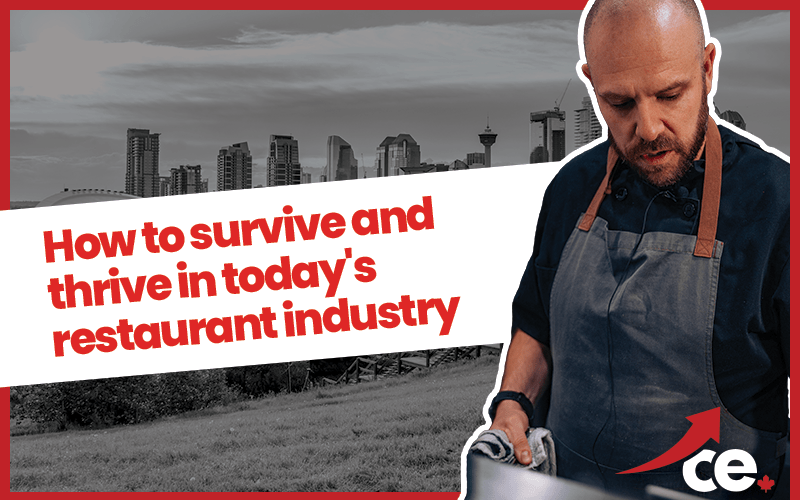
How to survive and thrive in today’s restaurant industry
Watch episode
Episode
Ryan Blackwell is a Calgary chef and restaurateur known for concept-driven menus and polished, approachable cooking. Raised in Cochrane...
Key takeaways
- Restaurants must stay moldable and strip away ego while remaining true to core values rather than getting distracted by every new trend or competitor in the market.
- Successful restaurant concepts require thorough marketplace testing before full commitment, including getting customer feedback on brands and carefully evaluating location costs to avoid being set up for failure.
- Chefs need strong support systems and work-life balance to handle the mental demands of the industry, including managing the constant highs and lows of service and avoiding unhealthy post-shift habits.
- Value in restaurants extends beyond price point to encompass consistency in every aspect of the experience, which requires unified team messaging and belief in the brand.
- Pop-up concepts serve as valuable testing grounds to gather real customer data and refine brands before making permanent commitments or pursuing multi-location expansion.
Transcript
Full transcript page · Interactive episode
============================================================
TRANSCRIPTION WITH SPEAKERS
============================================================

[00:00] SPEAKER_00: Welcome to Canada's Entrepreneur, where we talk to the entrepreneurs who are making it happen
[00:05] SPEAKER_00: across Canada and deliver the news, trends, knowledge and opinions from entrepreneurs and business
[00:13] SPEAKER_01: influences across the country. Hello, I'm Mario Taniguchi, managing editor of Canada's Entrepreneur.
[00:22] SPEAKER_01: Joining me today on Calgary's podcast is Ryan Blackwell, who is culinary director and partner
[00:27] SPEAKER_01: at Olya Restaurant in Calgary. Thanks for joining us today, Ryan. Thanks for having me.
[00:33] SPEAKER_01: I appreciate the call. Okay, let's talk a little bit about the restaurant itself and the concept.
[00:41] SPEAKER_01: What differentiates this concept compared to see all the other restaurants out there?
[00:49] SPEAKER_02: Yeah, I mean, it's a competitive market. It's always battling new restaurants and great entrepreneurs
[00:57] SPEAKER_02: and lots of good visionaries. So, you know, it's hard to say exactly when you hit it correctly
[01:04] SPEAKER_02: on if you can entertain all the customers out there. And that's obviously always the intention.
[01:10] SPEAKER_02: So when we're building these brands, we don't leave any stone unturned as best we can and
[01:16] SPEAKER_02: try and test our marketplace where we can to see what people need. So, you know, we built Olya,
[01:22] SPEAKER_02: the conversation was to have something that was upscale casual, but felt like it could be
[01:28] SPEAKER_02: everyday and everyday Olya is kind of the term we use. In a sense of we didn't want anything to
[01:35] SPEAKER_02: be too pretentious. We wanted it to be approachable, but we wanted it to have deep roots and
[01:41] SPEAKER_02: understanding of clear brand direction for people to understand, you know, what our core values are
[01:46] SPEAKER_02: and what we need to bring to the marketplace to kind of entertain that to people. So, you know,
[01:51] SPEAKER_02: Olya was simply named as a Latin word for all of. It's the genus name that includes all of tree.
[01:58] SPEAKER_02: So, deep roots within the Mediterranean cuisine. The idea of Mediterranean for us would
[02:04] SPEAKER_02: not be too broad across the Mediterranean spectrum and really trying to hone in of Western Mediterranean
[02:11] SPEAKER_02: being, you know, Italian, French, Greek, a little bit Spanish, even some Moroccan if we wanted to
[02:20] SPEAKER_02: on that side where we can really pull great ingredients and really have food that residents of people.
[02:26] SPEAKER_01: So, tell me we're first of all before I forget when did the restaurant open?
[02:32] SPEAKER_02: We've been in November 2022, so we're coming up on three years.
[02:36] SPEAKER_01: Okay. So, tell me just a little bit about sustainability and where sustainability,
[02:43] SPEAKER_01: sustainability, sorry, fits into all this.
[02:47] SPEAKER_02: Yeah, I think that's an ongoing conversation and seeing what's available to us, right?
[02:51] SPEAKER_02: And in a tricky marketplace of costs and cost to operate, especially within Canada,
[02:59] SPEAKER_02: you know, we have to be very selective on what we choose and where we pick from.
[03:03] SPEAKER_02: For a couple of reasons, one, you know, longevity, of us being able to get those products.
[03:08] SPEAKER_02: And if they're ever changing and to price point to that makes sense to our guest.
[03:14] SPEAKER_02: So, being sustainable comes from the farmer, comes from our suppliers,
[03:20] SPEAKER_02: and seeing what we can partner with on people to make sure that we have those roots in
[03:25] SPEAKER_02: and it continued valued effort put forward for the guest.
[03:28] SPEAKER_02: For a consistency level otherwise, we're becoming a place that is constantly turning over
[03:34] SPEAKER_02: key ingredients or key dishes, which we didn't really want to do for our patrons.
[03:39] SPEAKER_01: Yeah, and when you look at, you know, in the food industry these days and
[03:44] SPEAKER_01: things like the tarot, South, there and all that stuff is, is this forest, not so much forced you,
[03:51] SPEAKER_01: but made you look closer to home when looking for suppliers of food?
[03:58] SPEAKER_02: Yeah, well, again, within reason. If we could pull everything from a hundred-mile diet, we would
[04:05] SPEAKER_02: just, you know, how much focus and energy we put and financial aspect into that to be able to do
[04:12] SPEAKER_02: with the producers. We do within reason, right? And yes, tariff, all that stuff too, right?
[04:18] SPEAKER_02: It's, you we can't control the outcomes of that.
[04:21] SPEAKER_02: Our suppliers are obviously ever changing too in those efforts.
[04:25] SPEAKER_02: And what we're trying to do, but yeah, there's always a conversation at the table of saying,
[04:29] SPEAKER_02: how far are we going to get the product? And is that product necessary for our menu?
[04:33] SPEAKER_01: For what too far? Yeah, what is it taking? You know, when you mentioned it earlier,
[04:37] SPEAKER_01: you just about the number of brands that are out there in concepts and there seems to be a
[04:45] SPEAKER_01: restaurant opens every day in Calgary, but on the other hand, there's one or two that
[04:50] SPEAKER_01: closes every day as well, right? So what does it take in this day and age for a restaurant to be
[04:57] SPEAKER_02: successful in those in that environment? Yeah, I wish I had the magic once and I would have
[05:04] SPEAKER_02: to tell you that. This is a constant conversation amongst our partners. You know, we're all restaurant
[05:09] SPEAKER_02: tours, background, check background, some not-shut background, and we have multiple properties,
[05:16] SPEAKER_02: and we're all invested in different companies. And so it's a unique situation that will lay us.
[05:20] SPEAKER_02: We have a lot of data from our partnership to kind of have these open discussions.
[05:24] SPEAKER_02: And number one, it's like you got to be moldable in our opinion, meaning like we try and strip
[05:29] SPEAKER_02: the ego out of it and the pretentiousness out of it and say let's not get distracted by the
[05:33] SPEAKER_02: distractions. I think customers even naturally can be distracted because there's just so much
[05:39] SPEAKER_02: marketing coming at them all the time and what's the hot new ticket out there? And you know, so you
[05:44] SPEAKER_02: see that bounce around a lot. And not so just trying to stay okay, what's our values? Let's stay
[05:49] SPEAKER_02: true to our values, let's stay true to our training, understand the people that we're bringing in
[05:53] SPEAKER_02: to believe in our brand, to service our guests, we're all united and make sure that that common
[05:59] SPEAKER_02: messaging to people is there to keep consistency at a high. Without consistency, there's no value,
[06:06] SPEAKER_02: you know, to me, value is not just measured in capital or how much money you want to spend,
[06:11] SPEAKER_02: but it's measured in, you know, it might start with that, but peel away the layers, it's like
[06:15] SPEAKER_02: what's everything that adds up to that dollar amount. So, you know, open discussion and just
[06:20] SPEAKER_02: trying not to be distracted by everything that's happening around you. So tell me, you know, when
[06:25] SPEAKER_01: you're looking at the business side of things, what's the biggest challenge as a restaurant owner
[06:32] SPEAKER_02: you face these days? A combination thing, one is like, you know, is the brand right? Have we tested
[06:39] SPEAKER_02: it in the marketplace? You know, we started to do that with other brands right now, we're just
[06:45] SPEAKER_02: you know, not come up with the name and what we think needs to be in the public, but let's try
[06:50] SPEAKER_02: things where the public can give us feedback before we're fully committed, right? It's because there's
[06:55] SPEAKER_02: so many different opportunities of brands coming up. Other ones, you know, we have constant
[07:00] SPEAKER_02: commons for station on his location, right? Like how busy is the street? Is there parking
[07:04] SPEAKER_02: accessibility? Is it, you know, people able to walk or not walk? It's not always the main driving
[07:09] SPEAKER_02: factor, but it does play a role for sure. Yeah. And you know, just again, to reiterate too, it's,
[07:18] SPEAKER_02: you know, the branding specs are they correct? And if they are, and they feel right in the public
[07:24] SPEAKER_02: feel right, then the last piece is like on that location's, you know, specific situation. Are we
[07:30] SPEAKER_02: in a situation where we put the restaurant in good spot on a cost wise to take that space?
[07:35] SPEAKER_02: Because sometimes I think that restaurant chairs, including me in the past two, you get so
[07:39] SPEAKER_02: fixated on like that location is so good. I can't wait to put this brand there, but you know,
[07:45] SPEAKER_02: half a degree off. I always say it's death by a thousand paper cuts, right? This is one thing
[07:50] SPEAKER_01: that might hurt you. Yeah, you know, it's kind of funny, right? Because I often think of certain
[07:55] SPEAKER_01: locations in in Calgary and over the years, I drive by them and I go, oh, that place is closed now.
[08:04] SPEAKER_01: And you go like, like there's something almost like some places are cursed right.
[08:10] SPEAKER_01: Kind of what is behind it all. So I'm curious. From your background, how did you get into it all
[08:19] SPEAKER_02: this? Yeah, I mean, started a young age. I grew up in Cochran, Alberta. I grew up on a farm.
[08:26] SPEAKER_02: A hay farmer. My mom's an artist. So I was like to say, I met in the middle.
[08:33] SPEAKER_02: I was a small town kid that wanted to experience big city things. And I hadn't really done that.
[08:40] SPEAKER_02: So I had a friend that started working at Earl's. How was he? 2001? I was like, hey, come
[08:46] SPEAKER_02: try this out. So I did. And I had my driver's license and 16. I went through the whole process of
[08:51] SPEAKER_02: that. And it was, you know, I think for me, as I've always chased high-paced things. And that
[08:58] SPEAKER_02: at a young age was like, oh, wow, this is a really high-paced environment that you need to kind of
[09:03] SPEAKER_02: execute at a quick speed. So, you know, it was deep roots in me at a young age. I kind of got caught
[09:08] SPEAKER_02: into that. And then from there, you know, throughout high school, I stayed with it. And I went to
[09:13] SPEAKER_02: culinary school. I ended up going into SAID and graduated PCK in 2005 with Merida C.
[09:20] SPEAKER_02: That was an amazing program that just kind of strengthened my love for food, food and beverage,
[09:25] SPEAKER_02: and just hospitality in general. And then from there, you know, like just close notes for real
[09:31] SPEAKER_02: quackets, it was just like, I didn't think Calgary had what I needed to really grow myself at that
[09:38] SPEAKER_02: stage. I think Calgary really broke out starting in 2010-ish, where you started seeing some really
[09:43] SPEAKER_02: big restaurateurs and great chefs come into the city and everybody started to push. So I went
[09:48] SPEAKER_02: out to Vancouver and situated myself in 2007 for the Olympics out there and worked for some really
[09:53] SPEAKER_02: big, one really big company in general. And it just totally set me on the right direction at
[10:00] SPEAKER_02: our early age to become a young chef in my young 20s. Oh, cool. It's not an easy profession to be in,
[10:07] SPEAKER_02: right? No, you got to have the patience. I mean, it's ever changing. I mean, a lot of things
[10:12] SPEAKER_02: are these days. Technology plays a factor for sure. But you, the thing is, you know, if you don't
[10:20] SPEAKER_02: have a passion for it, don't do it. I always tell people like, you got to enjoy it. You got to
[10:24] SPEAKER_02: understand what the rush is about. You got to like that creativity piece. You know, if you want to
[10:28] SPEAKER_02: become a chef, you got to expose different hours of your life to be able to do it, right?
[10:32] SPEAKER_02: They were catering to people at times where people are off. Those are our peak hours, right? And
[10:38] SPEAKER_02: night time, weekends, holidays, you know, so if you can remove that and commit, you can make a run
[10:46] SPEAKER_02: out of it, but you've got to be dedicated to your craft. And from there, you can have a successful
[10:51] SPEAKER_02: career and you can be an entrepreneur within that spill too. So a personal story here. So last year,
[10:59] SPEAKER_01: I remember it was at a stampedeers game and I sat beside a guy who was a chef and he was a chef
[11:07] SPEAKER_01: and a couple of prominent establishments in the city. And then he started to tell me how
[11:16] SPEAKER_01: how devastating kind of life has been over the last since COVID. And the number of chefs that
[11:24] SPEAKER_01: he knew that committed suicide in that period. Like, what, you know, can you talk a little bit about
[11:33] SPEAKER_01: that stress and in the industry and, you know, what the chefs need to do, I guess, to get through that?
[11:42] SPEAKER_02: Yeah, I mean, you got to have a good support system, in my opinion, right? I think that a lot of
[11:46] SPEAKER_02: chefs, especially in their young years, can get caught up in the industry, meaning like it's such
[11:51] SPEAKER_02: as social environment, you know, even, you know, in my 20s to post work, you would work, you know, 12
[11:56] SPEAKER_02: to 14 hours sometimes back in the early days. I, I influenced my books and chefs never to do that
[12:02] SPEAKER_02: anymore. The industry started to change. So you're not. Some people are. But you get into an
[12:07] SPEAKER_02: overworked environment mentally for the grit. You have highs and lows. There's different, you know,
[12:13] SPEAKER_02: I like to call them gears throughout the day, whether you're prepping, you're going into service,
[12:17] SPEAKER_02: you're recovering, you're going back into another service. So there's a lot of like highs and lows
[12:21] SPEAKER_02: just throughout a daily period. Yeah, we, you know, services started 11 no matter what. If you're
[12:27] SPEAKER_02: a downtown Calgary, you're going to go sort of 250 people in 45 minutes. It's like, how can you
[12:32] SPEAKER_02: produce that? Then you got to come down. And then at night time again, you got to ramp back up.
[12:38] SPEAKER_02: So, you know, in this Toronto Vancouver Calgary rate, we all kind of have those high peaks of
[12:43] SPEAKER_02: people flooding those, those people. Yeah. So mentally, it's hard. So you got to be open and willing
[12:49] SPEAKER_02: and recognize that. But I always say to chef, keep your head out of it in the post, like,
[12:56] SPEAKER_02: end of the shift world because a lot of people go out, they have drinks, they socialize,
[12:59] SPEAKER_02: they don't get the rest they need it. A lot of chefs, too, they don't eat throughout the day.
[13:04] SPEAKER_02: Right? So then you'll, you'll see them at the end of the shift, they're eating a full meal at,
[13:09] SPEAKER_02: you know, 9, 10, 11 and 9. It's just not good for them. So mental, because they're just not balanced.
[13:15] SPEAKER_02: And I think it's, it's changing over the years because I think health and wellness is just on
[13:19] SPEAKER_02: the forefront these days and especially for the younger generation to take them more seriously. So
[13:23] SPEAKER_02: you want to see them? Yeah, they talk about these things in school.
[13:27] SPEAKER_02: Not really. Not in my stage. They might now, you know, see, I went to school 20 years ago. So,
[13:33] SPEAKER_02: yeah, I'm totally familiar. I had a couple of apprentices in there and we haven't had these
[13:37] SPEAKER_02: conversations yet. It's a good point to bring up with them and say, okay, you know, let's be aware of
[13:43] SPEAKER_02: it. And that's, that's my advice because I'm 25 years in the game now and I've seen it in my
[13:47] SPEAKER_02: own self too. And, you know, I had a family and a wife and I have kids and, you know, I'm an older
[13:52] SPEAKER_02: now. So my, my schedule's a little bit different. But I've had to do that, you know, to take care of
[13:57] SPEAKER_02: my other, my other needs. But yeah, you see it. You see how does try and say, don't get caught up in
[14:02] SPEAKER_02: it. You know, the other part is reviews, right? And you can't take those. I think everything's,
[14:07] SPEAKER_02: everything's a click away nowadays, right? So, oh yeah, try not to get caught up in Google reviews
[14:12] SPEAKER_02: or customer reviews or like, you know, take them for what they are. Some people are out there
[14:17] SPEAKER_02: just reviewing you for the sense they can hide behind their phone. And some people are giving you
[14:21] SPEAKER_02: reviews that make sense. And some people, you know, we can look at them and we can pivot and we can
[14:24] SPEAKER_02: take, you know, the criticism, but let's not take it over us. And that's what I always say. People
[14:29] SPEAKER_02: at the end of the day, it's our careers, it's our job. We have to have balance. And we need to be
[14:33] SPEAKER_02: able to separate to be able to get through the mental state because we're in. What's that? Yeah. So
[14:38] SPEAKER_01: back back to O'Lay, for a second, you know, I was in there recently and then I great meal there.
[14:47] SPEAKER_01: But you mentioned the pop-up and I noticed the pop-up in the back. Tell me about that concept and
[14:53] SPEAKER_02: what you're doing with pop-ups and why. Yeah. So, we're at the end of our season one. We like to
[15:00] SPEAKER_02: call it, which was Ori Nori. You know, successful. Had some really good feedback from people. The idea
[15:07] SPEAKER_02: of it was I talked to our partners when we had closed down Sensei Bar and we loved Sensei, but,
[15:13] SPEAKER_02: you know, it just didn't give us exactly what we wanted and kind of ran its course. So, we're like,
[15:18] SPEAKER_02: okay, what are we going to do? Space and, you know, instead just kind of start the conversation of
[15:23] SPEAKER_02: sitting here and going, well, I'm going to tell customers what they want. I need the customers to
[15:27] SPEAKER_02: give us some feedback and we'll see, you know, kind of how the field is out there. Maybe we can get a
[15:32] SPEAKER_02: more educated decision on what we want to change that space into. Yeah. So instead of just running
[15:37] SPEAKER_02: it as one meal, like we're like, let's run it as a full-scale restaurant for a period. So, I picked
[15:42] SPEAKER_02: 100 days and I was like, let's do 100-day sprint and say, okay, we got 100 days, meaning not 100
[15:48] SPEAKER_02: services, but just 100 days from day one, tell it's a closure day, which is September at the
[15:54] SPEAKER_02: end. And then we'll do a pop-up number two and we'll make sure that the brands are very differential.
[16:01] SPEAKER_02: So at the end, the goal is to say, okay, we had a lot of fun. We got to test the marketplace. We got
[16:06] SPEAKER_02: to test the customers, create some amazing recipes and some great laughs and experiences and
[16:13] SPEAKER_02: wait till the customer tells us what we think needs to go. And then next year in 2026, we'll decide
[16:19] SPEAKER_01: what we're going to permanently put in there. Do you see that also as a way to test
[16:25] SPEAKER_01: different concepts for more than a pop-up, like another standalone location?
[16:33] SPEAKER_02: Yeah, I think so. I think the intention for us too is to try and build a brand that has more
[16:39] SPEAKER_02: legs in a sense of, like, can we replicate? Sometimes even in a Lolaeus situation, it's hard to
[16:45] SPEAKER_02: replicate that because that's that location. It feels great there. It's really dialled. We
[16:51] SPEAKER_02: didn't necessarily build it to have 10 outlets of it. So what we're testing in there is saying, can we
[16:57] SPEAKER_02: test some full service, fast casual cut-ass scenarios that make sense to in a small area location
[17:04] SPEAKER_02: that we can go and multiply? So yes, that's the conversation in my back and to say, like, what makes
[17:10] SPEAKER_01: more sense here. So yeah, for Calgaryans who are watching this, you know, Oleh is in the belt line
[17:17] SPEAKER_01: and on 14th Street just down north of 17th Avenue. And it's remained, you know, most people remember
[17:26] SPEAKER_01: that place, so as the old bills. Did you ever go into that place? I never had, you know, I wasn't
[17:34] SPEAKER_02: one of our partners that'd be the Viet Chibo in there as well. And you know, it had some success
[17:41] SPEAKER_02: to it as well. So he did a major renovation in stage one and then I was introduced in a couple
[17:44] SPEAKER_02: of other people. So I never, I remember driving by it. I didn't spend a lot of time over there,
[17:49] SPEAKER_02: but I never actually went in. So I think there was some major changes for sure. And it's totally
[17:54] SPEAKER_01: evolved. No doubt about that. It's all different. And I remember, as I said, being in there just
[18:00] SPEAKER_01: recently and talking to the server and I said, oh, man, this reminds me, back in the 80s,
[18:06] SPEAKER_01: heroes of Phil's. And she said, number of people mentioned that. Yeah, yeah, no, it's
[18:12] SPEAKER_02: the test of the test time as a restaurant. So we're still holding that down. Yeah.
[18:16] SPEAKER_01: Right. Thanks so much. I Ryan for joining us today. Appreciate it.
[18:22] SPEAKER_01: And I appreciate you having me on. Yeah. Okay. Great. That was Ryan Blackwell, who's culinary director
[18:27] SPEAKER_01: and partner of the Leia restaurant in Galgary. I'm Mario Tonoguzi, managing editor of Canada's
[18:33] SPEAKER_01: entrepreneur. Thanks for joining us today.