
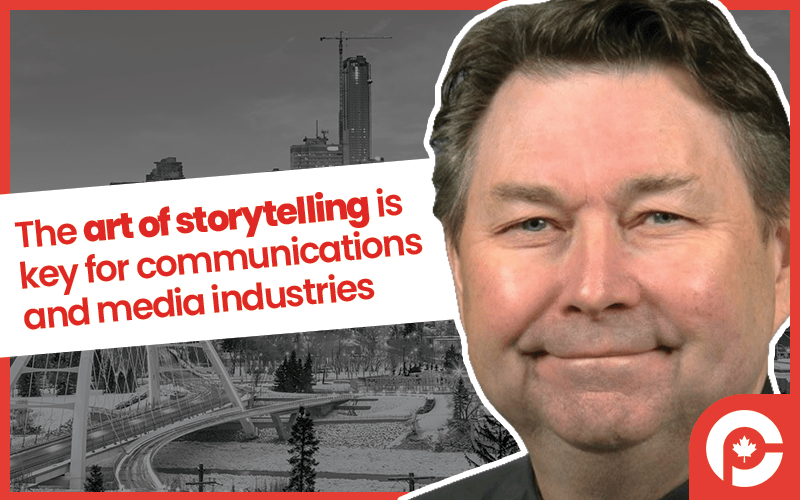
The art of storytelling is key for communications and media industries
Episode
Gary Lamphier, Principal of Lamphier Communications, was a business journalist for 34 years at various major international, national and...
Key takeaways
- The transition from journalism to communications consulting requires adapting storytelling skills to help clients communicate complex ideas in ways the broader world can understand.
- Effective media pitching today requires doing much of the legwork that reporters once did themselves, presenting stories on a platter due to shrinking newsroom resources and time constraints.
- Alberta's economy remains in a state of limbo where political decisions in Ottawa and Washington have become more influential than business decisions in determining the future of the province's key oil and gas industry.
- While economic diversification into technology and other sectors is possible, realistic expectations are necessary as Alberta's entrepreneurial spirit and future prosperity remain fundamentally tied to oil and gas.
- Building trust and leveraging existing relationships with media contacts is critical for communications professionals, especially when newsrooms have fewer experienced business journalists who understand complex industry stories.
Transcript
Full transcript page · Interactive episode
============================================================
TRANSCRIPTION WITH SPEAKERS
============================================================

[00:00] SPEAKER_02: Welcome to Canada's Podcast.
[00:05] SPEAKER_02: Hello, I'm Mario Toneguzi, Managing Editor of Canada's Podcast.
[00:10] SPEAKER_02: Today on Edmonton's Podcast, my guest is Gary Lamphier, who is Principal of Lamphier
[00:16] SPEAKER_02: Communications.
[00:17] SPEAKER_02: Thanks for joining us today, Gary.
[00:20] SPEAKER_02: Oh, my pleasure, very happy to see you again.
[00:22] SPEAKER_02: Okay, now when I collected in the intro to mention that you're a veteran journalist,
[00:26] SPEAKER_02: a business journalist, some more than 30 years with places like Edmonton, Gerneau, Vancouver,
[00:32] SPEAKER_02: Sun, Globe and Mail, Wall Street Journal, Financial Times of Canada, probably more.
[00:37] SPEAKER_02: We'll get into that a little later in the podcast.
[00:42] SPEAKER_02: But let me just ask you, first of all, Gary, tell me what you're up to these days and
[00:46] SPEAKER_02: what you do now.
[00:47] SPEAKER_02: Sure, yes, so I'm a communications consultant.
[00:50] SPEAKER_01: So I work on a wide variety of projects, whether it's website contact for a private client,
[00:58] SPEAKER_01: or the University of Alberta, the School of Medicine, Department of Psychiatry, have done
[01:03] SPEAKER_01: some work for them.
[01:05] SPEAKER_01: And it really just depends on the nature of the work depends on the needs of the client,
[01:08] SPEAKER_01: of course, it's all over the map.
[01:09] SPEAKER_01: Sometimes I'll do a little bit of media relations if let's say our researcher has done some
[01:15] SPEAKER_01: interesting stuff and wants some publicity, I'll try to help with that.
[01:17] SPEAKER_01: So again, just depends on their needs.
[01:20] SPEAKER_02: Okay, so tell us the story of how you got to where you are now in doing this.
[01:26] SPEAKER_02: Sure.
[01:27] SPEAKER_01: Well, as you mentioned, I work as a business reporter, slash columnist for 30 plus years,
[01:33] SPEAKER_01: in a variety of publications and cities across the country.
[01:37] SPEAKER_01: I wound up in Edmonton in 02 and worked as a business columnist for the Ebb and the
[01:42] SPEAKER_01: Journal.
[01:42] SPEAKER_01: I'll fill out retired from there in 2016, a little over seven years ago, which
[01:47] SPEAKER_01: unannocks me out to think that it's been that long already.
[01:50] SPEAKER_01: And so I decided about three months after I retired to put out a shingle and start to
[01:55] SPEAKER_01: advertising my services as a communications consultant.
[01:58] SPEAKER_01: I did that for a period of about four plus years in Vancouver during a sort of, I don't
[02:04] SPEAKER_01: know, a break from the world of journalism.
[02:05] SPEAKER_01: So that was from 98 to 02.
[02:08] SPEAKER_01: So I had some skills that I'd developed from those days.
[02:11] SPEAKER_01: I decided to utilize that to try and make some money as a semi-retired guy as I say.
[02:18] SPEAKER_01: I'm tired from newspapers, so I have a bit of a pension, but I needed to top that up and
[02:23] SPEAKER_01: also keep active.
[02:24] SPEAKER_01: So that's what I'm doing.
[02:26] SPEAKER_00: Join our thriving community of like-minded individuals who share a passion for success
[02:30] SPEAKER_00: and innovation.
[02:32] SPEAKER_00: Canada's podcast.com subscribe now.
[02:35] SPEAKER_02: You know, for a long time, journalists, how difficult was it to make that transition?
[02:43] SPEAKER_02: We grew up in this industry.
[02:46] SPEAKER_02: You were not the almost seeing two opposing camps.
[02:50] SPEAKER_02: The journalists and the communications are spin doctors, right?
[02:55] SPEAKER_02: You consider yourself a spin doctor now.
[02:59] SPEAKER_01: If I am, I'm a pretty crappy one I have to say.
[03:03] SPEAKER_01: I'm basically telling stories from a different perspective.
[03:06] SPEAKER_01: From the perspective of a guy trying to help a client get their story out and often the
[03:11] SPEAKER_01: stories I'm telling now as a communications advisor are pretty freaking complicated.
[03:16] SPEAKER_01: The world of science trying to explain how a brain scientist's research translated
[03:22] SPEAKER_01: the potentially a medication or treatment for people with depression or anxiety issues.
[03:28] SPEAKER_01: That's complicated stuff.
[03:30] SPEAKER_01: That's the skill set.
[03:32] SPEAKER_01: I'll just go back to what I said earlier in the intro.
[03:35] SPEAKER_01: I did do this for four or five years in Vancouver.
[03:38] SPEAKER_01: During those years, I was a more conventional corporate communications advisor.
[03:46] SPEAKER_01: I was working with public trade companies, technology companies, biotech companies, resource
[03:51] SPEAKER_01: companies, helping them tell their story.
[03:54] SPEAKER_01: At that juncture in my life, I was doing things like quarterly conference call scripts,
[03:59] SPEAKER_01: corporate presentations to investors, advising on media communications.
[04:05] SPEAKER_01: If a company had some kind of issue that had to address, so that was a little bit more
[04:09] SPEAKER_01: corporate and big picture.
[04:11] SPEAKER_01: The stuff on the big house was small, smaller clients and many of them are private.
[04:16] SPEAKER_02: It all comes out whether it's a journalist or whether it's a communications person.
[04:20] SPEAKER_02: It all comes down to the storytelling, right?
[04:23] SPEAKER_02: Absolutely.
[04:24] SPEAKER_01: Trying to engage people so that they have some understanding of what it is the client
[04:29] SPEAKER_01: is doing and trying to convey to them.
[04:35] SPEAKER_01: Often, when you talk to people who are neck deep and what they do, they are immersed in
[04:41] SPEAKER_01: it.
[04:42] SPEAKER_01: They kind of lose touch with the way the world perceives them.
[04:46] SPEAKER_01: They think the rest of the world gets what they're doing because in our own minds, it's
[04:50] SPEAKER_01: really, really important.
[04:52] SPEAKER_01: It's not so easy for them to communicate what they're doing to the broader world.
[04:57] SPEAKER_01: That's where we fit in.
[05:00] SPEAKER_02: What makes a good story?
[05:04] SPEAKER_01: People.
[05:05] SPEAKER_01: I think that's a big part of it.
[05:07] SPEAKER_01: People always make stories more interesting because it's just about numbers.
[05:10] SPEAKER_01: You lose people pretty quick.
[05:13] SPEAKER_01: You have to communicate the way it's going to change people's lives if there's some human
[05:19] SPEAKER_01: impact.
[05:20] SPEAKER_01: What the client is doing, whether it's in the world of psychotherapy, brain science, pharmacy.
[05:28] SPEAKER_01: One of my clients is a very entrepreneurial woman who's really got some pretty cool ideas
[05:35] SPEAKER_01: in terms of how to roll out medications to third world countries.
[05:40] SPEAKER_01: If I can use that term or developing countries in Africa.
[05:44] SPEAKER_01: She's trying to serve as an intermediary between the world of pharmaceuticals and the end user
[05:52] SPEAKER_01: in African countries where they don't have the money to typically buy or dispense pharmaceuticals
[05:59] SPEAKER_01: to the population.
[06:01] SPEAKER_01: She's got some pretty big picture ideas that are pretty interesting.
[06:04] SPEAKER_01: One little story that I communicated to the media recently about her is that she's got some
[06:12] SPEAKER_01: interesting backers in the US and Silicon Valley and elsewhere.
[06:16] SPEAKER_01: They funded Billboard and Times Square for her little company, your little tiny little
[06:21] SPEAKER_01: Edmonton company.
[06:23] SPEAKER_01: We got some interest in local media here in Edmonton about that because it's kind of cool when a little company
[06:29] SPEAKER_01: locally gets on big screen in Times Square.
[06:32] SPEAKER_01: It's just kind of an example of that off-beat stuff that I do.
[06:36] SPEAKER_02: You'll have to send me their contact info because it sounds like a good topic for me as a podcast.
[06:43] SPEAKER_02: Sure.
[06:43] SPEAKER_01: Actually, that's a great idea.
[06:45] SPEAKER_01: Be happy to.
[06:46] SPEAKER_02: Yeah.
[06:47] SPEAKER_02: You know what?
[06:47] SPEAKER_02: It's funny.
[06:48] SPEAKER_02: You talk about the human element, right?
[06:50] SPEAKER_02: And I've done some media training for companies as well over the last few years and always bring this up.
[06:59] SPEAKER_02: And I always bring up the example of when taxes go off, property taxes or whatever say.
[07:05] SPEAKER_02: And in a neighborhood, you know, the Calgary Herald would go grab little granny Smith and who lived in inner city neighborhood
[07:14] SPEAKER_02: or seeing her taxes going up senior, you know, and what impact it has.
[07:19] SPEAKER_02: But that human element is something that obviously grabs people's attention more than, as you said, the numbers.
[07:27] SPEAKER_02: I was going to ask you how, you know, from now sitting on that side of the fence, so to speak, approaching the media,
[07:36] SPEAKER_02: what are your thoughts today about approaching the media?
[07:39] SPEAKER_02: We all know what's happened to the media over the last, say, five to ten years, but more so in the last five years.
[07:48] SPEAKER_02: How different is it to approach the media with stories these days?
[07:53] SPEAKER_01: Well, yeah, it's a tough sell.
[07:55] SPEAKER_01: I mean, let's be honest, because these terms, as you alluded to, shrunk so much, I'll give you a concrete example.
[08:01] SPEAKER_01: When I came to Edmonton, an O2, to be their business columnist, we had a ten person business department.
[08:07] SPEAKER_01: So we had reporters with dedicated beats, forestry, manufacturing, mining, oil and gas, transportation, you name it.
[08:15] SPEAKER_01: When I walked out the door in December 2016 and seven years ago, I was the last surviving number of that ten person department.
[08:23] SPEAKER_01: And this is a hundred plus year old newspaper.
[08:25] SPEAKER_01: So I was the last guy who's a dedicated business journalist at a hundred plus year old newspaper walking out the door.
[08:31] SPEAKER_01: Yeah.
[08:32] SPEAKER_01: So yes, it's tough because there are fewer bodies.
[08:36] SPEAKER_01: And certainly way fewer business dedicated business bodies.
[08:39] SPEAKER_01: Oh, yeah.
[08:40] SPEAKER_01: So if you're covering business stories, I've heard you engage a general assignment reporter on a complex business story.
[08:47] SPEAKER_01: Yeah.
[08:48] SPEAKER_01: So you got to keep it short and sweet.
[08:51] SPEAKER_01: Timeliness is critical, right?
[08:54] SPEAKER_01: So whatever is happening in the 24 hour news cycle that day, if you can tie into that, that's great.
[09:00] SPEAKER_01: That's a big plus.
[09:03] SPEAKER_01: Trust is important like you and I have been around the block a few times.
[09:07] SPEAKER_01: So people know us.
[09:08] SPEAKER_01: Yeah.
[09:09] SPEAKER_01: The people that have survived in these newsrooms know us.
[09:13] SPEAKER_01: If you're coming in as a fresh face, it's tougher.
[09:16] SPEAKER_01: And I think just being able to connect the dots for people.
[09:19] SPEAKER_01: Like when you pitch them, you have to do a lot of the legwork that you would expect in the old days or reporter to do.
[09:26] SPEAKER_04: Yeah.
[09:26] SPEAKER_04: That's true.
[09:27] SPEAKER_01: When you do the pitch, you're like presenting a story on a platter, basically.
[09:30] SPEAKER_01: Yeah.
[09:31] SPEAKER_01: And if I people tell me, well, there was so much info in your release, I hardly had to do any research, right?
[09:35] SPEAKER_01: Well, I consider that, you know, thank you very much, your compliment because that's my job now.
[09:40] SPEAKER_01: Yeah.
[09:40] SPEAKER_01: To try and do the work that a reporter would have to because they have no time.
[09:44] SPEAKER_01: Right?
[09:44] SPEAKER_01: So if your body means less time and often they're doing two or three stories a day, not one.
[09:50] Speaker UNKNOWN:
[09:50] SPEAKER_02: And what you what you describe, they're Gary for Edmonton is the same story from from every say post media newspaper from Vancouver to Montreal, right?
[10:02] SPEAKER_02: That's the same issue.
[10:04] SPEAKER_02: Right.
[10:04] SPEAKER_02: You know, I know what the Harold the same thing, I think when when I left the Harold and so it would have been the January of 2016.
[10:15] SPEAKER_02: Yeah, January 2016.
[10:18] SPEAKER_02: So coming up the years actually next week.
[10:22] SPEAKER_02: Next week is eight years.
[10:24] SPEAKER_02: Anyway, same thing.
[10:25] SPEAKER_02: Like, you know, we had newsroom.
[10:28] SPEAKER_02: I think we had even more than 10 at one point in business in business because of the gas sector, et cetera.
[10:35] SPEAKER_02: And it was just literally like one or two left when I was gone.
[10:39] SPEAKER_02: So it's a.
[10:40] SPEAKER_01: How many are there now?
[10:41] SPEAKER_01: Do you know off the top?
[10:42] SPEAKER_02: No idea.
[10:43] SPEAKER_01: You know, there's Chris Harco.
[10:45] SPEAKER_01: I see his stuff, but.
[10:46] SPEAKER_02: Yeah, he's all around.
[10:47] SPEAKER_02: So so there are a couple of the old veterans, but.
[10:52] SPEAKER_02: But then you know, the thing is you multiply that across the board.
[10:57] SPEAKER_02: So it sports and it's arts and entertainment and it's city and politics.
[11:02] SPEAKER_02: All those departments, not just business, all those departments.
[11:05] SPEAKER_02: I got that.
[11:06] SPEAKER_02: So it does make it from a communications standpoint, much, much tougher for people to.
[11:14] SPEAKER_02: Get their story across what time?
[11:16] SPEAKER_02: You know, when when you look, you know, and spend a lot of a good chunk of time here in Alberta.
[11:23] SPEAKER_02: You know, what do you see in the Alberta?
[11:27] SPEAKER_02: I guess economy these days.
[11:29] SPEAKER_02: What are you sensing?
[11:31] SPEAKER_02: Is happening with this province?
[11:35] SPEAKER_01: Well, I get in the broad sense.
[11:38] SPEAKER_01: I get the feeling that we're in some sort of a weird limbo or pause with the right word is interact numbers.
[11:45] SPEAKER_01: Or something.
[11:47] SPEAKER_01: Because look, look at the big picture, national election in the US this year.
[11:51] SPEAKER_01: In the fall, that's huge.
[11:54] SPEAKER_01: Our own federal election, you know, next year, possibly the earlier who knows.
[11:59] SPEAKER_01: And I think that's going to have a huge bearing on the future of our key industry, oil and gas.
[12:05] SPEAKER_01: Which ever way those two elections go.
[12:09] SPEAKER_01: Because I'll just drop pull back from that specific question for a moment to give you.
[12:14] SPEAKER_01: A little bit more context.
[12:16] SPEAKER_01: So when I left the journal in 2016, there are a bunch of reasons, but one of the key reasons was I really reached the point in my career where I felt that.
[12:25] SPEAKER_01: I couldn't report on business anymore in the way that I traditionally had the politics to totally use served business.
[12:33] SPEAKER_01: And the most important industry in this province.
[12:35] SPEAKER_01: So the big decisions were political decisions. They weren't business decisions anymore.
[12:41] SPEAKER_01: And I felt, gee, I mean, what's my point?
[12:45] SPEAKER_01: What's my purpose in life here in this newsroom where really the decisions about the companies I covered aren't being made by the companies I covered.
[12:53] SPEAKER_01: They're being made in Ottawa or.
[12:55] SPEAKER_01: Or elsewhere.
[12:56] SPEAKER_01: So I just think since that time since 2015, what you know was elected.
[13:04] SPEAKER_01: And since Biden was elected, I think it's like the whole energy world is kind of on pause.
[13:11] SPEAKER_01: And yes, we've got record production and the US has record production.
[13:16] SPEAKER_01: And yes, crisis are still pretty good.
[13:18] SPEAKER_01: And companies are very profitable and the balance sheets are cleaner than in a long time.
[13:24] SPEAKER_01: But nonetheless, there's still kind of a stymied sense of investment.
[13:28] SPEAKER_01: Your future confidence and investment over the long term.
[13:32] SPEAKER_01: And you know, we got issues like this trans mountain pipeline never ending and budget just gone through the roof.
[13:38] SPEAKER_01: I just can't believe the numbers now that we see.
[13:42] SPEAKER_01: So you just wonder how much stinky politics underlies those numbers.
[13:46] SPEAKER_01: And until that gets cleaned up and investors have confidence again in investing big.
[13:52] SPEAKER_01: Soms of money tens of billions of dollars in projects.
[13:55] SPEAKER_01: I think we're going to be stuck in this kind of limbo.
[13:59] SPEAKER_01: And you know, there could be a sea change.
[14:01] SPEAKER_01: If Biden's gone, if Trudeau's gone.
[14:03] SPEAKER_01: And the leaders that succeed them are kept two thumbs up for oil and gas again.
[14:10] SPEAKER_01: And the kind of preoccupation with emissions, which I've had skeptical of.
[14:16] SPEAKER_01: And I think you probably guess.
[14:18] SPEAKER_01: If that dissipates, then I think it could be a new day.
[14:21] SPEAKER_01: In the meantime, we're doing pretty good.
[14:24] SPEAKER_01: Having said all that, right?
[14:25] SPEAKER_01: Like the massive population growth.
[14:28] SPEAKER_01: House prices are, you know, up significantly in Calgary, not so much in Edmonton, but Calgary.
[14:34] SPEAKER_01: And our GDP, I think led the nation last year.
[14:37] SPEAKER_04: Yeah.
[14:38] SPEAKER_01: You know, we're probably going to do okay this year within a kind of sea of difficulty in Canada.
[14:44] SPEAKER_01: In relative terms, we'll do okay.
[14:45] SPEAKER_01: So that's a long-winded answer to a short question.
[14:48] SPEAKER_01: Sorry.
[14:48] SPEAKER_02: I know.
[14:49] SPEAKER_02: So, you know, when you look at the oil and gas sector, right?
[14:53] SPEAKER_02: Obviously the bread and butter for this province for decades, for decades, it's been under attack.
[15:00] SPEAKER_02: It's been, you know, the lot of calls over the years for diversifying the economy, et cetera.
[15:08] SPEAKER_02: Yet it still are going to, right?
[15:12] SPEAKER_02: In the industry.
[15:12] SPEAKER_02: Absolutely.
[15:13] SPEAKER_02: And will continue to be, right?
[15:14] SPEAKER_01: Yeah, we're 80% of Canada's supply and Canada's fourth biggest oil producer in the world.
[15:21] SPEAKER_01: Fifth biggest natural gas, I think.
[15:24] SPEAKER_01: And, you know, on a positive note, we've got the Canada LNG plant coming on in BC.
[15:29] SPEAKER_01: The coastal gas plant pipeline being completed.
[15:32] SPEAKER_01: And so there's, you know, a little bit of, you know, enthusiasm.
[15:38] SPEAKER_01: Volusiness in the natural gas sector, given that.
[15:41] SPEAKER_01: And, now who knows?
[15:43] SPEAKER_01: I mean, maybe 10 years from now, we'll see this fleet of LNG plants that, Christy Clark promised 10 years ago.
[15:50] SPEAKER_01: For timing was a little off, but maybe it'll actually happen.
[15:53] SPEAKER_01: If it does, I think that'd be great for Canada and great for Alberta.
[15:57] SPEAKER_00: Discover the latest trends, strategies, and success stories in the ever evolving world of business.
[16:04] SPEAKER_00: Canada's podcast.com subscribe now.
[16:06] SPEAKER_02: Now, you know, when you started, say your career started not started career,
[16:13] SPEAKER_02: but started at the, at the journal and writing business.
[16:17] SPEAKER_02: How has the business environment in Alberta changed?
[16:21] SPEAKER_02: And I think more in terms of the types of businesses, obviously like back then.
[16:27] SPEAKER_02: Oil and gas was everything, right?
[16:30] SPEAKER_02: And today, you know, we're seeing smaller, you know, pockets of growth in what technology,
[16:38] SPEAKER_02: and alternative energy, agro food, and all that.
[16:43] SPEAKER_02: Is it, it's been a big change over the years that you've seen?
[16:48] SPEAKER_01: Sure. I mean, I think, you know, one, I give you one specific example.
[16:52] SPEAKER_01: One of our homegrown companies in Edmonton's stand type.
[16:55] SPEAKER_05: Yes.
[16:56] SPEAKER_01: So I remember writing stories early on at the journal saying, oh, we have our first billion dollar company.
[17:02] SPEAKER_01: Yes.
[17:03] SPEAKER_01: And then we added another Canadian Western bank.
[17:07] SPEAKER_01: And that capital power was a third.
[17:09] SPEAKER_01: So I just thought for fun the other day at Chuck's stand type market cap,
[17:13] SPEAKER_01: it's like 12 and a half billion dollars today.
[17:15] SPEAKER_01: And it's a global company, right? They're all over the planet.
[17:18] SPEAKER_05: Yeah.
[17:19] SPEAKER_01: So, and that's massive.
[17:20] SPEAKER_01: So they've got tens of thousands of employees.
[17:23] SPEAKER_01: So it's grown, it's mushroomed.
[17:26] SPEAKER_01: And there are others not as dramatic in terms of their growth, but steady eddy growers.
[17:33] SPEAKER_01: And so it has diverse economy.
[17:36] SPEAKER_01: And I think the future looks right for agriculture.
[17:40] SPEAKER_01: I think it's a sector where there's, you know, great global demand for our products,
[17:46] SPEAKER_01: high quality products, there's innovation happening.
[17:51] SPEAKER_01: But, you know, I also have to say, if I'm honest, that we sometimes get a little bit dazzled
[17:58] SPEAKER_01: by the prospect of economic transformation through innovation.
[18:02] SPEAKER_04: Yeah.
[18:02] SPEAKER_01: I'll tell you what I mean by that.
[18:04] SPEAKER_01: So when I started working as a journalist in the late 70s and early 80s,
[18:10] SPEAKER_01: there was always talk about Canada and Ontario outside of Ottawa,
[18:13] SPEAKER_01: becoming Silicon Valley North, right?
[18:16] SPEAKER_01: Well, you know, 40 plus years, almost half a century later, right?
[18:20] SPEAKER_01: We've got some success stories, it's true.
[18:23] SPEAKER_01: But I think if you added up all the tech companies in Canada,
[18:26] SPEAKER_01: they wouldn't be equal a quarter of one Microsoft, right?
[18:29] SPEAKER_01: So I think we got to get real too about what we can do in terms of diversification,
[18:35] SPEAKER_01: in terms of scale.
[18:37] SPEAKER_01: Yes, we can diversify.
[18:39] SPEAKER_01: And there are a thousand opportunities out there to do that in smaller ways.
[18:44] SPEAKER_01: And maybe out of those thousand opportunities will develop two or three, you know,
[18:48] SPEAKER_01: mid-size, publicly traded companies.
[18:51] SPEAKER_04: Yeah.
[18:51] SPEAKER_01: That may happen.
[18:53] SPEAKER_01: But that's kind of the opportunity as I see it.
[18:55] SPEAKER_04: Yeah.
[18:56] SPEAKER_01: I think we have to get real about what we can do.
[18:58] SPEAKER_01: We are relatively isolated.
[19:00] SPEAKER_01: We don't have the population of big US states like California.
[19:03] SPEAKER_02: So, no, that's true.
[19:06] SPEAKER_01: So Gary, I'm still an oil and gas booster.
[19:09] SPEAKER_02: That's where I think our future is.
[19:11] SPEAKER_02: Yeah, no, I think a lot of people are with you on that.
[19:14] SPEAKER_02: So Gary, over the years, you've obviously talked a lot of,
[19:16] SPEAKER_02: what I'm quote, movers and shakers out there in the business world.
[19:22] SPEAKER_02: You know, Alberta has kind of been known for its entrepreneurial spirit.
[19:30] SPEAKER_02: Do you believe, is that like an image that's been concocted out there to sell everybody?
[19:37] SPEAKER_02: Or is it something that you've truly seen over the years that we do really have this entrepreneurial spirit in this problem?
[19:45] SPEAKER_01: I think it's real.
[19:46] SPEAKER_01: I think it's genuine.
[19:47] SPEAKER_01: And I say that as a guy who grew up in Ontario and spent 13 years in BC before coming here.
[19:53] SPEAKER_01: I think it's in the DNA of the province.
[19:56] SPEAKER_01: I think, and I can't count the number of entrepreneurs that talk to who started from nothing and built real companies.
[20:02] SPEAKER_01: I mean, stand back some example, right?
[20:04] SPEAKER_02: Yeah, there you go.
[20:05] SPEAKER_01: Massive company.
[20:06] SPEAKER_01: But many, many others that built companies upscale by starting out with a pickup truck.
[20:12] SPEAKER_01: And it's kind of, you know, it's, it's a bit of a, I may some people, people may think it's kind of a myth, but it's true.
[20:21] SPEAKER_01: I've seen them.
[20:22] SPEAKER_01: And I think if we do get the wind in our sales again in the oil and gas industry, if we do see political change.
[20:27] SPEAKER_01: And there is a renewed confidence in investing.
[20:30] SPEAKER_01: That's going to trickle down to all these mom and pop companies and all these service providers.
[20:36] SPEAKER_01: And it will be on the oil and gas industry to all the other industries.
[20:40] SPEAKER_01: I mean, you and I will remember the days when they couldn't hire people in fast food restaurants.
[20:47] SPEAKER_04: Oh, yeah.
[20:47] SPEAKER_01: They're offering them like 20 bucks an hour to serve burgers because of, you know, job, uh, a shortage of employees.
[20:55] SPEAKER_01: They're all being sucked away by the oil and gas.
[20:57] SPEAKER_01: And so nobody wanted to work in other industries.
[21:00] SPEAKER_01: I don't think we want to see that again, exactly.
[21:03] SPEAKER_01: We want, you know, people to enter a variety of fields and industries and develop the talent base here.
[21:08] SPEAKER_01: But I do think that entrepreneurialism is a real part of the fabric here in Alberta.
[21:18] SPEAKER_01: And I think it will remain so I'm confident enough.
[21:22] SPEAKER_02: All right. Wonderful. Well, thanks very much.
[21:24] SPEAKER_02: Gary, particular time today.
[21:26] SPEAKER_02: Oh, it's my pleasure, Mary. I think it's a great pleasure to chat with you again.
[21:30] SPEAKER_02: All right. Super. That was Gary Lamphere, who is the principal of Lamphere communications in Edmonton.
[21:36] SPEAKER_02: And also a former business columnist and journalist with various newspapers and publications over the years.
[21:44] SPEAKER_02: I'm Mario Toneguzy, managing editor of Canada's podcast today on Edmonton's podcast.
[21:50] SPEAKER_02: Thanks for joining us.