
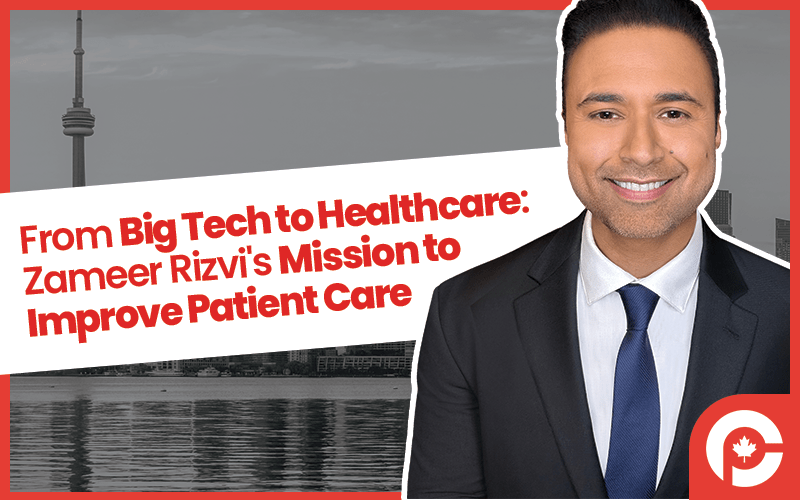
From Big Tech to Healthcare: Zameer Rizvi’s Mission to Improve Patient Care
Episode
Ontario-based Zameer Rizvi is the Founder & CEO of Odesso and has a great entrepreneurial story. Zameer has two...
Key takeaways
- Healthcare's biggest challenge is bridging the gap between deep technological expertise and domain knowledge through clear, simple communication that avoids industry jargon.
- Product-based businesses offer exponential scaling advantages over consulting because software can handle doubled workloads with only fractional increases in resources, creating better economics for both the company and customers.
- Persistence and resilience are essential entrepreneurial traits, as successful ideas often require decades of continuous pursuit before they can be fully realized.
- Starting a business in the US versus Canada should be evaluated based on where the problem is biggest, where you can create the most impact, and where there's greater capacity for positive change at scale.
- Transparency and immediate stakeholder communication are critical when handling sensitive patient data and operations, followed by root cause analysis and building systematic guardrails to prevent future issues.
Transcript
Full transcript page · Interactive episode
============================================================
TRANSCRIPTION WITH SPEAKERS
============================================================

[00:00] SPEAKER_01: Welcome to Canada's podcast.
[00:05] SPEAKER_01: Hi everyone, I'm Fulblis, founder and CEO of Canada's podcast and I'm coming to you today from Toronto.
[00:13] SPEAKER_01: Today I'm going to meet an Ontario-based CEO, Xeméa Rispy, of Odessa.
[00:18] SPEAKER_01: He's got a great entrepreneurial story.
[00:22] SPEAKER_01: Patient care has been deeply neglected as healthcare systems are overburdened and underfunded.
[00:28] SPEAKER_01: Xeméa recognized this and realized he had to do something and he launched Odessa in 2017.
[00:37] SPEAKER_01: Odessa helps healthcare providers shift focus back to the patient by alleviating operational
[00:43] SPEAKER_01: challenges. The company powers some of the most notable players in North America's healthcare
[00:49] SPEAKER_01: industry today. So let's find out why he started the company, where it's at and how he's helping
[00:57] SPEAKER_01: to solve one of America's biggest challenges today. So Xeméa, what I'm interested in right away
[01:04] SPEAKER_01: is why you started Odessa instead of starting another new venture.
[01:12] SPEAKER_03: Yeah, that's a great question. Well, first of all, thanks for having me with such a pleasure
[01:16] SPEAKER_02: to be here and being representing various Canadian entrepreneurs. I really appreciate what you do
[01:23] SPEAKER_02: here. Why Odessa started in 2017 and prior to that, I had found a company called BPM Group,
[01:34] SPEAKER_02: BPM Group, what a stand for business process management. My background, both educationally,
[01:43] SPEAKER_02: spiritually and emotionally, is in the aspect of streamlining everything I can possibly get my
[01:51] SPEAKER_02: hands on. And so if there's anything that is being done manually, if there's anything that is
[01:58] SPEAKER_02: a daily grind of getting from point A to point B and repeating that day to day, if there's anything
[02:06] SPEAKER_02: that's administrative that is being done, that becomes a focus of my attention. And I always like to
[02:15] SPEAKER_02: improve that from just an engineering, reengineering process engineering standpoint. I went to school in
[02:22] SPEAKER_02: Canada at the University of Western Ontario and London, I graduated with electrical engineering,
[02:29] SPEAKER_02: and that's really got even more and more engrained in me as I went to school is that I don't like to
[02:36] SPEAKER_02: see manual processes repetitive, administrative, little level tasks and the beautiful time of
[02:42] SPEAKER_02: human being, then doing that. When we have so many technological advances out there,
[02:47] SPEAKER_02: now it's really good for me and my career. It hasn't really posed that well in my personal life,
[02:52] SPEAKER_02: because it lends itself a little OCD behavior if you ask my two I used to ask now. But in terms of
[03:01] SPEAKER_02: the engineering passion, it's really paid off for me. When I founded my first company, it was more
[03:08] SPEAKER_02: around consulting process, reengineering, finding more efficiency that you're familiar with, the sixth
[03:15] SPEAKER_02: stigma, school of thought, being able to parameterize a lot of different human behaviors and system
[03:24] SPEAKER_02: behaviors, and then bring them into a more modern, technologically savvy system. That's where I focused
[03:31] SPEAKER_02: in on we just did consulting. We were consultants, so we'd get different things, we'd go out and fight for
[03:38] SPEAKER_02: new bid, and we'd win them. We grew to a large team of engineers like mine and engineers in the
[03:46] SPEAKER_02: process efficiency area, and won some good contracts in oil and gas manufacturing insurance, financial
[03:55] SPEAKER_02: tech, things, etc. We noticed over the five years or so doing that was that there's a lot of gas,
[04:03] SPEAKER_02: there's some gas in the marketplace. What we found that even the systems and tools that we were
[04:08] SPEAKER_02: implementing as subcontractors and contractors were just being implemented to conduct repetitive
[04:15] SPEAKER_02: processes. Instead of human doing it now, we insist on doing these repetitive processes. He
[04:21] SPEAKER_02: wishes a good thing, which is great. However, the real power of innovation was really in creating
[04:27] SPEAKER_02: a system of tools and agents that are able to assist in actually improving processes and being
[04:38] SPEAKER_02: intelligent about it, and not just doing the same old repetitive work over and over again.
[04:43] SPEAKER_02: And so, well, the answer was found on that intention and that premise. And it's the best
[04:49] SPEAKER_02: decision that I made back in 2017, because with that innovation and that innovative mindset,
[04:58] SPEAKER_02: they say necessity is the mother of all invention. In the five years prior to starting the
[05:05] SPEAKER_02: death, healthcare was the hardest business to implement newer technologies, more modern technologies,
[05:13] SPEAKER_02: more relatively untested technologies, because there's so much of a compliance, resistance,
[05:19] SPEAKER_02: and risk aversion in healthcare. The sentiments that the healthcare industry
[05:23] SPEAKER_02: is very, very different. And when we were just doing the mundane day-to-day technology implementation
[05:28] SPEAKER_02: for systematic improvements, healthcare wasn't that responsible. However, as soon as the
[05:36] SPEAKER_02: death zone was formed and we were focused on innovation using newer technologies like
[05:43] SPEAKER_02: a generative AI, large-language model, and hyper-automation. The healthcare industry just
[05:51] SPEAKER_02: opened up with Bloomberg's power, because in the sense, invention is the inventive thought
[06:01] SPEAKER_02: processes really drive and solve the important problems for the healthcare business.
[06:07] SPEAKER_02: So, really excited about that. To answer your question, a very long-winded way, you can tell
[06:11] SPEAKER_02: I'm very excited about my company and what we're doing here. That's why we focused on the death
[06:17] SPEAKER_02: zone to create an innovative product and bring it, cutting out its technology to the industry.
[06:25] SPEAKER_01: I just said, you're starting another venture. Why, why, why, why, you saw you were consulting,
[06:34] SPEAKER_01: which is kind of entrepreneurship, but there's a lot of difference between consulting and
[06:41] SPEAKER_01: building a product company and building a business around that. Why did you decide to build that route?
[06:53] SPEAKER_02: Creating a product lends itself more to the innovation aspect, just the way the industry is structured.
[07:02] SPEAKER_02: With the product, you're able to implement more innovative features, be able to implement more
[07:09] SPEAKER_02: cutting edge technology, newer technology within your framework of tool that you're able to implement.
[07:16] SPEAKER_02: And consulting, it's a lot more prescriptive. The bids come with a graphy, what needs to be done,
[07:22] SPEAKER_02: whereas with the product, you're solving a particular problem and solving and giving a solution.
[07:26] SPEAKER_02: The particular problem is that consulting, you're usually bringing broad end to continue operating
[07:34] SPEAKER_02: something that already exists or builds something that needs to be maintained.
[07:40] SPEAKER_01: For those who are listening, you've got that background of having run a consulting
[07:49] SPEAKER_01: business and run a product business. Let's look at the talk about the economics of the consulting
[07:57] SPEAKER_01: side versus the economics of the product side. Give us some insights on that.
[08:07] SPEAKER_02: Yeah, to really simplify the economics of a consulting business is based on climate materials.
[08:14] SPEAKER_02: And the economics of software product is based on a subscription licensing model.
[08:25] SPEAKER_02: That's the fundamental difference.
[08:26] SPEAKER_02: Yes, your question. And really, what for you prefer, what you sell out and where you want to land on that?
[08:34] SPEAKER_02: That's right.
[08:35] SPEAKER_01: Is one a bigger leap than the other? I mean, in terms of, as an entrepreneur,
[08:43] SPEAKER_01: going to a product business, is that more of a risk factor than consulting?
[08:54] SPEAKER_02: Yes, it is more of a risk and with that risk, you get a lot more reward because just the way
[09:03] SPEAKER_02: that the software and the license description business can scale and the economy to scale are very
[09:11] SPEAKER_02: complex, which is why they're risky, but they're also a lot more exponential, not as linear as
[09:18] SPEAKER_02: climate material. For climate material, you have a certain number of hours, you have a certain number of humans.
[09:24] SPEAKER_02: To be able to work a specific problem. With software, there's a lot more factors that go into it.
[09:33] SPEAKER_02: It's time to still a factor. You still have the resources that you're applying. That's still a factor.
[09:39] SPEAKER_02: But there's also a factor of scale of implementing that technology, whether that's on the hardware
[09:45] SPEAKER_02: or the middleware level. There's a lot of factors to the pricing model that's very complex.
[09:51] SPEAKER_02: And the value that's delivered
[09:56] SPEAKER_02: is scales a lot better than with humans. So a human, which is having a material consulting
[10:02] SPEAKER_02: scale essentially one to one. You have a problem becomes bigger. You throw another head at it.
[10:10] SPEAKER_02: Whereas with software, what we find is that you have a problem that gets bigger, you need to not
[10:16] SPEAKER_02: necessarily double. So imagine the problem doubles really in terms of scale. The software you
[10:22] SPEAKER_02: have to throw at it is probably a quarter more to solve that problem of double, the problem
[10:29] SPEAKER_02: doubling. Whereas in the consulting state, if the problem doubles, you have to double the resources
[10:34] SPEAKER_02: you throw at it. And so it's a lot more, it's all bent for the customer. It's a lot more economical
[10:40] SPEAKER_02: from that perspective. It also brings a lot more innovative and provides a little more of a
[10:46] SPEAKER_02: path of income string that allows you to push back some of those resources into R&D,
[10:54] SPEAKER_02: innovation research, and build and improve that product with better technology.
[11:24] SPEAKER_02: The biggest challenge is it's a great question. It's really very elementary. It may come
[11:35] SPEAKER_02: off with elementary rather. It's evangelizing and educating the marketplace. Right, about what's
[11:45] SPEAKER_02: possible. I may tech head. I may I've been in the technology space for 20 years in the
[11:53] SPEAKER_02: entrepreneur space, right, tech product. And so what I know is a deep well of information about
[12:01] SPEAKER_02: how technologies can improve for an intention like patient outcomes, right, and improving patient
[12:08] SPEAKER_02: outcomes in the healthcare space. For example, now when we're speaking to our customer base or
[12:16] SPEAKER_02: potential prospect and other peers in the industry, they have 20 to 30 years of domain expertise
[12:23] SPEAKER_02: in ambulatory care for emergency medicine or nephrology. That's their deep domain knowledge.
[12:33] SPEAKER_02: You're taking two very deep steps of information and helping men and marry that
[12:41] SPEAKER_02: those information sets together the fine synergy. That is the hardest challenge. That just
[12:48] SPEAKER_02: breaks down to communication, education, evangelism. In the specifically the healthcare space,
[12:56] SPEAKER_02: it's driven by so many different intentions about patient outcomes, about quality care,
[13:01] SPEAKER_02: about low risk to the patient's in population sets. Those conversations are a lot more sensitive
[13:12] SPEAKER_02: than if you're talking about a bank. In a bank, it's like profit margin. It's very mathematical
[13:17] SPEAKER_02: or looking for. And now it's fair it's a lot more nuanced. To be able to speak to that,
[13:22] SPEAKER_02: coming from not a medical background has been quite the challenge and overcoming it is just being
[13:26] SPEAKER_02: real and keeping it very simple and explaining things so that in general population can understand it.
[13:38] SPEAKER_01: You can aid your entrepreneur. Moving between Canada and the US and running the
[13:47] SPEAKER_01: built build a business in the US. Is there any, I mean people here building a business
[13:56] SPEAKER_03: look at the US. What's different about building a business in the US versus Canada?
[14:07] SPEAKER_02: That's a wonderful question. The intention that I carried to build starting a business in the US
[14:14] SPEAKER_02: was to scale with the principles and sentiments that I would like to carry in technology product
[14:24] SPEAKER_02: could be applied. And the scale of the problem. And so when you just premise things on scale like the
[14:37] SPEAKER_02: best that naturally lend itself to larger populations that are more fragmented healthcare systems like
[14:44] SPEAKER_02: in the US and more access to a capital and also technological innovation being able to be kind of
[14:54] SPEAKER_02: the cost of that. So to answer your question, it can be answered in many ways about why start in the US
[15:04] SPEAKER_02: as a social Canada. But the lens that we saw the marketplace through was, where's the problem
[15:12] SPEAKER_02: the bigger and where the most impact and most capacity for change that we could bring positive outcomes.
[15:22] SPEAKER_03: Interesting. You know, you've had a bunch of challenges. How did you typically,
[15:31] SPEAKER_01: you know, when you hit something unexpected, do you have a process in terms of how you overcome them?
[15:43] SPEAKER_02: Yeah. Generally speaking, the process that we carry forward is number one is a transparency and
[15:57] SPEAKER_02: understanding the solution. Right. And understanding the root cause. And so there's a couple of layers to it.
[16:03] SPEAKER_02: Right. Specifically in the text space when you're handling information, that carries a lot of value and
[16:12] SPEAKER_02: importance to a particular patient's life, for example, or patients well being. There's cyber security aspects.
[16:20] SPEAKER_02: There's systematic aspects you have to look at. And so the first step is transparency around it to
[16:26] SPEAKER_02: ensure that the stakeholders involved are taken care of. And any thing that's compromised from that,
[16:33] SPEAKER_02: either the customer base, the patients and the clinicians involved is taking care of some
[16:39] SPEAKER_02: communication standpoint. And secondly, it's understanding if there's an immediate acute problem
[16:47] SPEAKER_02: that needs to be addressed through a temporary solution. And that we don't understand with the
[16:54] SPEAKER_02: root causes, the root cause analysis is very important critical. However, those can take time sometimes.
[17:00] SPEAKER_02: Like for example, not that this has happened to us, but a data leak, for example, you stop the leak first.
[17:05] SPEAKER_02: Right. And then you go ahead and understand what the root causes. So understanding if there's a potential leak
[17:12] SPEAKER_02: and immediate actions to take care of that and then moving on to the root cause analysis.
[17:16] SPEAKER_02: And then, what's pulling all that learning back into your product framework to make sure that never
[17:22] SPEAKER_03: happens again, building the guardrails around that. What do you enjoy most about being an entrepreneur versus being an on payroll?
[17:33] SPEAKER_02: It goes back to the initial intention of founding of this company based on the premise that
[17:44] SPEAKER_02: every day repetitive tasks, predictable tasks that are being done on the daily basis
[17:54] SPEAKER_02: that are inefficient and not streamlined are inherently,
[18:02] SPEAKER_02: is that I believe that the awhile they get you from A to B, they do inhibit
[18:09] SPEAKER_02: progress and growth. And that even ingrained in me spiritually and also in a creative and career
[18:20] SPEAKER_02: way. And so the reason I'm really enjoying the path of being an entrepreneur is that
[18:28] SPEAKER_02: I get to live that value growth every day. As opposed to I did work for Bel Canada. I did work for
[18:38] SPEAKER_02: Blacknery. So I spent the first decade in my career working for companies in Canada. And
[18:44] SPEAKER_02: a lot of times my job was, hey, we have data coming in from this system,
[18:51] SPEAKER_02: we have data coming in from this system, we don't know how to merge it together.
[18:55] SPEAKER_02: You know, every day we have a team that merges us saying, let's do that.
[19:00] SPEAKER_02: Right. And so, and it was a wonderful six-figure salary and it's like here I am just doing
[19:04] SPEAKER_02: something every day because the system can't do it. And in my mind, the latest all that problem
[19:11] SPEAKER_02: is to create data connector and create an innovative solution that allows us to free up our time
[19:18] SPEAKER_02: to do more intelligent tasks and have a system actually agree that is. This is a long-winded
[19:22] SPEAKER_02: example just to say that I cannot survive in that environment in which if that is the task at hand,
[19:28] SPEAKER_02: even if I raise my hand in a corporate environment with a bureaucracy as you know, oftentimes it's
[19:34] SPEAKER_02: like, hey, no, you just keep doing what you're doing. Nobody asks you to build, you know,
[19:39] SPEAKER_02: us to an innovative solution near your job as a. So I like it the entrepreneur task for that
[19:44] SPEAKER_03: meeting. So you think we entrepreneurs wired differently?
[19:52] SPEAKER_03: I think you met a few. I have an interesting question.
[20:00] SPEAKER_02: I think it's wire in human color. I think it's just our tolerance for risk. I mean, that's
[20:11] SPEAKER_02: what it comes down to. I would love to sit on a desk for a couple of days and make a
[20:20] SPEAKER_02: under 60,000 years with a wonderful benefit package to a whole month of vacation and meet and
[20:28] SPEAKER_02: work with great people all day long. And you know, you get my savings, get my RSTs in line,
[20:35] SPEAKER_02: and I'm good. Play my kids so I want to do. I didn't choose that path in my risk tolerance
[20:43] SPEAKER_02: is higher because some days I'm pulling my hair out and some days I can't flee still. But then
[20:49] SPEAKER_02: some days I'm sleeping extremely well and I'm not pulling my hair out and my life is actually great
[20:55] SPEAKER_02: and we're actually having the fulfilling experience of creating something, right? And creation
[21:03] SPEAKER_02: is one of the things that I really get through. So I don't know if it's a different wiring,
[21:07] SPEAKER_02: maybe we can colloquialize it that way in language, but I think it's just just risk tolerance
[21:15] SPEAKER_00: for it comes down to. Stay ahead of the game with our expert tips and strategies that will help
[21:20] SPEAKER_00: your business thrive in a digital era. Canada's podcast.com subscribe now.
[21:27] SPEAKER_01: So moving on to mentorship, what's the best piece of advice that you've ever received
[21:33] SPEAKER_01: that you know doesn't go away, that you kind of keep in your, keep in your back pocket and
[21:38] SPEAKER_01: use it on a regular basis?
[21:42] SPEAKER_02: On necessity being a mother of all inventions is key. That I learned after you know just seeing
[21:51] SPEAKER_03: what's happening within the healthcare space using AI, right? That is one of them. I think
[22:01] SPEAKER_02: a lot of you know one of the mentorship advice that I give to a lot of my staff is just the
[22:08] SPEAKER_02: key. The importance of simplicity and communication. You know we have some really really smart folks
[22:16] SPEAKER_02: working in in multiple jobs where communication often, if you're, if I'm talking to again I've
[22:27] SPEAKER_02: always go back to the astrology. Even though I'm in my 40s, there in the 40s they have a deep
[22:33] SPEAKER_02: well of information, 30 years experience that 30 years experience. We also come, we're speaking
[22:38] SPEAKER_02: a different language. And so when communicating in an idea or a thought or an intention,
[22:48] SPEAKER_02: sometimes we overdo it. You know we use some specific, you know some vernacular that's specific
[22:55] SPEAKER_02: to our industry. We assume that there's this basic concept that I you know we've been
[23:01] SPEAKER_02: gladdened to last ten years that someone on the other side that's in the medical field would
[23:06] SPEAKER_02: understand. And oftentimes people think that they talk to people very slowly in a very simple way
[23:16] SPEAKER_02: that they may be taken as unintelligent or not known what they're talking about, but it's
[23:21] SPEAKER_02: the complete opposite. And so I always give that advice that it's not you know it's a virtue
[23:27] SPEAKER_02: to be able to speak patiently and to be able to use simple words and convey ideas like you're
[23:34] SPEAKER_02: talking to somebody who has no idea. It hasn't been the space you've been in for the last 30 years.
[23:40] SPEAKER_01: Oh, Simon, let's tune in down from the series side of it. Let's have some great, some some
[23:57] Speaker UNKNOWN: some of the things that I've been doing. I wasn't doing what I was doing now. I probably
[24:07] SPEAKER_02: be spending a lot more time by family. I you know being the OCD tech guy who can't ever do two
[24:18] SPEAKER_02: things twice. I tend to drive a lot of people away which is the which is one thing. The other
[24:25] SPEAKER_02: aspect of music I love writing songs and I express myself emotionally through that process
[24:32] SPEAKER_02: and writing. And so I not that's something I do that already. I do put out a lot of I share that
[24:40] SPEAKER_02: with the world a lot. I would if I wasn't doing what I was doing today, I probably do a lot more
[24:49] SPEAKER_01: traveling and taking the time. Okay. What book are you currently reading, listening to or podcasts
[24:59] SPEAKER_03: I would recommend to the audience? I am currently reading a book on
[25:10] SPEAKER_02: reading kids because of few C&Rs and I was told what between that and the next book that I
[25:16] SPEAKER_02: escalated is by an author who I am extremely fascinated by his name. You've all know
[25:24] SPEAKER_02: Ferrari. He wrote the book Sapien. He wrote the book called
[25:31] SPEAKER_02: He's in the last new book called Nexus. Next on my list. But I forgot to mention the book that I'm
[25:38] SPEAKER_02: writing in love right now. It's called a creative app. More of a spiritual book is by
[25:43] SPEAKER_02: gentleman named Rick Rubin who's a creative music producer and he is very interesting look on
[25:53] SPEAKER_02: life and how to take in the atmosphere around us and it's a very very good book.
[26:00] SPEAKER_03: So you're a morning or a night person?
[26:05] SPEAKER_03: I'm a morning person. My brain is on fire and finally balanced in the morning as I get more
[26:12] SPEAKER_03: at the night time. It's a little more volatile. If you had to pick one word to describe yourself,
[26:21] SPEAKER_03: what would it be and why would you choose it?
[26:26] SPEAKER_02: Persistent. To a fault. You know, people across the moon probably mentioned that I have some
[26:37] SPEAKER_02: pretty good ideas. Ideas that would really pan out if I just stated them to you today in words.
[26:48] SPEAKER_02: However, I have a strange map for pursuing those and for decades in continuing to pursue them
[26:55] SPEAKER_02: until there's a way to realize them. So you know, persistence and resilience is key.
[27:03] SPEAKER_01: Persistence is a common, a common answer. So that's something you can do with the entrepreneurial side of it,
[27:10] SPEAKER_03: I think. Let's keep it in your upper night.
[27:17] SPEAKER_02: Well, there's a couple of aspects. On the technology side, going back to being curious,
[27:27] SPEAKER_02: I apologize, but no, we're delapping. I'll give you a light-hearted answer also.
[27:33] SPEAKER_02: But on technology side, we're in some really high-stakes operations in our day-to-day,
[27:40] SPEAKER_02: as I mentioned, we're dealing with some really, really important data and processes that need to
[27:48] SPEAKER_02: be handled with extreme care. And we're using some newer technology, like large language models,
[27:57] SPEAKER_02: machine learning, and creating some of our own utilities to further that and improve it and get
[28:06] SPEAKER_02: better. So there's a lot of high-risk thoughtfulness that has to be able to be thought about and
[28:13] SPEAKER_02: and insured. And as a leader of our company, I take a big honest on that for some ability.
[28:22] SPEAKER_02: And I think that's what that was. It's a mess, really keeping me up, but it is at the forefront of
[28:26] SPEAKER_02: my brain to make sure that I'm thinking about everything all the time, in terms of keeping
[28:31] SPEAKER_02: our patients and our clients data and operations secure. On a lighter side,
[28:44] SPEAKER_02: I mentioned earlier that at nighttime, the day and the only activities around the day
[28:50] SPEAKER_02: co-let together, you start spending time with more family, you get your friends, you have a
[28:56] SPEAKER_02: block of wine or two, perhaps, right? And the day just becomes more real because at the end of the day,
[29:03] SPEAKER_02: I think most people will agree that family is the most important thing in the world and friends,
[29:08] SPEAKER_02: and that's really important. So we spend this entire day in the theoretical world of our career
[29:14] SPEAKER_02: path in the real, very real world also. And then the night ends with what's more even more important.
[29:20] SPEAKER_02: And then I just get excited and what keeps me up is I'll get into a conversation and so
[29:26] SPEAKER_02: it's one o'clock, it's two o'clock, I don't care. Let's keep going. Like let's connect a little more.
[29:31] SPEAKER_01: That's cool. So you're keeping yourself up at night. And your friends?
[29:38] SPEAKER_01: Yeah. That's great. That's a good thing to end on.
[29:42] SPEAKER_01: So if someone's listened to this, there's lots of good stuff in there. How can people get a hold of
[29:50] SPEAKER_02: you online? The best way is LinkedIn, Zimir Rizfi, is where I am at. And if you want to learn a
[30:00] SPEAKER_02: little more about our company or software, objective.com. Okay. Zimir, it's been super heavy. Thanks for
[30:09] SPEAKER_01: coming on Candace Podcast. Thank you for having me. Appreciate it. Thanks for listening, everybody.
[30:15] SPEAKER_01: Once again, I'm Phil Bliss and don't forget to subscribe to our newsletter on the website
[30:20] SPEAKER_01: or and subscribe on our YouTube channel as well. And on any of the major podcast channels.
[30:27] SPEAKER_01: Thanks for listening to Candace Podcast where you meet the entrepreneurs that drive Candace economy.