
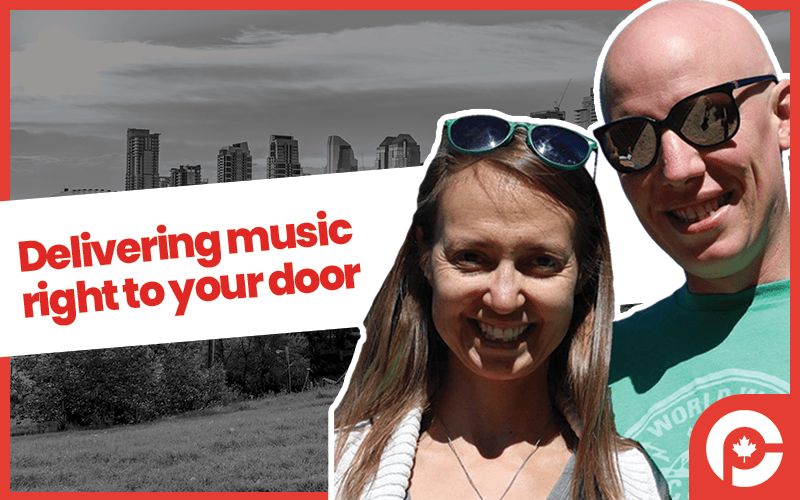
Delivering music right to your door
Episode
Amanda Burgener is the co-founder of Curbside Concerts, a Calgary-based company that delivers live music right to your door,...
Key takeaways
- Curbside Concerts revolutionized live music delivery by providing daytime work opportunities for professional musicians, allowing them to maintain stable schedules without touring.
- The company prioritizes artist welfare by paying two-thirds of all fees directly to performers, providing insurance and WCB coverage, and ensuring prompt payment—unprecedented practices in the Canadian music industry.
- Live music serves as a powerful community-building tool because free, shared listening experiences create connections between strangers and strengthen neighborhood bonds.
- Success in the music industry often comes from providing essential services and infrastructure rather than performing alone, similar to how those selling shovels profited more than gold miners.
- Building a business during crisis allows you to establish a company culture from the ground up that reflects modern values like diversity, equity, and consideration for mental health without having to retrofit old systems.
Transcript
Full transcript page · Interactive episode
============================================================
TRANSCRIPTION WITH SPEAKERS
============================================================

[00:00] SPEAKER_01: Welcome to Canada's podcast.
[00:05] SPEAKER_01: Hello, I'm Mario Tonoguzi, Managing Editor of Canada's podcast.
[00:10] SPEAKER_01: Today, on Calgary's podcast, I have Matt and Amanda Bergenner, who are co-founders of
[00:17] SPEAKER_01: Curbside concerts, and you might know Matt also by his stage name, Matt Masters.
[00:23] SPEAKER_01: Thanks for joining us today.
[00:25] SPEAKER_01: Till you.
[00:26] SPEAKER_03: Thank you for coming out.
[00:27] SPEAKER_01: Thanks for coming out.
[00:29] SPEAKER_01: What Curbside concerts is?
[00:34] SPEAKER_03: Yeah, for sure.
[00:34] SPEAKER_03: So Curbside concerts is a four-year-old company, where you live music, booking agency.
[00:40] SPEAKER_03: That's kind of the simplest way to see us, but we're almost like skip the dishes for live music.
[00:45] SPEAKER_03: Because what you with our company is you go to our website,
[00:49] SPEAKER_03: curbsideconcert.ca, you choose the music, the time, and the space that you're looking for.
[00:54] SPEAKER_03: I want to jazz band, dad, my parents, how I was saw on Wednesday.
[00:57] SPEAKER_03: And that's what you get.
[00:58] SPEAKER_03: So it's live music and dance delivery.
[01:03] SPEAKER_03: We do a lot of work in shopping malls.
[01:05] SPEAKER_03: We work with municipalities.
[01:07] SPEAKER_03: We work all across Canada.
[01:09] SPEAKER_03: Our company started during COVID.
[01:11] SPEAKER_03: When we had musicians, we kind of lost our work.
[01:14] SPEAKER_03: We couldn't work in clubs and venues.
[01:16] SPEAKER_03: We couldn't teach classes.
[01:18] SPEAKER_03: We were, we have three little kids.
[01:20] SPEAKER_03: And so we realized that if you took the music to the Curbside
[01:24] SPEAKER_03: and turned up the volume on a battery-powered speaker,
[01:27] SPEAKER_03: you could have a non-contact, distance compliant, concert, a curbside concert.
[01:34] SPEAKER_03: So that was the genesis of the idea.
[01:36] SPEAKER_03: It started kind of, it inspired days into the pandemic in May of 2020, we launched.
[01:43] SPEAKER_03: And we promptly grew nationwide.
[01:48] SPEAKER_03: You know, to this point now, where we've delivered thousands of concerts across Canada.
[01:52] SPEAKER_03: We're active in seven provinces.
[01:54] SPEAKER_03: And we're quite excitedly.
[01:57] SPEAKER_03: We're nearing a big landmark number as our company.
[02:01] SPEAKER_03: We're about to pay artists our $1 million dollar.
[02:05] SPEAKER_01: Wow.
[02:06] SPEAKER_01: So how many different artists would you have in this?
[02:11] SPEAKER_02: Well, we are growing pretty much every day.
[02:15] SPEAKER_02: I think we have about 200 professional musicians on our roster.
[02:21] SPEAKER_02: All across Canada.
[02:23] SPEAKER_02: And basically any city or any town that has asked for live music delivered to them,
[02:30] SPEAKER_02: we have local artists in their area that they can pick and choose from and will help get that to you.
[02:36] SPEAKER_01: So do you two also still perform as well for these curbside concerts?
[02:44] SPEAKER_03: Yeah.
[02:45] SPEAKER_03: So I'm a country in Western singer and it's my day job for 25 years.
[02:48] SPEAKER_03: So I have two curbside concerts this week.
[02:50] SPEAKER_03: One's in a care facility and then one's at a public kind of amusement park.
[02:57] SPEAKER_03: So you know what, that's the variety.
[02:59] SPEAKER_01: Don't speak of variety.
[03:01] SPEAKER_01: Tell me like what kind of places have you guys done these things in?
[03:08] SPEAKER_01: What's the weirdest place?
[03:11] SPEAKER_03: Well, I mean, I have to think a second for the weirdest place.
[03:15] SPEAKER_03: The majority of our shows nowadays happen in shopping malls.
[03:19] SPEAKER_03: So when we watched, we were primarily like a business to customer model.
[03:23] SPEAKER_03: When we were bringing music to people's houses, bringing music to community centers and facilities
[03:29] SPEAKER_03: and community associations.
[03:31] SPEAKER_02: But as we're even on top of the minivan, we had a stage set up.
[03:36] SPEAKER_03: That's true.
[03:36] SPEAKER_03: At the very start, there was a minivan with the stage on top of it.
[03:40] SPEAKER_03: The idea was to stay distanced from the audience.
[03:42] SPEAKER_03: So I was driving around Calgary in the summer of 2020 with a minivan stage.
[03:47] SPEAKER_00: Canada's podcast is your gateway to success in the world of entrepreneurship.
[03:52] SPEAKER_00: Start listening today.
[03:54] SPEAKER_00: Canada's podcast.com subscribe now.
[03:57] SPEAKER_01: Yeah, I got to tell you a story.
[03:58] SPEAKER_01: I get to what?
[04:00] SPEAKER_01: Our neighbors across the street had you over that time.
[04:06] SPEAKER_01: And I remember because they had set up in the front lawn and actually I'm looking up my
[04:10] SPEAKER_01: picture window here and I see their yard and you had set up there.
[04:16] SPEAKER_01: And then all the other neighbors bought out their lawn chairs and sat on their own
[04:21] SPEAKER_01: respective yards and listening.
[04:24] Speaker UNKNOWN:
[04:24] SPEAKER_03: So now, you hit on it right there.
[04:27] SPEAKER_03: At the core of our work, we are a music delivery service.
[04:31] SPEAKER_03: But the end result of our work is the building of community.
[04:35] SPEAKER_03: That's this interesting thing.
[04:37] SPEAKER_03: We're in the community development industry.
[04:39] SPEAKER_03: Because what happens when you put live music for free because it's not ticketed.
[04:44] SPEAKER_03: The host or the owner of the space is paid for it.
[04:48] SPEAKER_03: Yeah.
[04:48] SPEAKER_03: So the lot of this is being commented professionally.
[04:51] SPEAKER_03: But the neighbors get a free concert.
[04:53] SPEAKER_03: And when you have free shared listening, shared listening is really the foundation of community
[05:00] SPEAKER_03: building.
[05:01] SPEAKER_03: Because it's not a thing, who are you for you come in?
[05:04] SPEAKER_03: It says, come on in.
[05:06] SPEAKER_03: We're listening together.
[05:07] SPEAKER_03: And so then those two neighbors, the next time they see each other,
[05:10] SPEAKER_03: they say, do you remember that thing we did together?
[05:12] SPEAKER_03: And imagine this, in a shopping mall, you've got two parents, both with kids.
[05:17] SPEAKER_03: And the kids like take a second to dance to the music.
[05:19] SPEAKER_03: And those parents have that out.
[05:20] SPEAKER_03: They share a look.
[05:21] SPEAKER_03: It's unspoken.
[05:22] SPEAKER_03: But they're just like, man, I'm glad my kids dancing.
[05:25] SPEAKER_03: Aren't you glad you're, yeah, it's great.
[05:26] SPEAKER_03: You have your hands free.
[05:27] SPEAKER_03: Great.
[05:28] SPEAKER_03: And that look shared between two strangers comes through live music and it builds community.
[05:33] SPEAKER_03: So that's one of the beautiful things about our company.
[05:35] SPEAKER_03: Is it even though we're helping professional musicians and dancers get paid to work in safe
[05:40] SPEAKER_03: conditions?
[05:40] SPEAKER_03: We're also helping build community for audiences all across Canada.
[05:44] SPEAKER_01: So the concept came out of a period of, I guess, necessity and need, right?
[05:52] SPEAKER_01: And do you think that the idea, if it wasn't a pandemic, the idea whatever popped up in your head?
[06:04] SPEAKER_02: That's a good question.
[06:06] SPEAKER_02: I don't know that it would have come to fruition the way it did because, yeah, it was definitely
[06:12] SPEAKER_02: a time of necessity, like you said.
[06:16] SPEAKER_02: Yeah, I think things would have kept track in the way they were and people going to venues to see
[06:22] SPEAKER_02: music.
[06:22] SPEAKER_03: And then that's, I primarily worked in clubs and theaters.
[06:26] SPEAKER_03: Amanda plays flute with the Calvin Win Symphony.
[06:29] SPEAKER_03: So she would often be teaching music in a classroom setting.
[06:33] SPEAKER_03: That's so, that was our family income structure.
[06:37] SPEAKER_03: And so I will say, at the end of 2019, started 2020, I had a little idea board for the year.
[06:46] SPEAKER_03: And I did write down, start a music service business.
[06:50] SPEAKER_03: As part of my experience over 25 years working in, like I'm a stage performer,
[06:55] SPEAKER_03: where a cowboy hat on stage, but I've also worked in the music industry.
[06:59] SPEAKER_03: I've worked with not for profits.
[07:00] SPEAKER_03: I've worked in the city of Calgary, it's a culture.
[07:01] SPEAKER_03: I've worked in the National Music Center.
[07:03] SPEAKER_03: I've worked at the CKU radio.
[07:05] SPEAKER_03: So I have a variety of professional music experiences.
[07:08] SPEAKER_03: So I realized that the money is often in the delivery.
[07:14] SPEAKER_03: I was thinking about the old, my gold miners.
[07:17] SPEAKER_03: And how the person selling shovels was more likely to make money than the person digging for gold.
[07:21] SPEAKER_03: And in music, we're all digging for gold.
[07:25] SPEAKER_03: Like we're all out there just hoping and praying and working.
[07:28] SPEAKER_03: But there are certain pieces that the industry needs.
[07:32] SPEAKER_03: And so what I realized was there was a gap.
[07:35] SPEAKER_03: And the gap that we filled was we give artists daytime work.
[07:40] SPEAKER_03: This is this big mind blowing thing.
[07:42] SPEAKER_03: When you think of music, it happens at night, in a place.
[07:46] SPEAKER_03: There's stairs, there's a ticket.
[07:48] SPEAKER_03: It's loud.
[07:49] SPEAKER_03: But no, there's music all day, every day, and every corner of Canada.
[07:54] SPEAKER_03: And a shopping mall or a plaza or a school or a, you know, a care facility.
[07:59] SPEAKER_03: All these places need music.
[08:00] SPEAKER_03: And they can pay professional wages.
[08:02] SPEAKER_03: So artists don't have to go on tour to get paid.
[08:05] SPEAKER_03: So you can get up, go to work, then pick up the kids from soccer.
[08:08] SPEAKER_03: It's a mind blowing for musicians.
[08:11] SPEAKER_01: So I'm curious.
[08:13] SPEAKER_01: In terms of your roster of musicians,
[08:19] SPEAKER_01: do you like me musicians sign up with you and say,
[08:23] SPEAKER_01: hey, I've got a country band and I'm open for work or whatever.
[08:30] SPEAKER_03: No.
[08:33] SPEAKER_03: Yeah, we take applications from bands who are interested.
[08:37] SPEAKER_03: But one of our skill sets is that we have,
[08:41] SPEAKER_03: we're in our company over 50 years of programming.
[08:43] SPEAKER_03: So we know all the musicians in Canada.
[08:46] SPEAKER_03: That's pretty much what it comes down to.
[08:48] SPEAKER_03: If you say to me, I want to find a band-aid player in Doth and Manitoba,
[08:52] SPEAKER_03: I will have that person for you in two phone calls.
[08:56] SPEAKER_03: And that's one of the skills of our company.
[08:58] SPEAKER_03: So rather than, it's not as much musicians coming to us saying,
[09:01] SPEAKER_03: I'm a great musician and want to work.
[09:03] SPEAKER_03: It's usually a client coming to us saying,
[09:05] SPEAKER_03: I'm looking for a country band.
[09:07] SPEAKER_03: And then we in turn say, where do you live?
[09:09] SPEAKER_03: Here's a great country band in your neighborhood.
[09:11] SPEAKER_03: So we'll work with anybody.
[09:13] SPEAKER_03: We're not exclusive.
[09:16] SPEAKER_03: We'll book a band one time or we'll book an artist 25 times.
[09:19] SPEAKER_03: It just depends on the demand for that artist in a lot of ways.
[09:22] SPEAKER_03: But we do have an open application process,
[09:26] SPEAKER_03: but we don't get it most of our artists from that.
[09:28] SPEAKER_01: And what's the range of music that you offer?
[09:32] SPEAKER_02: It's pretty much anything that you want.
[09:36] SPEAKER_02: So if we get asked for a jazz band or a brass band for a tailgate party,
[09:42] SPEAKER_02: we'll get that.
[09:43] SPEAKER_03: Like DJ, if you want an Indigenous drummer,
[09:46] SPEAKER_03: if you want First Nations dancers, you want a...
[09:49] SPEAKER_03: Fiddler.
[09:50] SPEAKER_03: Fiddler, if you like, pretty much...
[09:52] SPEAKER_03: Stringport.
[09:52] SPEAKER_03: Every genre of music is represented.
[09:55] SPEAKER_03: You know, from reggae to classic rock,
[09:57] SPEAKER_03: we work with professional musicians.
[09:59] SPEAKER_03: We do not...
[10:01] SPEAKER_03: We have kids artists,
[10:02] SPEAKER_03: kids from...
[10:03] SPEAKER_03: And painters on our pastor.
[10:05] SPEAKER_03: You know...
[10:05] SPEAKER_01: Well, you know, if anybody's ever wanting a rendition,
[10:09] SPEAKER_01: a unique rendition of House of the Rising Sun,
[10:12] SPEAKER_01: call me.
[10:13] SPEAKER_03: Here's a guy.
[10:14] SPEAKER_03: Okay.
[10:14] SPEAKER_03: All right.
[10:15] SPEAKER_03: All right.
[10:16] SPEAKER_03: That was gonna be the first song I learned on guitar too.
[10:18] SPEAKER_01: A little...
[10:18] SPEAKER_01: Cool.
[10:19] SPEAKER_01: So let's talk about your musical backgrounds.
[10:22] SPEAKER_01: Also, with Amanda first.
[10:24] SPEAKER_01: So, I mentioned a little bit about what you do.
[10:28] SPEAKER_01: Maybe talk about your career,
[10:30] SPEAKER_01: how you started and what you do.
[10:33] SPEAKER_02: Yeah.
[10:33] SPEAKER_02: So I started playing flute when I was a little 10-year-old kid.
[10:39] SPEAKER_02: And I just loved it.
[10:40] SPEAKER_02: And it opened up a whole new world of colors for me.
[10:44] SPEAKER_02: So I kept out it.
[10:45] SPEAKER_02: I went to University of Calgary and I did my bachelor degree in flute performance.
[10:51] SPEAKER_02: And from there, I've done various projects.
[10:54] SPEAKER_02: And currently, I'm with the Calgary Wind Symphony.
[10:58] SPEAKER_02: Going on 10 years with those guys.
[10:59] SPEAKER_02: It's a really fantastic group.
[11:01] SPEAKER_02: We commissioned new music.
[11:03] SPEAKER_02: We perform regularly.
[11:05] SPEAKER_02: We have free concerts in the park.
[11:07] SPEAKER_02: So it's wonderful being a part of that.
[11:10] SPEAKER_02: And that said, I also do a little bit of teaching on the side.
[11:14] SPEAKER_02: But, you know, with three kids and running at their own business.
[11:18] SPEAKER_02: It's a pretty full day.
[11:20] SPEAKER_01: Yeah.
[11:20] SPEAKER_01: It can imagine.
[11:21] SPEAKER_01: Yeah.
[11:21] SPEAKER_01: Matt, how about you, your music background?
[11:24] SPEAKER_03: Yeah.
[11:25] SPEAKER_03: I mean, I play guitar and sing.
[11:27] SPEAKER_03: You know, I'm a country singer.
[11:28] SPEAKER_03: Go by the name Matt Masters.
[11:30] SPEAKER_03: I'm currently pushing my seventh album.
[11:33] SPEAKER_03: And I just released a song about two weeks ago.
[11:35] SPEAKER_03: And it's quite exciting.
[11:37] SPEAKER_03: It's doing pretty well on the streaming.
[11:39] SPEAKER_03: The interesting thing is it's doing well in Mexico City of all places.
[11:45] SPEAKER_03: So I have, I have rounded up my friends who are Mexican.
[11:50] SPEAKER_03: And they're helping me figure out what the next possible step is because
[11:54] SPEAKER_03: you know, as an artist, you've got to go where the people like your work.
[11:57] SPEAKER_03: You know, I mean, in our fisherman, you've got to go to the seat or
[11:59] SPEAKER_03: and if you're a musician, you've got to go to the place where the people like your music.
[12:02] SPEAKER_03: And I'm a country singer.
[12:03] SPEAKER_03: So living in Calgary is a great fit.
[12:05] SPEAKER_03: But this particularly recording of mine is really again, traction in South America
[12:09] SPEAKER_03: and Central America.
[12:11] SPEAKER_03: And so I have toured in Mexico City before.
[12:14] SPEAKER_03: And I'm wondering about maybe a maybe a time for a return visit.
[12:18] SPEAKER_01: There you go.
[12:19] SPEAKER_01: Where did the name Masters come from?
[12:22] SPEAKER_01: How did that come about?
[12:23] SPEAKER_03: You know what? When I was 20, living in Vancouver, I wrote a song one night with my roommate
[12:27] SPEAKER_03: and another roommate suggested the name.
[12:29] SPEAKER_03: Walking past into Damly, he said, great song.
[12:31] SPEAKER_03: You should call yourself Matt Masters in the gentlemen of the rodeo.
[12:34] SPEAKER_03: And that is my name and my band's name ever since.
[12:47] SPEAKER_01: Let's talk a little bit about music.
[12:49] SPEAKER_01: Obviously an important part of both your lives for many, many years.
[12:56] SPEAKER_01: Did you both grow up with music and influenced by music a lot?
[13:03] SPEAKER_01: As kids?
[13:05] SPEAKER_02: Yeah, I remember as a kid, we had a record player in tons of vinyl albums and there was always
[13:11] SPEAKER_02: music playing in the house, usually my dad's collection.
[13:16] SPEAKER_02: But yeah, I think no one else in my house was a musician, but I think it played a big part
[13:23] SPEAKER_02: just in day-to-day life.
[13:25] SPEAKER_02: It's part of the fabric of growing up.
[13:28] SPEAKER_03: And I got out of the opposite experience with four kids in my family, we all played.
[13:32] SPEAKER_03: My dad taught us all to play guitar and my mom was a bit of a performer too.
[13:37] SPEAKER_03: So we had a piano in the house and everyone was singing all the time.
[13:41] SPEAKER_03: When I was in high school, I joined the choir, I joined the musical.
[13:45] SPEAKER_03: And then me and my buddies started getting into guitar, in our teenage and university years,
[13:50] SPEAKER_03: and started playing and shows around clubs and Calgary.
[13:54] SPEAKER_03: And when I was about, like I say, when I was 20, I was in a Vancouver and decided that I would
[13:58] SPEAKER_03: have this persona, Matt Masters, you know, 48 now and I've toured to about 12 different countries
[14:04] SPEAKER_03: and probably 2500 concerts or not.
[14:07] SPEAKER_03: Yeah, I know 2500 concerts around the world.
[14:09] SPEAKER_03: Like I've digged a lot and you know, so music is definitely part of the fabric of our lives.
[14:14] SPEAKER_03: It's the lens through which we see the world, you know, and like it's also,
[14:18] SPEAKER_03: it's a tool that we use to travel and it's also a language we teach our children.
[14:23] SPEAKER_03: You know, music is more than just like what's in the background at the grocery store.
[14:27] SPEAKER_03: Although it's great for that too, but it's really, music is a system, the same way mathematics
[14:34] SPEAKER_03: or a system. And if you choose to use the system, there are benefits galore.
[14:39] SPEAKER_01: Let's talk about the benefits of music.
[14:42] SPEAKER_01: You know, especially, especially through the periods that we've been through, we hear in, you know,
[14:50] SPEAKER_01: in 1920, and in the following couple of years, how important was music during that period to get
[15:02] SPEAKER_03: people through that period? Well, I think we all know the answer to that, that it was key,
[15:08] SPEAKER_03: you know, that the music has a healing power, music has a connecting power, and that,
[15:14] SPEAKER_03: especially in times of solitude, especially during the pandemic, music was a tool that a lot of us
[15:19] SPEAKER_03: cross, not just Canada, but around the world used to connect and to heal.
[15:23] SPEAKER_03: And so, I mean, music industry went through a weird thing because it's important to differentiate,
[15:29] SPEAKER_03: there's music, there's the music community, and then there's the music industry, and all those
[15:34] SPEAKER_03: are different things. Like when you enjoy music at home, it's just music. You know, when you're
[15:39] SPEAKER_03: listening to your friend, piano, that's music, but it kind of starts getting into music community
[15:44] SPEAKER_03: when you share with somebody. Music community is music that people hear in their community.
[15:50] SPEAKER_03: It's public, it's a gig at a local venue, you know, it's a Taylor Swift concert at a big venue.
[15:57] SPEAKER_03: Those are music community things. And then the music industry is like usually the buying and
[16:02] SPEAKER_03: selling of records and tickets. And that's like almost exclusively what it is. So we kind of fit
[16:08] SPEAKER_03: this little bit in between. We're like music community because our shows are free, but our artists
[16:12] SPEAKER_03: is getting paid off both professional ways. And another thing we do, we ensure our artists,
[16:17] SPEAKER_03: and we give them WCB, which is like unheard of in Canada. We're the only agency in Canada that does
[16:23] SPEAKER_03: that because we want to treat our artists like professional working people. And you know, so that's
[16:27] SPEAKER_03: like it takes us into the industry side, but we're still kind of in the community side. We're kind of,
[16:32] SPEAKER_03: we're like the industry, you know, to be honest, they kind of don't know what to do with us because
[16:37] SPEAKER_03: we're like we're generating significant revenues. We're supporting a lot of artists. And even we've
[16:42] SPEAKER_03: got a Grammy winner on our roster. We've got Juno winners in any country music association
[16:45] SPEAKER_03: matters. We've got like some big names, but we don't sell any tickets and we don't sell any albums.
[16:50] SPEAKER_03: So they're like, what do you guys do? We just hire musicians. And Mario, I want to mention,
[16:55] SPEAKER_03: we're currently nominated for two of the Canadian Live Music Industry Awards. That's our national
[17:00] SPEAKER_03: highest award. It's like the Grammys for the Canadian Music Industry. And we're up for a community
[17:05] SPEAKER_03: support. And for the third year in a row, we're nominated for agent of the year for our Winnipeg
[17:10] SPEAKER_03: based agent, Robbie Mayes. So it's like the industry is recognizing us. We've actually won the award
[17:16] SPEAKER_03: from that age. We won an organization of the year beating Maple Leaf Sports Entertainment in 2021.
[17:21] SPEAKER_03: For the impact we made, you know, putting money into musicians hands. Not agents hands,
[17:26] SPEAKER_01: musicians hands. Yeah. Yeah. What would the world be like without music?
[17:36] SPEAKER_03: Well, you know, to be honest, I guess the thing I would describe it is, it would be animal
[17:42] SPEAKER_03: because music is a language. And as humans, we evolved language. And part of the
[17:50] SPEAKER_03: music is like the icing on the cake of language. You know, it's like when we got, we started to
[17:56] SPEAKER_03: communicate. We probably started with music. You know, it's probably, we probably sang a lullaby
[18:02] SPEAKER_03: to a child sooner than we did anything else. We probably sang a nursery rhyme in our head to
[18:08] SPEAKER_03: remember the way to the water source or the way to avoid the poisonous leaf. These are
[18:13] SPEAKER_03: music's a memory tool. And music's just a language with a lot of words. Wait, I got that
[18:17] SPEAKER_03: backwards English. It's just a song with a lot of words. Yeah. So I don't think there's such a
[18:22] SPEAKER_03: thing as a human existence without music. It's like it's a foundational part of our character.
[18:26] SPEAKER_01: And how do you two like obviously, you know, you've got your careers as musicians.
[18:33] SPEAKER_01: And but you also have your career as a business people. How do you balance those two?
[18:41] SPEAKER_02: Right, well, balance is kind of like an ongoing challenge. We take it day to day because
[18:49] SPEAKER_02: especially having young kids and having uncertainties in life like the music industry is
[18:57] SPEAKER_02: definitely an uncertainty at times. You just kind of, you know, plan as best you can, but also
[19:06] SPEAKER_02: you should also expect unpredictable things to happen. So I think there's always, you're working
[19:12] SPEAKER_02: towards balance. I don't know that I ever accomplish it, but it's always an ideal that's out there.
[19:19] SPEAKER_03: And Mariah, I'm not mind mentioning it and just full disclosure, I'm a person who lives
[19:22] SPEAKER_03: with mental illness. I've got bipolar disorder too. And so part of our daily lives is living
[19:27] SPEAKER_03: with mental illness. A lot of people in music have mental illness. A lot of people in our community
[19:33] SPEAKER_03: have mental illness. And the truth is you can have mental illness and still run a business
[19:37] SPEAKER_03: successfully, you know, grow it over a million in revenue. You can still have a family, you know,
[19:42] SPEAKER_03: and so when you speak though of our kind of day to day balance between the work life thing,
[19:48] SPEAKER_03: you know, we take time for rest, we take time for healing, we take time for listening,
[19:55] SPEAKER_03: because these are things that you need to have when you're dealing with mental illness.
[19:59] SPEAKER_03: And there are also just good things to have in general, but they're also great things to build
[20:04] SPEAKER_03: a company culture around because we're a pandemic built company. We don't have to, we don't have to
[20:09] SPEAKER_03: adjust to COVID because we were born of COVID. We only exist in a place where things
[20:18] SPEAKER_03: like consideration of others, it has to be taken into account. That's why we need diversity
[20:23] SPEAKER_03: in our hiring. So why our artist roster has a large percent of Indigenous performers all across
[20:28] SPEAKER_03: Canada. You know, we have this opportunity to build a company that is different than the historic
[20:33] SPEAKER_03: kind of stereotypical evils of the music industry, the sexism, the racism, the things that are
[20:40] SPEAKER_03: very prominent, the taking advantage of artists. You know, the very foundation of our company
[20:45] SPEAKER_03: is a two-thirds of all fees go to the artist. So everything we do exists on one third,
[20:52] SPEAKER_03: and that is something the artist knows going into it because historically artists have been
[20:56] SPEAKER_03: taken advantage of in every contract. So we put most of money in the artist's hands and let them
[21:00] SPEAKER_03: know where all the rest goes. And then you know what, that's super popular with the artists because
[21:05] SPEAKER_03: they're like, wow, you're treating us with respect, paying us per wages, and you know what else on time,
[21:10] SPEAKER_03: we pay them on time. Musicians have had to wait for so long to get paid because like our
[21:17] SPEAKER_03: industry is not one that has the checks and balances the normal industry has. So there's a
[21:22] SPEAKER_03: often age as promoters, venues, who just you know, kind of take advantage of a musician. So we like,
[21:28] SPEAKER_03: we strive to build a business model where the artist is first. And that's really like, it's at the
[21:33] SPEAKER_03: foundation of our principles, who we are as people, parents, community members, and it's something we
[21:39] SPEAKER_01: can translate to our professional community too. Okay, wonderful. Well, thank you so much, both of you
[21:45] SPEAKER_03: for joining us today. Oh, I'm so glad you're the chat about website concerts. All right, wonderful.
[21:51] SPEAKER_01: That was Amanda and Matt Bergener. Matt also goes by Matt Masters as a stage name.
[21:58] SPEAKER_01: There are co-founders of curbside concerts. I'm Mario Tonoguzi, managing editor of Canada's
[22:04] SPEAKER_01: podcast today on Calgary's podcast. Thanks for joining us.