

A spike in energy prices from the conflict in the Middle East will boost revenues for Canada’s oil producing regions, but threatens to add to household affordability concerns—particularly at the lower end of the income distribution, according to a recent RBC report.
“Tariff uncertainty also remains a key risk to the outlook with potentially contentious negotiations to extend CUSMA this summer,” said RBC.
“Add in the impact of sharp slowing in population growth to gross domestic product, plus, a more uncertain economic backdrop that keeps businesses cautious about making large new investments. Yet, on a per-person basis, GDP growth rose for the first time in three years in 2025. And, per-worker labour market conditions have begun to improve with the unemployment rate starting to drift lower in recent months.
“We remain optimistic that per-capita GDP growth will rise again in 2026. Most Canadian exports remain duty-free via the CUSMA exemption to the new Section 122 tariffs that replace the broad tariffs from 2025 struck down by the U.S. Supreme Court. Earlier Bank of Canada interest rate cuts also continue to ease concerns about household balance sheet, and planned government spending is beginning to ramp up.”
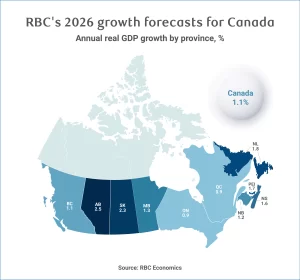
Source: RBC

RBC said the surge in oil prices from conflict in the Middle East will increase revenues in the Canadian and U.S. energy sectors, but raise costs (particularly gasoline prices) for most consumers.
Since both economies are net energy exporters, the net GDP impact is likely modest. However, distributional effects still pose challenges, it said.
“Higher gasoline costs will disproportionately impact lower-income households with energy prices consuming a larger share of disposable incomes—adding to already rising grocery bills. Income inequality has not widened in Canada to the extent seen in the U.S., but affordability pressures are, particularly, acute at the lower end of the income distribution.”
Overall, GDP contracted in the last quarter of 2025, but underlying details showed the decline largely came from a drawdown in inventories by businesses, said RBC.
Canadian businesses, consumers, and governments all spent more in Q4, and exports rose for a second straight quarter after a post U.S. tariff plunge in Q2 2025. That improvement is not uniform across the economy though. Sectors targeted directly with U.S. tariffs over the last year have underperformed—steel product and forestry exports fell by 24% and 8%, respectively, in 2025 from a year earlier, it said.

Mario Toneguzzi
Mario Toneguzzi is Managing Editor of Canada’s Entrepreneur. He has more than 40 years of experience as a daily newspaper writer, columnist, and editor. He was named in 2021 and 2024 as one of the top business journalists in the world by PR News. He was also named by RETHINK to its global list of Top Retail Experts 2024, 2025 and 2026.
About Us
Canada’s Entrepreneur is the number one community media platform in Canada for entrepreneurs and business owners. Established in 2016, our podcast team has interviewed over 800 Canadian entrepreneurs from coast-to-coast. With hosts in each province, entrepreneurs have a local and national format to tell their stories, talk about their journey and provide inspiration for anyone starting their entrepreneurial journey and well- established founders.
The commitment to a grass roots approach has built a loyal audience on all our social channels and YouTube – 500,000+ lifetime YouTube views, 250,000 + audio downloads, 50,000 + average monthly social impressions, 15,000 + engaged social followers and 120,000 newsletter subscribers. Canada’s Entrepreneur is proud to provide a local, national and international presence for Canadian entrepreneurs to build their brand and tell their story